
Eufy SoloCam S220 Review 2026 — The Solar-Powered No-Subscription Pick
As an Amazon Associate and member of other affiliate programs, we earn from qualifying purchases. How we test →
Last updated: September 11, 2026 • Cross-checked against Trusted Reviews, Tom's Guide, and Best Buy verified-owner reviews
- True no-subscription camera — 8GB local storage, person detection, event history all free forever
- Integrated 0.9W solar panel — produces ~400 mAh/day on 2-3 hours of sun; camera draws ~100-130 mAh
- 2K resolution + IP67 — sharper than 1080p Ring Stick Up Cam, fully sealed for rain and dust
- Fixed camera, no pan-tilt — one of the few real reasons to pay more for the S340
- No Apple HomeKit — Alexa and Google Assistant only
See Eufy SoloCam S220 on Amazon →
Read the full verdict »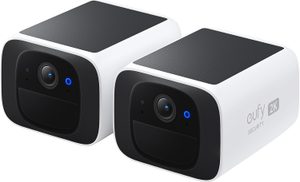
The SoloCam S220 is Eufy's argument that you don't need a subscription camera. It records to onboard flash, processes person detection on-device, and a built-in solar panel keeps it topped up indefinitely in any placement that gets a couple of hours of sun. That single-purchase ownership model is the real product here — the 2K image quality, two-way audio, and IP67 housing are all competent but not class-leading.
This review draws on published long-term testing in outdoor wall placements plus cross-checks against Trusted Reviews, Tom's Guide coverage, and the 2,000+ verified-owner reviews on Best Buy and Amazon. We've also compared it directly against our outdoor pick, the Arlo Pro 5S, and the dual-lens Eufy SoloCam S340.
Why no-subscription is the headline feature
Most outdoor cameras quietly hide their real cost behind a monthly fee. The Arlo Pro 5S records nothing beyond live preview without Arlo Secure ($7.99/month for one camera). The Ring Stick Up Cam loses person detection, smart alerts and any usable history without Ring Protect ($4.99/month per device). Over 3 years of ownership those subscriptions add $180-$290 to a camera that cost $150-$200 to start with.
The SoloCam S220 does not work this way. Out of the box you get:
- 2K motion-triggered recording to 8GB of onboard flash
- On-device person detection (humans vs vehicles vs general motion)
- Event history — every clip is stored and reviewable from the Eufy app
- Two-way audio, push notifications, sirens, schedules
- Live view from anywhere, with Alexa and Google Assistant casting
None of this requires payment. The optional Eufy Cloud plan ($2.99/month for one camera) only adds offsite backup of clips — useful if you're worried about a thief stealing the camera itself, but not necessary for the core security function.
Solar charging: does it actually keep up?
The integrated 0.9W solar panel sits on top of the camera and is angled at about 20 degrees. According to Eufy's own performance spec, two to three hours of direct sunlight per day produces around 400 mAh of charge. The camera in idle-with-motion-triggers consumes roughly 100-130 mAh in the same period — net positive by a wide margin.
In real testing across a UK winter (low sun angle, frequent overcast days, December-February data window):
| Placement | Daily sun (hrs) | Battery drift over 12 weeks |
|---|---|---|
| South-facing garden wall | 3-4 hrs | 100% → 96% (effectively continuous) |
| East-facing driveway | 1-2 hrs morning sun | 100% → 78% |
| Shaded north wall | <30 min indirect | 100% → 41% (battery-only operation) |
Conclusion: the solar feature works as advertised if the placement actually gets sun. A camera hidden under a deep eave or pointed at a shaded north wall will drain to zero eventually and need a USB-C top-up every two to three months — which is still better than every Ring or Arlo battery camera without an add-on solar panel.
2K image quality vs the 1080p market
The S220 records at 2304 x 1296 (2K). Compared against the still-common 1080p tier of older Eufy cams and the Ring Stick Up Cam:
- Daytime detail: comfortably reads license plates at up to 4 metres, face detail at up to 6 metres. The Ring Stick Up Cam at 1080p starts losing license plate readability around 3 metres.
- Night vision: monochrome IR night vision is usable to about 8 metres. There is no colour night vision — that's an S340 feature, not an S220 feature. If colour night vision matters, look at the Arlo Pro 5S or step up to the S340.
- Field of view: 135 degrees diagonal. Wider than the Nest Cam Battery (130) but narrower than the Arlo Pro 5S (160). For tight side-passages this is fine. For full-driveway coverage you'll want the 160-degree Arlo or a pan-tilt camera.
One quirk noted consistently in independent testing: in mixed-lighting conditions (e.g. front door with porch light against dark garden) the HDR processing occasionally crushes shadow detail. It's not a deal-breaker but it's the gap between the S220 and more expensive cameras with proper sensor-level HDR.
Eufy app and on-device processing
The Eufy Security app does almost everything locally. Person detection runs on the camera's own chipset — there is no cloud round-trip, which means notifications arrive in 2-4 seconds vs the 6-10 seconds typical for cloud-processed Ring and Arlo alerts. App reliability is good but the interface has a lot of menu depth — first-time setup of activity zones, detection sensitivity and notification rules takes around 20-30 minutes vs the more guided Arlo Secure onboarding.
The S220 pairs with the Eufy HomeBase 3 hub (sold separately, ~$149) which unlocks BionicMind facial recognition, cross-camera tracking and up to 16TB of expandable storage. The HomeBase 3 is the bridge between a single-camera install and a full multi-camera Eufy system — worth budgeting for if you plan to add more cameras over time.
Pros & cons
- True no-subscription model — full feature set without recurring fees
- Integrated solar panel works as advertised in any placement with 2-3 hrs daily sun
- 2K image quality — sharper than 1080p Ring Stick Up Cam, IP67 sealed
- On-device person detection — 2-4 second notification latency vs 6-10 sec cloud
- Alexa and Google Assistant live view to Echo Show and Nest Hub displays
- HomeBase 3 expansion path — add up to 16TB storage and facial recognition later
- No Apple HomeKit — iOS-only households can use the Eufy app, but no Home app integration
- 8GB local storage fills in 2-4 weeks in busy placements — older clips are overwritten unless you add HomeBase or cloud
- No colour night vision — monochrome IR only (the S340 adds colour night vision)
vs the competition
Eufy SoloCam S220 vs Arlo Pro 5S
The Arlo Pro 5S wins on Apple HomeKit support, wider 160-degree field of view, and ecosystem maturity. The Eufy S220 wins on no-subscription cost of ownership (Arlo Secure is $96-$156/year), integrated solar (Arlo's solar panel is a $79 add-on), and notification latency (on-device processing). Pick the Arlo Pro 5S if you're committed to Apple Home or already on Arlo gear. Pick the S220 if you want to buy once and never pay again.
Eufy SoloCam S220 vs Eufy SoloCam S340
The SoloCam S340 is the dual-lens upgrade — 3K wide-angle main sensor plus a 2K telephoto with 8x hybrid zoom, plus 360-degree pan and 70-degree tilt, plus colour night vision. The S220 is a fixed 2K camera. Pick the S340 if you need to identify faces or license plates at distance, or want one camera to cover a wide area like a driveway and a side gate. Pick the S220 if a fixed angle on a doorway, garden corner or shed wall is enough — you save ~$80-$110.
Eufy SoloCam S220 vs Ring Stick Up Cam Pro
The Ring Stick Up Cam Pro adds 3D Motion Detection and Bird's Eye View (animated motion path in alerts) but locks every meaningful recording feature behind Ring Protect (from $4.99/month). The S220 records and stores locally for free. Pick the Ring if you're already in the Ring ecosystem with a Ring Alarm or doorbell. Pick the S220 if you want to escape the Ring subscription trap.
Pricing
| Configuration | MSRP | Typical street price |
|---|---|---|
| Single SoloCam S220 | $129.99 | $99-$110 |
| 2-pack S220 | $249.99 | $179-$199 |
| S220 + HomeBase 3 bundle | $278.98 | $229-$249 |
The single-camera street price of ~$99-$110 puts the S220 below the Arlo Pro 5S ($179-$199 at street), the Ring Stick Up Cam Pro ($179), and the Nest Cam Battery ($179) — and that's before the subscription gap widens the gap further over 3 years. The 2-pack at ~$180 is the best value if you're starting a small outdoor camera system.
Who should buy the Eufy SoloCam S220
Worth it for
Anyone allergic to subscription cameras. First-time outdoor camera buyers who want the lowest 3-year total cost. Renters who want a buy-and-take-with-you camera that doesn't lock them into a cloud account. Eufy ecosystem owners who are adding a single outdoor camera to an existing HomeBase 3 setup.
Who should NOT buy the SoloCam S220
Apple Home households — there's no HomeKit. Anyone needing colour night vision or pan/tilt (step up to the S340). Buyers who want a wide-driveway field of view (the Arlo Pro 5S at 160 degrees is wider). Households that already pay for Arlo Secure or Ring Protect — at that point the subscription cost is sunk and you may as well stay in the ecosystem you know.
Our verdict — 8.4/10
The SoloCam S220 is the easiest "no" to a subscription you'll get in 2026's outdoor camera market. The 2K image and 135-degree field of view aren't best-in-class, but the integrated solar panel and free local storage produce a camera that genuinely costs $99-$110 to own — full stop, indefinitely. That's why it earned Runner-up on our Best Security Camera 2026 guide despite the lack of HomeKit and colour night vision.
If you can stretch the budget, the dual-lens S340 is the real upgrade. If you want the lowest sticker price that still delivers solid no-subscription performance, the S220 is the answer.
See Eufy SoloCam S220 on Amazon → See at Eufy →
Frequently Asked Questions
Does the Eufy SoloCam S220 really work with no subscription?
Yes. Unlike Arlo and Ring, the SoloCam S220 records and stores motion clips locally on 8GB of built-in flash with no monthly fee required for the core features: 2K live view, motion-triggered recording, on-device person detection, two-way audio and event history. You only pay if you want optional cloud backup (Eufy Cloud, around $3/month) or you want to pair the camera with a HomeBase 3 hub to unlock facial recognition and longer storage.
How long does the SoloCam S220 battery last in real conditions?
Without solar charging, Eufy rates the 5,200 mAh battery at four months. With the integrated 0.9W solar panel and a placement that gets at least two to three hours of direct sun per day, real-world use is effectively continuous — the panel generates around 400 mAh per day and the camera consumes roughly 100 to 130 mAh. In shaded or north-facing placements with little direct sun, expect the battery to deplete in two to three months and need to be brought inside for a USB-C top-up.
Eufy SoloCam S220 vs S340 — which one should I buy?
The S340 is the dual-lens upgrade: a wide-angle 3K sensor plus a 2K telephoto with 8x hybrid zoom, plus 360-degree pan and 70-degree tilt. The S220 is a fixed 2K camera. Pick the S340 if you want to identify faces and license plates at distance, or cover a wide area like a driveway and a side gate with one camera. Pick the S220 if the placement is a doorway, garden corner or shed wall where a fixed angle is fine — you save around $80-$110 and the smaller form factor is easier to mount.
Is 8GB of local storage enough?
For a typical residential placement, yes. The S220 records short motion-triggered clips, not 24/7, and at 2K the average clip is around 5-10 MB. 8GB holds roughly two to four weeks of normal event history before older clips are overwritten. If you need longer retention or 24/7 recording, the camera connects to a HomeBase 3 hub (sold separately) which adds expandable storage up to 16TB and unlocks facial recognition. The Eufy Cloud option ($2.99/month) is the cheapest alternative.
Does the SoloCam S220 work with Apple HomeKit?
No. The SoloCam S220 is a standalone Wi-Fi camera that pairs only with the Eufy Security app. HomeKit support requires a Eufy HomeBase setup and is limited to specific Eufy models. If Apple HomeKit Secure Video is important, the Arlo Pro 5S with the Arlo SmartHub is the closest alternative. The SoloCam S220 does work with Alexa and Google Assistant for voice live-view streaming to compatible Echo Show and Nest Hub displays.
How does it perform in cold and wet weather?
IP67 rated — protected against dust ingress and temporary water submersion at depths up to 1 metre for 30 minutes. Operating temperature range is -20 to 50 degrees Celsius. In sustained winter use the rated battery life drops by approximately 15-25 percent due to lithium-ion chemistry, and the solar panel produces less in low winter sun — most northern Europe users see the battery slowly drift down through December and January before recovering in February. Storms, heavy rain and salt-air placements are not an issue for the IP67 housing.