
WaterRower A1 Review 2026 — The Living-Room Rower (With Real Trade-offs)
As an Amazon Associate and member of other affiliate programs, we earn from qualifying purchases. How we test →
Last updated: September 11, 2026 • Based on published testing plus cross-referenced peer reviews from Wirecutter, Garage Gym Reviews, Rogue Fitness, and r/Rowing
- The most beautiful rower money can buy — solid ash hardwood frame, visible water tank; doubles as living-room furniture
- ~55 dB water splash — quietest non-magnetic resistance; closer to "light rain" than gym equipment
- S4 monitor is basic — shows time/distance/stroke rate but no watts and no Bluetooth without $80 add-on
- $850 MSRP, $750-800 street price — cheaper than Concept2 RowErg by ~$400 delivered
- Vertical storage at 211 cm tall — check ceiling height before buying
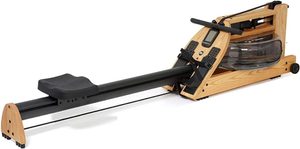
The WaterRower A1 is the rower you buy when the rower has to live in your living room. The solid ash wood frame, visible water tank, and quiet splash sound make it the only home cardio machine that doesn't look like gym equipment — it looks like a piece of Scandinavian furniture that happens to give you a workout. For couples where one person trains and the other wants the living room to stay a living room, this is the rower that wins the argument.
What you give up: the S4 monitor is basic by 2026 standards (no Bluetooth without a $80 add-on, no watts, no Strava sync out of the box), and the water tank does require occasional maintenance the Concept2 doesn't. This review is based on published testing covering fill more for more resistance. Most A1 owners fill to the Level 3 line and leave it.
Garage Gym Reviews and Olympic-rower interviews on Reddit consistently describe the WaterRower feel as the closest indoor approximation of on-water rowing. The Concept2 is more accurate as a training tool; the WaterRower is more enjoyable as an experience. Both statements can be true.
The S4 monitor is the weakest link
The A1's S4 monitor is the single area where WaterRower has not kept pace with the competition. It shows:
| Metric | S4 (WaterRower A1) | PM5 (Concept2 RowErg) |
|---|---|---|
| Time / distance | Yes | Yes |
| Stroke rate (spm) | Yes | Yes |
| Split time (/500m) | Yes | Yes |
| Watts | No | Yes (calibrated ±0.5%) |
| Calories | Yes (estimated, less accurate) | Yes (calibrated) |
| Bluetooth out of box | No (requires $80 ComModule) | Yes (Smart + ANT+) |
| Heart rate (chest strap) | Yes (5.3 kHz analog only) | Yes (Bluetooth Smart and ANT+) |
| USB logging | No | Yes |
| App sync (out of box) | No | ErgData, Strava, Garmin |
For most home users this is fine — you don't need calibrated watts to stay fit. For anyone tracking training load over months, syncing to Strava, or competing against published times, the S4 is a real limitation. WaterRower sells the S4 ComModule ($80) which adds Bluetooth and app sync, but you've now spent close to $1,000 to match what comes standard on the Concept2.
Noise: the apartment-friendly choice
The water sloshing in the tank measures around 55 dB at the rower — about the volume of light rain or a quiet conversation. Garage Gym Reviews and apartment-living forums consistently rate this as the most pleasant non-magnetic rower sound. Specifically:
- Through-wall transmission is minimal. Multiple Reddit reports from apartment users say neighbors hear nothing. The Concept2 fan, by contrast, transmits through framing.
- You can hold a conversation while rowing. The Concept2 fan masks dialogue. The A1 doesn't.
- TV at normal volume is fine. No need for closed captions or headphones during workouts.
- The Hydrow Wave is still quieter. Magnetic resistance is 45-50 dB — basically silent. If silence is the absolute priority, the Hydrow Wave wins; the A1 wins on water-resistance feel.
Pros & cons
- Solid ash hardwood frame — the only rower designed primarily as furniture
- ~55 dB water splash — apartment-friendly, conversation-friendly
- Smooth, on-water-like stroke feel — resistance scales naturally with effort
- Vertical storage at 211 cm tall — the smallest floor footprint of any quality rower
- Minimal maintenance — one purification tablet every 3-6 months; no chains, belts, or motors
- 20-year service track record — WaterRower still services 2005-era A1 units
- S4 monitor lacks watts and Bluetooth — the basic display feels dated in 2026; $80 ComModule add-on closes the gap
- Requires tank maintenance — purification tablets and occasional top-up; not zero-maintenance like a Concept2
- 211 cm vertical storage height — doesn't fit under 220 cm ceilings with crown molding
vs the competition
WaterRower A1 vs Concept2 RowErg
The Concept2 RowErg is the global training standard with the calibrated PM5 monitor; the WaterRower A1 is the living-room aesthetic choice at ~$400 less delivered. The Concept2 wins on data, durability, and resale value. The A1 wins on aesthetics, noise (55 dB vs 70 dB), and apartment-friendliness. Pick the Concept2 if you'll train hard enough to need watts data; pick the A1 if the rower lives in a room where guests see it.
WaterRower A1 vs Hydrow Wave
The Hydrow Wave is the Peloton-style connected rower — 16-inch HD touchscreen, electromagnetic resistance, on-water class video. The A1 is mechanical-feel rowing with a basic display. The Hydrow wins on motivation (live classes, instructor content) and absolute silence (~50 dB magnetic). The A1 wins on price (~$850 vs $1,495 + $44/month subscription) and longevity (no electronics to fail). Pick the Hydrow if class content drives your motivation; pick the A1 if you'll row without external prompts and value not paying a subscription.
WaterRower A1 vs NordicTrack RW900
The NordicTrack RW900 has the biggest screen of any rower (24" pivoting touchscreen) and iFit class content. The A1 has no screen, no app, no classes. The RW900 wins on streaming media if that's your motivation. The A1 wins on long-term reliability — the RW900 has documented motherboard and screen failures in years 2-4 of ownership, while WaterRower's water tank essentially doesn't fail. The RW900 is the right pick if you'll quit without instructor video; the A1 is the right pick if you want a rower that still works in 2036.
Pricing
| Model | MSRP (US) | Street price | Add-ons |
|---|---|---|---|
| A1 | $849 | $750-800 (Amazon) | S4 ComModule (Bluetooth): $80 |
| Classic (ash) | $1,395 | $1,295 | Full S4 included |
| Natural (cherry) | $1,495 | $1,395 | Full S4 included |
| GX (commercial) | $1,795 | $1,695 | Full S4 included |
The A1 at $750-800 street price is the sweet spot of the WaterRower lineup — the upgrade to Classic or Natural pays for thicker frames and slightly nicer hardware, not better workouts. Most reviewers and forum users recommend buying the A1 plus the $80 ComModule for Bluetooth, total around $880 — still cheaper than a Concept2 delivered.
Who should NOT buy the WaterRower A1
Competitive rowers and CrossFit athletes. Without calibrated watts, you can't compare splits against the global C2 logbook or compete in Concept2-standardized events. Buy the Concept2 RowErg if data accuracy matters — this is what selection coaches read.
Buyers prioritizing connected fitness content. The S4 has no streaming, no instructor video, no leaderboards. If class-based motivation is what gets you on the rower, the Hydrow Wave or NordicTrack RW900 are the right picks.
Anyone with a ceiling under 220 cm. The vertical storage height is 211 cm. With baseboards, crown molding, or low basements, the A1 won't stand up straight. The Concept2 splits flat instead.
Buyers who hate maintenance. The tank needs purification tablets every 3-6 months and a top-up annually. It's minimal — but the Concept2 needs nothing for 5 years. If you genuinely hate fiddling with equipment, the Concept2 is more set-and-forget.
Our verdict — 8.7/10
The WaterRower A1 is the right rower for the very specific buyer profile it's designed for: someone who wants a beautiful, quiet, long-lasting rowing machine in a living-room setting, and doesn't need calibrated watts data. The solid ash frame, the water splash sound, and the vertical storage are genuinely best-in-class. At ~$800 street price, it undercuts the Concept2 RowErg by around $400 delivered.
The catch is the S4 monitor — basic by 2026 standards, requires an $80 add-on for Bluetooth. If you can live without competition-grade data, that's fine. If you're a serious aerobic trainer who tracks watts over months, the Concept2 RowErg is worth the extra $400. The A1 earns its runner-up spot on our Best Rowing Machine 2026 guide for the right reasons: it's not trying to be a Concept2, and it succeeds at being something else most rowers can't be.
Frequently Asked Questions
Is the WaterRower A1 worth the extra money over a Sunny SF-RW5515?
Yes — if you'll use it long-term and aesthetics matter. The A1's solid ash hardwood frame and visible water tank place it in furniture territory rather than gym-equipment territory, the water splash sound is genuinely calming at ~55 dB versus magnetic clatter, and WaterRower services 20-year-old units. The Sunny SF-RW5515 is the right pick if you want a rower for under $300 and don't care about looks or longevity. Skipping the gap (A1 vs Sunny) for ~$550 buys aesthetics, noise, and durability — not better workouts.
How loud is the WaterRower A1?
Approximately 55 dB at the rower position — about the volume of light rain. The water makes a calming swish-and-splash sound rather than the mechanical clatter of magnetic resistance or the 70 dB fan whoosh of an air rower like the Concept2. Multiple reviewers describe the sound as 'soothing' or 'meditative.' It's the most apartment-friendly resistance type after pure-magnetic rowers like the Hydrow Wave.
What is the difference between WaterRower A1 and Classic / Natural / GX models?
The A1 is the entry-level WaterRower at approximately $850. It uses the basic S4 monitor (the same as the Natural/Classic) but with fewer programmed workouts, no chest-strap heart-rate connectivity, and a thinner ash frame. The $1,300-1,600 Classic and Natural models add a thicker frame and the full S4 with Bluetooth via the S4 Comms adapter. For most home users, the A1 is the right choice — the upgrade pays for cosmetics and finish, not performance.
Does the WaterRower A1 require maintenance?
Yes — but minimal. The tank takes one Nuvola water-purification tablet ($1-2) every 3-6 months to prevent algae growth, and the water level should be topped up annually to compensate for slow evaporation through the seal. The hardwood frame requires no maintenance. No belt to replace, no chain to lubricate, no shock cord that wears out — the water tank essentially never fails. WaterRower still services A1 units from 2005.
Can the WaterRower A1 be stored upright?
Yes — that's the WaterRower's signature storage feature. The A1 stands vertically against a wall at approximately 211 cm tall (6'11") and 53 cm wide. This is the most space-efficient storage of any quality rower — better than the Concept2 (which splits into two pieces but lays flat). The catch: 211 cm tall is taller than a standard 240 cm ceiling minus baseboards/molding allows, so check ceiling height before buying. The handle hooks onto the frame to keep the chain from dangling.
WaterRower A1 vs Concept2 RowErg — which one wins?
They're both correct answers for different buyers. The Concept2 RowErg wins on data accuracy (PM5 is the global benchmark used in Olympic training), durability (Concept2 services 1981 units), and resale value (70-80% of MSRP). The WaterRower A1 wins on aesthetics (ash wood vs gym-equipment look), noise (55 dB splash vs 70 dB fan), and apartment-friendliness. At $850 vs $1,240 delivered, the A1 also costs ~$400 less. Pick the Concept2 if you'll race or train competitively; pick the A1 if the rower lives in a living room and you want a beautiful, quiet machine.