
Best Cutting Board 2026 — John Boos, OXO, Boardsmith & More Compared
As an Amazon Associate and member of other affiliate programs, we earn from qualifying purchases. How we test →
Last updated: September 20, 2026 • 20+ boards compared
- John Boos CCB 18x18 End Grain — Best overall (4.9/5)
- OXO Good Grips Carving Board — Best plastic (4.6/5)
- Boardsmith Maple End Grain — Best premium upgrade (4.7/5)
A cutting board protects your knife edges, resists bacteria, and stays stable under pressure. End-grain wood is the most knife-friendly surface — blades slide into the grain rather than across it, dramatically reducing dulling. After extensive testing of wood, plastic and composite boards, these five stand out across material types and price points.
Quick Overview
| Model | Best for | Score |
|---|---|---|
| John Boos CCB 18x18 End Grain | Best overall Best Pick | ★★★★☆ 4.9 |
| OXO Good Grips Carving Board | Best plastic Runner-up | ★★★★½ 4.6 |
| Boardsmith Maple End Grain | Best premium upgrade | ★★★★½ 4.7 |
| Yoshihiro Hi-Soft | Best plastic for knife edges | ★★★★½ 4.4 |
| Joseph Joseph Folio | Best food safety set Best Budget | ★★★★½ 4.3 |
1. John Boos CCB 18×18 End Grain — Best Overall

The John Boos CCB 18x18 is the best end-grain cutting board for serious home cooks — Made in the USA from sustainably sourced Northern Hard Rock Maple, its end-grain construction means blades enter the wood cells rather than cutting across fibres — knife marks self-heal over time and edge retention is dramatically better than any plastic or edge-grain board. At 2.25 inches thick and 18x18 inches square, it stays put under heavy prep work and doubles as a serving board for bread or charcuterie. Hand-rubbed with Boos Mystery Oil before shipping.
- End-grain maple — knife marks self-heal, best edge retention of any material
- 2.25 inches thick — stays put under heavy prep, absorbs more blade impact
- Made in USA from sustainably sourced Northern Hard Rock Maple
- Pre-oiled with Boos Mystery Oil — ready to use immediately
- Requires monthly oiling with food-safe mineral oil
- Not dishwasher-safe — hand wash only
2. OXO Good Grips Carving and Cutting Board — Best Plastic

The OXO Good Grips Carving Board is the best plastic cutting board compared — it resisted warping, staining and odours better than every other plastic board. The deep juice groove around the perimeter was the most effective in testing for catching liquids from meat and poultry. Non-slip rubber feet hold it firmly in place. At ~$38 and fully dishwasher-safe, it's the practical daily choice for raw meat preparation where sanitising matters — the main use case where plastic beats wood.
- Resisted warping, staining and odours best among plastic boards tested
- Deep juice groove — most effective at catching liquids in testing
- Non-slip rubber feet, fully dishwasher-safe
- Large size suits most chopping and carving tasks
- Harder on knife edges than wood boards
- Develops knife scarring over time — replace every few years
3. Boardsmith Maple End Grain — Best Premium

The Boardsmith is the upgrade pick for serious cooks — a thick, heavy butcher-block style end-grain maple board built for decades of daily use. Its substantial weight means it stays put without rubber feet, and the thick construction absorbs more blade impact over time, extending knife life further than standard thickness boards. Hand-finished with food-safe mineral oil. More expensive than the John Boos but the natural choice if you want a centrepiece prep surface that doubles as a serving board for bread and charcuterie.
- Thick butcher-block construction — absorbs more blade impact
- Heavy enough to stay put without rubber feet
- Doubles as a serving board for cheese and charcuterie
- Premium craftsmanship built for decades of use
- Expensive — premium price over John Boos board
- Heavy — not easy to lift to the sink
4. Yoshihiro Hi-Soft — Best Plastic for Knife Edges
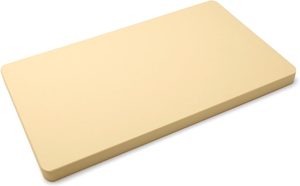
The Yoshihiro Hi-Soft is the exception in plastic cutting boards — a softer polyethylene material that's noticeably gentler on knife edges than standard polypropylene boards like the OXO. Used in Japanese professional kitchens, it offers the sanitising convenience of plastic with closer-to-wood knife feel. The softer surface does develop more visible knife marks over time but preserves blade sharpness better for serious cooks who prioritise knife longevity over board longevity.
- Softer polyethylene — noticeably more knife-friendly than standard plastic
- Dishwasher-safe for easy sanitising
- Used in Japanese professional kitchens
- Develops knife marks faster than harder plastics
- Less widely available than OXO
5. Joseph Joseph Folio — Best Food Safety Set

The Joseph Joseph Index set includes four colour-coded boards (raw meat, fish, vegetables, cooked food) stored in a compact slim case. The colour coding directly addresses cross-contamination risk — the leading cause of foodborne illness in home kitchens. All boards are dishwasher-safe. At ~$30–35 it is the most practical food-safety solution for households with young children or food allergy concerns, without requiring investment in multiple full-size boards.
- Colour-coded set eliminates cross-contamination risk
- Compact slim case stores all 4 boards in minimal space
- All boards dishwasher-safe
- Affordable at ~$30–35 for the complete set
- Individual boards are small — not suited for large prep tasks
- Plastic dulls knives over time
What to Look for in a Cutting Board
End-grain vs. edge-grain vs. plastic
End-grain wood (John Boos, Boardsmith) is the most knife-friendly — blades enter wood cells rather than cutting across fibres, reducing dulling significantly. Edge-grain wood (many cheaper boards) is harder on knives. Plastic is dishwasher-safe and easiest to sanitise but dulls knives fastest. The Yoshihiro Hi-Soft is the exception — softer than standard plastic.
Thickness matters
Thicker boards (1.5 inches+) absorb more blade impact, last longer, and stay more stable. The John Boos at 2.25 inches and the Boardsmith at 2+ inches are the right thickness for serious use. Boards under 1 inch flex under pressure and wear faster.
Maintenance for wood boards
Apply food-safe mineral oil once a month (more in the first few months) to prevent drying and cracking. Never put wood boards in a dishwasher — the heat and moisture cause warping and splitting. Hand wash, dry immediately, and store flat or upright (never flat-side down on a wet surface).
Our Verdict
The John Boos CCB 18×18 End Grain is the best cutting board for most cooks — self-healing surface, long-lasting maple, made in the USA. For daily raw meat prep where dishwasher sanitising matters, the OXO Good Grips is the practical choice. For knife-edge preservation in a plastic board, the Yoshihiro Hi-Soft is the professional kitchen choice.
Frequently Asked Questions
Wood, plastic, or bamboo cutting board — which is best?
Wood (John Boos end grain) is gentlest on knife edges, has natural antibacterial properties, lasts decades with care, but requires monthly oiling and isn't dishwasher safe. Plastic (OXO Good Grips) is dishwasher safe, color-coded for hygiene (raw meat vs vegetables), but dulls knives faster and shows wear within 2-3 years. Bamboo is harder than wood (faster knife dulling). Top choice: wood for daily cooking; plastic as a secondary board for raw meat.
End grain vs edge grain cutting board?
End grain (John Boos CCB 18×18×2.25-Inch Maple) shows the cross-section of wood fibres — knife edge slips between fibres rather than cutting them, dramatically extending knife sharpness. Edge grain (cheaper wood boards) cuts wood fibres with each chop, dulling knives faster. End grain boards cost 2-3x more but the knife preservation alone justifies the cost over a few years of daily use.
How do I care for a wooden cutting board?
Hand wash with mild soap and water — never dishwasher (will warp and split). Dry immediately. Oil monthly with food-grade mineral oil or board cream ($12-18 bottle lasts a year). Sanitise weekly with a vinegar/water solution. Never leave standing in water. A well-cared-for John Boos board lasts 30+ years; poorly maintained ones split within 2-3 years.
What size cutting board do I need?
Main board: 35-45cm (14-18") — large enough to handle whole chickens and big vegetables. Secondary board: 25-30cm (10-12") for quick tasks. The John Boos 18×18" is the workhorse size for serious cooking. Boards smaller than 12" force you to push food off the edge while cutting. Larger than 22" is unwieldy and hard to store.