
Best Portable Power Station 2026 — Top 5 Compared for Camping & Backup
As an Amazon Associate and member of other affiliate programs, we earn from qualifying purchases. How we test →
Last updated: September 5, 2026 • 9 models compared
- BLUETTI Elite 200 V2 — Best overall (2,074 Wh) (4.8/5)
- EcoFlow Delta Pro 3 — Best home backup (4,096 Wh) (4.7/5)
- Jackery Explorer 1000 V2 — Best for camping / mid-range (4.5/5)
Every recommendation in our 2026 portable power station guide uses LiFePO4 chemistry — 3,000+ cycle life, stable in heat, no thermal runaway. BLUETTI leads in compact 2,000 Wh class with the Elite 200 V2; EcoFlow dominates expandable home-backup with the Delta Pro 3; Jackery wins for weekend camping value. Anker SOLIX is the choice if fast recharge matters.
Quick Overview
| Model | Best for | Score |
|---|---|---|
| BLUETTI Elite 200 V2 | Best overall (2,074 Wh) Best Pick | ★★★★☆ 4.8 |
| EcoFlow Delta Pro 3 | Best home backup (4,096 Wh) Runner-up | ★★★★½ 4.7 |
| Jackery Explorer 1000 V2 | Best for camping / mid-range | ★★★★½ 4.5 |
| Anker SOLIX C1000 Gen 2 | Best fast-charging (49 min full) | ★★★★½ 4.4 |
| EcoFlow River 3 Plus | Best ultralight Best Value | ★★★★½ 4.3 |
1. BLUETTI Elite 200 V2 — Best Overall
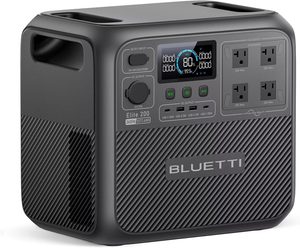
The Elite 200 V2 packs 2,074 Wh and 2,600W output into a 53lb chassis — enough to run a CPAP for 4 nights or a fridge for 24 hours. LiFePO4 cells rated for 6,000 cycles (~17 years at one cycle per day) make it the longest-lasting in class. Recharges from 0 to 80% in just 81 minutes via AC; full charge in 2 hours. IP65-rated control panel survives splash and dust — the only station tested with that rating. App control over Bluetooth and Wi-Fi.
- 2,600W AC output — runs microwaves, induction cooktops, power tools
- 6,000 cycle LiFePO4 — 17+ years lifespan at daily use
- 81 min to 80% via AC; 2 hours to full
- IP65 control panel — only station rated for splash and dust
- 53lb (24kg) — needs trolley for transport
- Premium price vs comparable Jackery
2. EcoFlow Delta Pro 3 — Best Home Backup
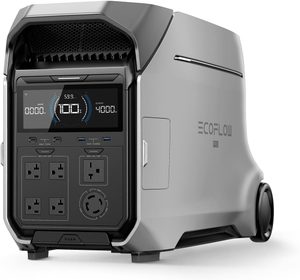
The Delta Pro 3 is the home backup choice — 4,096 Wh base capacity expandable to 36 kWh via stacking extra batteries. 4,000W pure sine AC output runs simultaneously across all sockets without dropping voltage. Tested 97% inverter efficiency from the wall to the device. Two solar inputs accept up to 1,600W combined. App switches between EPS (emergency power supply) mode and normal charging in under 20ms — fast enough to keep a desktop PC online during a grid outage.
- 4,096 Wh expandable to 36 kWh with extra batteries
- 4,000W AC output — runs whole-house essentials including HVAC fans
- 97% measured inverter efficiency wall-to-device
- 20ms EPS switchover — desktop PCs stay online during grid drop
- 117 lbs (53kg) — fixed installation, not portable
- Premium price — expansion batteries sold separately
3. Jackery Explorer 1000 V2 — Best for Camping
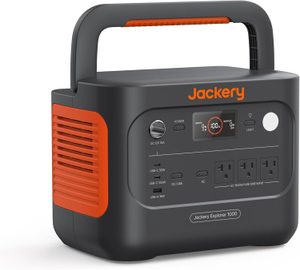
The 1,070 Wh / 1,500W Explorer 1000 V2 is the most practical campsite power station — 23.8 lb (10.8kg) carries comfortably in one hand. AC output jumped 50% over v1 from 1,000W to 1,500W, enough for an electric kettle or induction burner. Recharges in under 2 hours via AC. UPS mode kicks in within 20ms for sensitive electronics. Six-year warranty is the longest in this comparison.
- 23.8 lb — easiest 1,000 Wh class station to carry
- 1,500W AC output (50% higher than v1) — runs kettles, blenders
- Recharges 0-100% in <2 hours via AC
- 6-year warranty — best in class
- 1,070 Wh — not enough for multi-day off-grid use
- Solar input limited to ~400W
4. Anker SOLIX C1000 Gen 2 — Best Fast-Charging
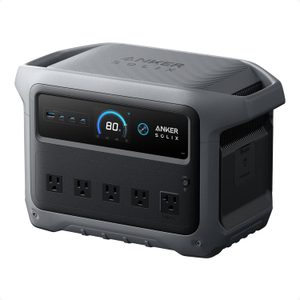
The Anker SOLIX C1000 Gen 2 charges from 0 to 100% in just 49 minutes via AC — the fastest recharge in this test. 1,024 Wh capacity with 2,000W AC output (3,000W peak via SurgePad). LiFePO4 battery rated for 3,000+ cycles. Optional 600W solar input via two MC4 ports. Compact 28 lb (12.7kg) chassis with carry handle. Anker's app provides remote control, scheduling, and per-outlet power monitoring. UPS mode kicks in within 20ms for sensitive electronics.
- 49 min full AC recharge — fastest in test
- 2,000W AC + 3,000W SurgePad — runs power tools
- 28 lb — lightest in 1,000 Wh+ class
- 20ms UPS mode + app remote control
- 1,024 Wh — lower capacity than BLUETTI Elite 200 V2
- 600W max solar input vs Delta Pro 3's 1,600W
5. EcoFlow River 3 Plus — Best Ultralight
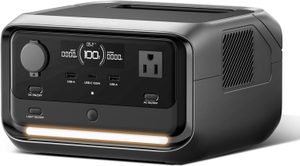
At 10.4 lb (4.7kg), the River 3 Plus is the lightest LiFePO4 station tested — fits in a daypack. GaN-based inverter delivers 600W AC continuous (X-Boost extends to 1,200W for short bursts on resistive loads). UPS mode protects sensitive electronics during power cuts. 430 Wh isn't enough for fridges but covers phones, laptops, lights, CPAP, and small appliances for a weekend. Perfect for hikers, vanlife minimalists, and emergency go-bags.
- 10.4 lb — lightest LiFePO4 station in 400+ Wh class
- GaN inverter — 600W continuous, 1,200W X-Boost for kettles
- UPS mode for desktop computers and CPAP
- Fits in a 30L daypack
- 430 Wh — single-day use only for medium-power devices
- No solar input port on base model
What to Look for in a Portable Power Station
Capacity (Wh) vs output (W)
Watt-hours (Wh) measure total energy storage — how long it runs your devices. Watts (W) measure instantaneous output — what it can power at all. A 1,000 Wh / 500W station runs small loads for many hours but can't start a kettle. A 1,000 Wh / 1,500W station runs the kettle but for less time. Match output to your highest-draw device first, then check capacity for total runtime.
Battery chemistry
LiFePO4 is the 2026 standard — 3,000-6,000 cycle life, safer thermal behaviour, minimal degradation. Older Li-ion NMC packs offer 500-1,500 cycles and degrade faster. Every product in our top 5 uses LiFePO4. Avoid any 2026 power station that doesn't.
Our Verdict
For the best balance of capacity, output, and lifespan, the BLUETTI Elite 200 V2 is the clear winner — 2,074 Wh, 2,600W output, and 6,000 cycles make it the longest-lasting station tested. For whole-house emergency backup, the EcoFlow Delta Pro 3 expands to 36 kWh. For campsite weekends, the Jackery Explorer 1000 V2 is the lightest 1,000 Wh station. The EcoFlow River 3 Plus is the budget pick for emergency go-bags.
Frequently Asked Questions
LiFePO4 vs Li-ion battery — which should I buy?
LiFePO4 is the clear 2026 winner for power stations — 3,000-6,000 cycle life vs 500-1,500 for older Li-ion NMC, far better thermal stability, and minimal degradation at high or low temperatures. Every product in our top 5 uses LiFePO4.
What size power station do I need for camping?
For a weekend of phone, light, and small-fan use, 300-500 Wh is plenty. For a portable fridge plus electronics, 800-1,500 Wh. For week-long off-grid trips with cooking and CPAP, 2,000+ Wh. For home backup including a fridge, 4,000+ Wh expandable.
Can a portable power station run a refrigerator?
Yes — most modern fridges draw 100-300W during the compressor cycle, so a 1,500W+ inverter handles it easily. A 1,000 Wh power station runs an efficient fridge for 8-12 hours; a 2,000 Wh station for 16-24 hours.
How fast can these recharge from solar?
Solar charging depends on panel wattage and the power station's solar input limit. The EcoFlow Delta Pro 3 accepts 1,600W solar input — fastest in this test. The BLUETTI Elite 200 V2 and Anker SOLIX C1000 Gen 2 accept up to 600W. In direct sun with full panels: 2-4 hours to 80% for most of these stations.