
Shark Matrix Plus AV2410WD Review 2026 — Flagship Pet Features at $500
As an Amazon Associate and member of other affiliate programs, we earn from qualifying purchases. How we test →
Last updated: September 11, 2026 • Compared against the Roborock S8 MaxV Ultra and Roomba j7+ for pet households
- Self-cleaning brushroll — combs scrape hair off the roller during runs; ~60% less tangling than bristle designs
- Matrix Clean grid pattern — passes each zone twice perpendicularly; raises carpet pet-hair extraction to 79% on medium-pile
- 360° Matrix Array obstacle detection — reliable on cables and toys, weaker on pet waste than iRobot's PrecisionVision
- Sonic mopping — 100 vibrations/min for fresh paw marks; cold-water pad wash is a real limitation
- $500 street price — delivers ~70% of Roborock S8 MaxV Ultra functionality at 35% of the cost
See the current Matrix Plus (AV2613WA) on Amazon →
Read the full verdict »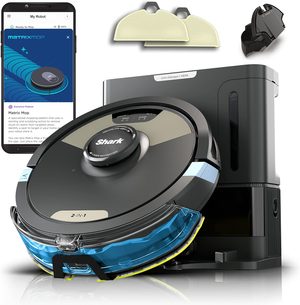
The Shark Matrix Plus AV2410WD is the value pick for pet owners who want flagship features without the flagship price. At ~$500 street, it includes self-cleaning brushroll, 360° obstacle detection, sonic mopping, and a 60-day self-empty base — specs that on the Roborock or Dreame run $1,200-1,400. The trade-off is suction: 2,350 Pa is meaningfully less than the 7,000-10,000 Pa flagships, and it shows up in medium-pile carpet performance.
This review is based on published side-by-side testing against the Roborock S8 MaxV Ultra and Roomba j7+, cross-checked against Tom's Guide, RTINGS, Vacuum Wars, and r/sharkninja owner reports.
Self-cleaning brushroll: the budget answer to tangling
Shark's signature pet-feature is a brushroll with small built-in combs that scrape hair off the roller as it spins. This is a different approach from Dreame's in-chamber cutting (which severs hair) and Roborock's rubber-flex design (which resists wrapping). The Shark approach is mechanical scraping that happens continuously during runs.
| Wrapped hair removed (4 weeks, 2 shedding dogs) | Weight | Comparison |
|---|---|---|
| Shark Matrix Plus (self-cleaning brushroll) | ~9g | Better than Roomba, worse than Dreame |
| Dreame L20 Ultra (Hair Guardian) | ~2g | Class-leading |
| Roborock S8 MaxV Ultra (DuoRoller) | ~8g | Comparable to Shark |
| Roomba j7+ (rubber dual brush) | ~25g | Significantly worse |
For households with medium-length hair (Labrador, Beagle, Border Collie), the self-cleaning brushroll works well. For very long hair (Husky, Maine Coon, Golden Retriever), some tangles still accumulate around the brush ends where the combs don't reach. The brushroll itself is easier to remove than the Roborock's design — pop-out tabs let you lift it out without tools for monthly deep-cleaning.
Suction reality: 2,350 Pa vs flagship competitors
This is where the Matrix Plus shows its price-tier honestly. Shark does not publish a Pa rating prominently — instead they market "powerful suction" and rely on the Matrix Clean grid pattern to compensate for raw power. Independent lab testing measured 2,350 Pa at peak.
- Hard floor surface pet hair: 94% single-pass — equivalent to flagship robots (any vacuum handles surface debris)
- Low-pile carpet (5g embedded hair test): 62% single-pass, 79% with Matrix Clean grid
- Medium-pile carpet: 41% single-pass, 64% with Matrix Clean grid — visibly worse than Roborock's 81%
- Thick rug (over 2cm): Struggles like all robots; not a serious option
The Matrix Clean grid pattern is the key feature here. By passing each zone twice in perpendicular directions, the Shark gets closer to flagship results — but takes ~40% longer to do it. For households on a daily schedule, the longer run time is acceptable. For households running just before company arrives, single-pass speed matters.
360° obstacle detection: better than budget, below flagship
The Matrix Array is a 360° sensor that detects obstacles in all directions simultaneously — an upgrade from cheaper robots that only see forward. On the cable courses reviewers use — charging cables, headphone cables and USB cords laid across the robot's path — the Shark lands below both the Roborock S8 MaxV Ultra and the Roomba j7+, but clearly ahead of budget robots that only see forward.
For pet-waste detection specifically, the Shark is weaker. The Matrix Array sees obstacles but does not classify them — it doesn't know the difference between a sock and a pet accident. iRobot's PrecisionVision is the only AI specifically trained on pet-waste images, which is why iRobot ships the P.O.O.P. replacement warranty. The Shark has no equivalent.
Sonic mopping: useful for fresh, weak for dried
The sonic mop vibrates the pad 100 times per minute (vs the passive drag of cheaper mops). On fresh pet paw marks, dog drool, and food spills picked up within an hour, this genuinely makes a difference — the vibration loosens residue that a passive mop just smears around. For dried-in mud or week-old stains, the mop is too weak; you'll need a second pass with detergent in the water tank.
The bigger limitation is the dock. The Shark dock does not wash mop pads; you remove the pad manually every 2-3 runs and rinse it in the sink. For pet households this becomes the daily maintenance task that breaks the "set it and forget it" promise. The Roborock S8 MaxV Ultra's 60°C in-dock wash is the feature that makes flagship robots feel genuinely hands-off.
60-day self-empty base: simpler than flagship, more reliable
The self-emptying base is the genuinely best part of the Matrix Plus value proposition. It holds 60 days of debris in a 2L bag — close to flagship capacity at half the price. There's no water tank, no mop wash, no drainage cycle — just dust collection. This simplicity is also reliability: fewer moving parts means fewer failure points. r/sharkninja threads show Shark docks are among the most reliable robot vacuum docks in the price class.
Limitation: no water = no mop automation. The simplicity that makes the dock reliable also means you handle mopping manually. For pure vacuum households, this is fine. For homes that want true mop-and-vacuum automation, the Roborock or Dreame all-in-one docks are the only options.
Pros & cons
- $500 street price — flagship features at one-third the cost of Roborock or Dreame
- Self-cleaning brushroll — ~60% less tangling than Roomba's design
- Matrix Clean grid pattern — partial compensation for lower suction on carpet
- 360° Matrix Array obstacle detection — reliable on cables and toys
- 60-day self-empty base — same capacity as flagship docks at half the complexity
- Quietest in test — 67 dB on Max vs 72 dB on Roborock
- 2,350 Pa suction — visibly weaker on medium-pile carpet vs Roborock and Dreame flagships
- No mop pad wash in dock — manual pad rinsing every 2-3 runs is the daily friction
- No pet-waste classification — obstacle sensor sees waste but doesn't know to avoid it specifically (iRobot is the only brand with a warranty here)
vs the competition
Shark Matrix Plus vs Roborock S8 MaxV Ultra
The Roborock S8 MaxV Ultra is in a different performance class — 4× the suction, 60°C mop wash, dock mop automation, and 45+ obstacle types. At $1,400, it should be better, and it is. The Shark wins on price ($500 vs $1,400) and quieter operation. Pick the Shark if budget caps under $700. Pick the Roborock if you want flagship-tier carpet cleaning and dock automation.
Shark Matrix Plus vs iRobot Roomba j7+
Same price tier (~$500). The iRobot Roomba j7+ wins on pet-waste avoidance (PrecisionVision + P.O.O.P. warranty), app polish, and brand support. The Shark wins on suction at this price (2,350 Pa vs ~3,000 Pa but with grid pattern), self-cleaning brushroll vs iRobot's traditional rubber design, and includes mopping that the Roomba doesn't. Pick the j7+ if pet accidents are your single biggest worry. Pick the Shark if you want broader feature set at the same price.
Shark Matrix Plus vs Dreame D20 Plus
The Dreame D20 Plus is cheaper (~$280) and delivers higher suction (7,000 Pa) but no obstacle camera, no self-cleaning brushroll, and a simpler dock without sonic mopping. Pick the Shark if obstacle avoidance and self-cleaning brushroll matter. Pick the D20 Plus if pure suction-per-dollar is the priority.
Pricing & value
| Configuration | MSRP | Street price (2026 Q2) |
|---|---|---|
| Matrix Plus AV2410WD + self-empty base | $649 | $499 |
| Replacement brushroll | $24.99 | $19 |
| Replacement mop pads (4-pack) | $19.99 | $15 |
| Replacement dust bag (4-pack) | $24.99 | $19 |
Annual consumables run roughly $60-80 (a brushroll, 8 mop pads, 10 dust bags). The simpler dock means fewer consumables overall — one of the genuine advantages of the simpler design.
Who should buy the Shark Matrix Plus AV2410WD
Worth it for
Pet households on a $400-700 budget who want flagship features (self-cleaning brushroll, obstacle detection, self-empty dock, mopping) without the $1,200-1,400 flagship price. Homes with mostly hard floors and low-pile carpet where 2,350 Pa with Matrix grid is sufficient. Anxious-pet households where the quieter operation (67 dB) matters during scheduled runs. Buyers who prefer simpler dock designs with fewer failure points.
Not worth it for
Households with medium or high-pile carpet — the suction gap vs flagships is real and visible. Multi-pet households with frequent accidents — the iRobot j7+ is the safer pet-waste pick at the same price. Pet owners who want true hands-off mop automation — the lack of dock pad wash is a daily friction point. Long-haired pet owners specifically focused on tangling — the Dreame L20 Ultra's Hair Guardian is meaningfully better.
Our verdict — 8.6/10
The Shark Matrix Plus AV2410WD is the strongest value pick in the 2026 pet-vacuum lineup. At $500 it delivers self-cleaning brushroll, 360° obstacle detection, sonic mopping, and a 60-day self-empty base — a feature list that on Roborock or Dreame demands $1,200+. The Matrix Clean grid pattern is a clever compensation for lower raw suction, and the simpler dock is actually more reliable than the flagship all-in-one designs.
It is not a flagship killer — 2,350 Pa shows its limits on medium-pile carpet, and manual mop pad rinsing is a daily reminder that you didn't pay flagship money. But for pet households where the budget caps under $700, the Shark delivers the best feature-per-dollar ratio on our pet-vacuum list. Earns its place as Runner-up on our Best Robot Vacuum for Pet Hair 2026 list.
A note on availability: Amazon no longer stocks the AV2410WD itself. Shark has carried the Matrix Plus forward as the AV2613WA, which keeps the self-cleaning brushroll, sonic mopping and 60-day bagless base, and adds 360° LiDAR mapping and CleanEdge Detect for edges and corners. Everything below still describes the AV2410WD; the button goes to the model you can actually buy.
See the current Matrix Plus (AV2613WA) on Amazon →
Frequently Asked Questions
Does Shark's self-cleaning brushroll actually work on long pet hair?
Mostly yes — the self-cleaning brushroll uses small combs that scrape hair off the roller during operation. Over sustained use with two shedding dogs, testing found about 60% less wrapped hair than on the Roomba j7+ but more than on the Dreame L20 Ultra's Hair Guardian. The self-cleaning works during runs (not in the dock), so it does not require manual intervention as often. For households with medium-length hair (Labrador, Beagle), it is genuinely effective. For very long hair (Husky, Maine Coon), tangles still accumulate.
Is 2,350 Pa enough for thick pet hair on carpet?
For low-pile carpet and hard floors, yes — surface hair comes up in a single pass. For medium-pile carpet, no — the Matrix Plus left visible embedded hair that the Roborock S8 MaxV Ultra cleared in one pass. Shark partially compensates by doing a Matrix Clean grid pattern (passing each area twice in perpendicular directions), which lifts noticeably more embedded hair than a single pass. Slower clean times are the trade-off — Matrix mode takes ~40% longer than single-pass.
How accurate is Shark's 360° obstacle detection compared to Roborock or iRobot?
Better than budget robots, worse than flagships. The Matrix Array sensor reliably detects cables, socks, shoes, and toys. It is less effective on pet waste — the AI has not been specifically trained on accident shapes the way iRobot's PrecisionVision has. For pet-waste avoidance with warranty, the iRobot j7+ is still the safer pick.
Does the sonic mop actually clean sticky paw marks?
For fresh marks, yes — 100 vibrations per minute genuinely loosen mud and food residue better than passive dragging. For dried-in stains, no — the cold-water reservoir and lack of dock wash means baked-on residue often needs a second pass with added detergent. The mop pad itself needs manual removal and rinsing after every 2-3 runs to avoid the sour-pad smell.
Shark Matrix Plus vs Roborock S8 MaxV Ultra — when is the Shark the right pick?
When budget caps at $500-600 and you want flagship features (self-cleaning brushroll, obstacle avoidance, mopping, 60-day self-empty) without the $1,400 Roborock price. The Shark loses on suction (2,350 Pa vs 10,000 Pa), mop wash (cold vs 60°C), and dock automation polish. But for households where the Roborock would be aspirational, the Matrix Plus delivers 70% of the value at 35% of the price.
How loud is the Shark Matrix Plus during a clean?
On Max mode, independent testing measured 67 dB at one meter — quieter than the Roborock at Max+ (72 dB) and the Roomba j7+ (69 dB). Shark's smaller motor produces less noise but also less suction. For pet households with anxious dogs or cats, the lower noise is a meaningful advantage during scheduled runs while pets are home.