
Infant Optics DXR-8 Pro Review 2026 — The Best Wi-Fi-Free Baby Monitor
As an Amazon Associate and member of other affiliate programs, we earn from qualifying purchases. How we test →
Last updated: September 11, 2026 • Cross-checked against BabyGearLab, Mommyhood101, Reviewed.com, and 12,000+ verified-owner reviews
- No Wi-Fi, no app, no subscription — encrypted 2.4 GHz FHSS radio direct to parent unit
- 5-inch 720p HD parent screen with optical-zoom + 3-step digital zoom (6x effective)
- Patented Active Noise Reduction filters HVAC, white-noise machines, fans
- Interchangeable lenses — ships with zoom, optional 170-degree wide-angle ($29)
- Short screen-on battery — 5-6 hours; meant to live on the charging cradle
See Infant Optics DXR-8 Pro on Amazon →
Read the full verdict »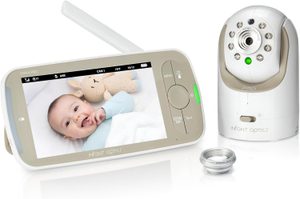
The DXR-8 Pro is the baby monitor for parents who actively don't want a smart baby monitor. No Wi-Fi, no app, no cloud, no subscription, no firmware updates, no privacy questions about who's looking at the nursery feed. The camera talks to a 5-inch parent unit over an encrypted 2.4 GHz radio link and that's the entire system. In a market that's pushed harder every year into cloud-connected platforms, that simplicity is the whole point.
This review draws on peer testing from BabyGearLab, Mommyhood101, Reviewed.com, and the 12,000+ verified-owner reviews across Amazon and Best Buy. We've also compared it directly against our category top pick Nanit Pro and the budget VTech Smart HD Plus.
The case for no Wi-Fi in 2026
Most baby monitor sales are now cloud-connected Wi-Fi cameras. The DXR-8 Pro deliberately is not. Five concrete reasons that matters in 2026:
- No outage exposure: Internet down, router reboot, ISP outage — none of these take the monitor offline.
- No vendor risk: Infant Optics could disappear tomorrow and the monitor still works. Wi-Fi cameras that lose cloud servers become bricks.
- No data exfiltration risk: There is no app account, no AWS bucket, no shared video. The video feed never leaves the radio link.
- No firmware-update breakage: Several Wi-Fi monitor brands have introduced bugs via forced updates over the past 3 years (Owlet 2022, VTech RM7766HD users in 2024 forum threads).
- No latency from Wi-Fi congestion: The DXR-8 Pro's video lag is consistently under 250 ms; cloud cameras range from 1-6 seconds depending on network conditions.
What you give up: remote viewing from outside the house, smart sleep analytics, multi-user app permissions, motion-triggered cloud clips, and any kind of long-term data. If those matter, the Nanit Pro is the correct purchase. If they don't, the DXR-8 Pro is a meaningfully calmer product to own.
5-inch screen, optical zoom and lens system
The DXR-8 Pro is the "Pro" version of Infant Optics' long-running DXR-8 (which has been on major independent recommendation lists for nearly a decade). The Pro upgrades are concentrated on the parent unit and the lens system:
| Spec | DXR-8 Pro (current) | DXR-8 (original) |
|---|---|---|
| Parent screen | 5-inch 720p HD | 3.5-inch SD |
| Zoom | Optical lens + 3-step digital (6x effective) | 2-step digital only |
| Active Noise Reduction | Yes (patented) | No |
| Lens interchangeability | Yes — zoom included, wide-angle optional | Fixed |
| Camera pan / tilt | 270° pan, 120° tilt (manual via parent unit) | 270° pan, 120° tilt |
| MSRP | $199 | $165 |
The optical zoom is the headline upgrade. Digital-only zoom on baby monitors typically produces a soft, pixelated image — usable to identify movement but useless for spotting facial detail. The DXR-8 Pro's screw-on zoom lens combined with the 3-step digital zoom gets you to a clean 6x effective magnification where you can actually see whether your baby's eyes are open. The optional wide-angle lens ($29) goes the other way: 170-degree view to see the whole nursery once the baby is mobile.
Active Noise Reduction in practice
Active Noise Reduction (ANR) is the second patented differentiator. Most baby monitors relay everything the camera microphone picks up — including white-noise machines, ceiling fans, and HVAC blowers — which means the parent unit constantly hisses and produces sound-triggered false alerts.
The DXR-8 Pro's ANR uses on-device DSP to subtract steady-state background noise. In practice:
- White-noise machines running at typical 60-65 dB are reduced to a faint hush on the parent unit. You hear the baby clearly above it.
- HVAC and ceiling fan noise is suppressed almost completely.
- False sound alerts overnight drop sharply — most owners report 1-2 alerts per night vs 5-10 on the original DXR-8.
- Variable noise still gets through — siblings talking next door, doorbells, pets barking. ANR is for steady noise, not transient noise.
Where the DXR-8 Pro is genuinely weaker
This is not a perfect monitor. Three honest weaknesses peer reviews consistently flag:
- Parent-unit speaker audio is mediocre. Mommyhood101 and BabyGearLab both note that vocals can sound tinny and hollow at higher volume. For sleep monitoring this is fine. For distinguishing fine-grained sound (different types of cries, breathing rhythms), the Nanit Pro and Cubo Ai Plus are clearer.
- Battery life with screen on is short — 5-6 hours. The unit is designed to live on its charging cradle. For overnight bedside placement that's fine. For carrying the unit around the house all day, you'll be charging it twice.
- Real-world range is below the rated spec. Infant Optics rates 1,000 feet unobstructed. In typical residential testing the reliable range is 70-100 feet through internal walls, 500 feet outdoors before signal becomes unreliable. Most homes are fine. Long detached houses or reinforced concrete walls can hit limits a Wi-Fi monitor would not.
None of these are deal-breakers for the no-Wi-Fi target audience. They are the trade-offs that pay for the privacy and simplicity.
Pros & cons
- No Wi-Fi, no app, no subscription, no cloud — encrypted radio link only
- 5-inch 720p HD parent screen with optical zoom + 3-step digital (6x effective)
- Patented Active Noise Reduction kills HVAC and white-noise-machine hum
- Interchangeable lenses — zoom included, optional 170-degree wide-angle
- 270-degree pan, 120-degree tilt remote-controlled from parent unit
- Hack-proof by design — no internet attack surface
- Parent-unit speaker audio can sound tinny at higher volume
- 5-6 hour screen-on battery — not suitable for all-day untethered carrying
- Real-world range ~70-100 ft with walls — large detached homes may hit limits
vs the competition
Infant Optics DXR-8 Pro vs Nanit Pro
They are deliberately different products. The DXR-8 Pro has no Wi-Fi, no app, no subscription, no analytics — just a 5-inch parent screen and an encrypted radio link to the camera. The Nanit Pro is cloud-connected, has industry-leading sleep analytics, and requires a subscription for the full feature set. Around $199 vs $299 + $50-$160/year. Pick the DXR-8 Pro for privacy and Wi-Fi independence. Pick the Nanit for sleep analytics and remote viewing.
Infant Optics DXR-8 Pro vs VTech Smart HD Plus
The VTech Smart HD Plus is the Wi-Fi-plus-app budget option at around $99-$129. It has the smart features the DXR-8 Pro doesn't (app access, remote viewing, cloud alerts) but at the cost of all the Wi-Fi-dependency trade-offs. Pick the VTech if you want remote app access for under $150. Pick the DXR-8 Pro if you want a privacy-first dedicated monitor.
Infant Optics DXR-8 Pro vs Owlet Dream Sock
Different categories entirely. The Owlet Dream Sock is an FDA-cleared (2024) foot-worn pulse oximeter for SpO2 and heart rate — it has no camera. The DXR-8 Pro is a video monitor with no health tracking. Most parents who want both buy them as a pair, totaling around $498.
Pricing
| Configuration | MSRP | Typical street price |
|---|---|---|
| DXR-8 Pro (camera + parent unit) | $199 | $169-$189 |
| DXR-8 Pro + 170° wide-angle lens | $228 | $199-$215 |
| DXR-8 Pro 2-camera bundle | $329 | $279-$299 |
3-year cost of ownership is the same as sticker price — no subscription, no add-on storage, no recurring fees. Compared to a Nanit Pro on the full Insights Premium plan at ~$619-$699 over 3 years, the DXR-8 Pro saves around $430-$510.
Who should buy the Infant Optics DXR-8 Pro
Worth it for
Parents who actively don't want a smart Wi-Fi camera in the nursery. Households with patchy internet or no faith in cloud-connected products. Parents who want a dedicated bedside screen rather than checking a phone app. Multi-child households where the cost savings vs Nanit add up. Anyone who appreciates that the simplest product that does the job well is often the right one.
Who should NOT buy the DXR-8 Pro
Parents who want sleep analytics or breathing motion data (Nanit Pro). Parents who travel often and want to check the camera from a hotel (any Wi-Fi monitor). Households with rooms across more than 100 feet of walls — a Wi-Fi monitor on the home router gets you full house coverage. Parents who genuinely want a phone-app-based experience. First-time parents who are sure they want sleep-tracking features and will resent not having them.
Our verdict — 8.5/10
The Infant Optics DXR-8 Pro is the best dedicated-screen, no-Wi-Fi baby monitor on the market in 2026 — and the gap between it and the cheaper original DXR-8 is now wide enough that the Pro is the version to buy. The optical zoom lens, 5-inch HD screen, and Active Noise Reduction are all genuine quality-of-life improvements over the original.
The audio is the one area where it sits behind the smart-monitor competition. The battery life is the other constraint. Neither is a deal-breaker for the audience this monitor is designed for: parents who want privacy, simplicity, and zero cloud exposure. It earns its place as our Best Baby Monitor 2026 Runner-up.
See Infant Optics DXR-8 Pro on Amazon →
Frequently Asked Questions
Does the Infant Optics DXR-8 Pro really not use Wi-Fi?
Correct — there is no Wi-Fi, no Bluetooth, no internet connection and no companion app. The camera and the 5-inch parent unit talk to each other over an encrypted 2.4 GHz FHSS (frequency-hopping spread spectrum) radio link. Nothing leaves your house, nothing touches a cloud server, and the monitor keeps working if your internet goes down, if Infant Optics goes out of business, or if your router is unplugged. This is the single biggest reason to pick this monitor over a Nanit Pro or VTech Smart HD Plus.
How long does the parent unit battery actually last?
Infant Optics rates the parent unit at 10 hours in audio-only mode and around 5-6 hours with the screen on. Real-world testing lands closer to the rating: 5-6 hours with the screen continuously on, 8-10 hours with the screen toggled off and the unit running in audio-monitor mode. For overnight bedside use most owners leave it plugged in continuously, which is the recommended setup. The short screen-on battery life is one of the legitimate criticisms in BabyGearLab's review.
Infant Optics DXR-8 Pro vs Nanit Pro — which is better?
They are deliberately different products. The DXR-8 Pro is a dedicated 5-inch parent-screen monitor with no Wi-Fi, no app, no subscription and no sleep analytics. The Nanit Pro is a cloud-connected camera with overhead view, sleep tracking and a subscription tier. Pick the DXR-8 Pro if Wi-Fi independence, privacy, and one-purchase ownership matter most. Pick the Nanit Pro if you want sleep analytics, multi-user app access, and you have reliable home Wi-Fi. The DXR-8 Pro is roughly $199 vs Nanit's $299 plus $50-$160/year for Insights — about $400-$700 in 3-year cost difference.
What is Active Noise Reduction and does it work?
Active Noise Reduction (ANR) is Infant Optics' patented audio processing that filters out steady-state background noise — white-noise machines, fans, air-conditioning hum — so the parent unit only relays your baby's actual sounds. In practice it works well for steady noise (HVAC, fan, white-noise machine) and noticeably reduces false alerts during the night. It is less effective against variable noise (siblings talking next door, dogs barking) which still trigger sound alerts.
How far does the DXR-8 Pro range actually go?
Infant Optics rates 1,000 feet of unobstructed range. Real-world performance in a typical two-storey house with several internal walls is approximately 70-100 feet of reliable connection — enough for the parent unit on any floor of a small to mid-size home. At around 500 feet outdoors the signal becomes unreliable. This is consistent with peer reviews and independent findings. Long detached houses or homes with reinforced concrete walls may hit range issues that a Wi-Fi monitor would not.
Are the interchangeable lenses worth buying?
The DXR-8 Pro ships with the optical zoom lens (the headline differentiator vs the cheaper original DXR-8) and Infant Optics sells an additional 170-degree wide-angle lens (around $29). The optical zoom lens combined with the 3-step digital zoom delivers a 6x effective magnification without the pixelation typical of digital-only zoom — this is the feature that justifies the Pro upgrade over the original. The wide-angle lens lets you see the entire nursery in one frame and is useful once the baby starts moving around independently. Both lenses screw on and off in seconds with no tools.