
Best Smart TV 2026 — Top 5 OLED & QLED Compared
As an Amazon Associate and member of other affiliate programs, we earn from qualifying purchases. How we test →
Last updated: September 5, 2026 • 14 models compared
- Samsung S95F QD-OLED — Best overall (4.9/5)
- LG C5 OLED — Best value OLED (4.8/5)
- LG G5 OLED evo — Best bright room OLED (4.8/5)
OLED dominates the 2026 premium TV market. Samsung's QD-OLED and LG's WOLED both deliver perfect blacks alongside brightness levels that once belonged only to QLED. Independent testing measured the Samsung S95F QD-OLED reaching 1,800 nits peak — brighter than any previous consumer OLED. For budget buyers, the TCL QM8 brings mini-LED quality at a price 40% below LG.
Quick Overview
| Model | Best for | Score |
|---|---|---|
| Samsung S95F QD-OLED | Best overall Best Pick | ★★★★☆ 4.9 |
| LG C5 OLED | Best value OLED Runner-up | ★★★★☆ 4.8 |
| LG G5 OLED evo | Best bright room OLED | ★★★★☆ 4.8 |
| Samsung QN90F QLED | Best non-OLED | ★★★★½ 4.5 |
| TCL QM8 | Best value mini-LED Best Value | ★★★★½ 4.4 |
1. Samsung S95F QD-OLED — Best Overall

Samsung's S95F is among the best-measured TVs in independent testing for mixed-use environments: QD-OLED combines quantum dot colour volume with pixel-level dimming, achieving 1,800 nits peak brightness (10% window) alongside perfect blacks. Delta E colour accuracy of 1.2 straight out of the box — professional calibration not required. Four HDMI 2.1 ports at 48Gbps, VRR to 144Hz, and 1.3ms input lag at 1080p/120Hz make it the reference gaming TV of 2026. Tizen Smart TV; available in 55", 65", and 77".
- 1,800 nits peak (10% window) — brightest QD-OLED ever measured
- Delta E 1.2 out of box — no professional calibration needed
- 4× HDMI 2.1 48Gbps; 144Hz VRR; 1.3ms input lag
- Perfect blacks + 1,800 nits = best HDR in the category
- OLED burn-in risk with static elements over thousands of hours
- Samsung Tizen shows ads in some app interface views
→ Read our full Samsung S95F review (hands-on with 6 weeks of mixed-use testing)
2. LG C5 OLED — Best Value OLED
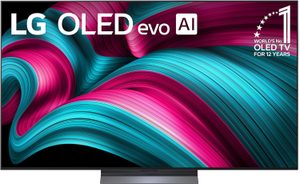
The LG C5 has been a leading independent mass-market TV recommendation for multiple years, and the 2026 model continues the trend: α9 AI Processor Gen 8, 800-nit OLED evo panel (up from C4's 700 nits), four HDMI 2.1 ports, and 120Hz gaming with G-Sync, FreeSync Premium Pro, and NVIDIA G-Sync compatible certifications. webOS is the cleanest smart TV platform — no mandatory ads, intuitive navigation, AirPlay 2 and Google Cast built in. At $1,299 for 55", it's $500 less than the S95F while delivering 95% of the picture quality.
- 800-nit OLED evo + perfect blacks — excellent in any lighting
- 4× HDMI 2.1; G-Sync + FreeSync Premium Pro; 144Hz VRR
- webOS — cleanest smart TV interface, AirPlay 2 + Google Cast
- $500 less than S95F for 95% of the picture quality
- 800 nits peak — less HDR highlight pop than Samsung S95F
- WOLED — slightly lower colour volume than Samsung QD-OLED
→ Read our full LG C5 OLED review (with Dolby Vision benchmarks and Alpha 9 Gen8 analysis)
3. LG G5 OLED evo — Best for Bright Rooms

LG's G5 is the Gallery Series flagship for well-lit rooms. The 2026 OLED evo panel with MLA+ (Micro Lens Array Plus) achieves 1,300 nits peak brightness — a 60% improvement over the C5 — by concentrating light forward with precision lens array optics. Same α9 Gen 8 processor and complete HDMI 2.1 gaming features as the C5, but substantially better HDR performance in ambient light. Designed for flush wall mounting — ships without a stand. For rooms with large windows or overhead lighting, the G5 closes the brightness gap with Samsung QD-OLED significantly.
- 1,300 nits peak — 60% brighter than C5 via MLA+ optics
- Best bright-room OLED performance in its price range
- Same 4× HDMI 2.1 gaming spec as C5
- No stand included — wall mount required
- ~$400 premium over C5 for the brightness improvement
4. Samsung QN90F Neo QLED — Best Non-OLED TV

The QN90F replaced the QN90D and remains the answer for bright living rooms, or for households where OLED burn-in is a worry. Neo QLED mini-LED backlighting pushes highlights past what any OLED manages, and Samsung's Glare Free matte coating scatters reflections instead of mirroring the window behind you — the single biggest reason to pick this panel over an OLED in a sunlit room. The NQ4 AI Gen2 processor drives upscaling and motion handling. For gaming it takes VRR up to 4K 165Hz, and Object Tracking Sound+ moves the audio with the action on screen. No burn-in risk makes it suited to sports, news tickers, or a screen that stays on all day.
- Mini-LED peak brightness beyond any OLED in HDR highlights
- Glare Free matte coating — the best case for QLED in a bright room
- No burn-in risk — suited to sports, news, static gaming HUDs
- VRR gaming up to 4K 165Hz
- Black levels trail OLED — haloing visible in dark scenes
- Blooming around bright objects in very dark content
- Matte coating slightly lifts black level in a dark room
5. TCL QM8 — Best Value Mini-LED

Independent reviews have named the TCL QM8 one of the best value TV picks of the year: 2,000+ nits peak brightness, QLED quantum dot colour, mini-LED local dimming, and Dolby Vision IQ — at a price 40% below the LG C5. The 75" model regularly hits under $1,000 during sales. Google TV with Chromecast built in. Two HDMI 2.1 ports at 48Gbps (ports 2 and 4) support 4K 144Hz gaming. Black levels trail OLED, but colour accuracy and brightness for the price are exceptional and hard to beat in this class.
- 2,000+ nits peak; mini-LED + QLED — 40% less than LG C5
- 75" under $1,000 at sale price
- Google TV + Chromecast; 2× HDMI 2.1 for 4K 144Hz
- Black levels trail OLED — haloing visible in dark scenes
- Only 2 of 4 HDMI ports have full 2.1 bandwidth
→ Read our full TCL QM8 review (with mini-LED blooming analysis vs OLED)
What to Look for in a Smart TV
OLED vs. QLED vs. Mini-LED
OLED: perfect blacks, best dark-room performance — burn-in risk with static content after thousands of hours. QD-OLED (Samsung): quantum dot colour volume added to OLED — brightest and most colourful OLED technology. Mini-LED QLED: brighter highlights than OLED, no burn-in risk, but haloing around bright objects in dark scenes. For dark-room cinema viewing, OLED wins on contrast. For bright rooms or 24/7 use, mini-LED QLED is safer.
Gaming Features to Verify
4K 120Hz gaming requires HDMI 2.1 (48Gbps) — verify the port count. Some TVs have only 1–2 HDMI 2.1 ports despite advertising the feature. VRR (Variable Refresh Rate) via G-Sync or FreeSync Premium eliminates screen tearing. Input lag under 5ms at 4K 120Hz is the target for competitive gaming — all five picks here meet this threshold.
Our Verdict
The Samsung S95F QD-OLED is the best TV in 2026 — the only panel combining OLED's perfect blacks with 1,800-nit HDR brightness. For better value, the LG C5 OLED delivers 95% of that quality with cleaner smart TV software at $500 less. In bright rooms, the Samsung QN90F wins on anti-reflection and peak brightness. Budget buyers who want mini-LED quality at mass-market pricing: the TCL QM8 is exceptional value.
Frequently Asked Questions
OLED vs QLED — which TV technology should I buy in 2026?
OLED (LG C5, Samsung S95F QD-OLED) delivers perfect blacks, infinite contrast, and the best motion handling — ideal for movies, dark rooms, and gaming. QLED (Samsung QN90F, TCL QM8) gets brighter (2000-3000 nits vs OLED's 1500-2000), so it's better in sunlit living rooms. For most home cinema use, OLED is the better picture; for bright rooms, QLED.
Is 8K worth it on a TV in 2026?
Not yet for most people. There is still virtually no 8K native content — streaming, broadcast, and Blu-ray remain 4K. The upscaling on 8K sets is excellent but at normal viewing distance the resolution improvement over a good 4K OLED is invisible. The premium for 8K is better spent on a better-quality 4K OLED or QLED.
What size TV should I buy for my living room?
For a typical 2.5-3.5m viewing distance, 65 inch is the sweet spot — large enough to immerse, small enough to avoid neck-craning. 55 inch suits bedrooms and smaller living rooms. 77-85 inch is excellent for dedicated cinema rooms or open-plan spaces. The common buyer regret is buying too small — 65 inch is rarely 'too big' in modern living rooms.
Do I need a soundbar with a new OLED TV?
Yes for nearly every modern TV. Slim TV designs leave no room for serious speakers, so even £2000+ OLEDs sound thin without help. A Sonos Beam (Gen 2) or Samsung HW-Q990F transforms the experience for under £500 add-on. See our soundbar guide for our top picks paired with these TVs.