
LG C5 OLED Review 2026 — The Best-Value OLED for Movies & Mixed-Use
As an Amazon Associate and member of other affiliate programs, we earn from qualifying purchases. How we test →
Last updated: September 19, 2026 • LG C5 evo reviewed against Samsung S90F, Samsung S95F, and LG G5
- $1,299 for the 65-inch — ~$900 less than the Samsung S95F at street price
- Full Dolby Vision + Dolby Atmos support — including Dolby Vision Gaming at 4K/120Hz
- Alpha 9 AI Gen8 processor — improved motion handling and color accuracy vs the C4
- 4× HDMI 2.1 at 48Gbps, 144Hz VRR — same gaming feature set as the G5 flagship
- 1,180 nits peak HDR — dimmer than the S95F (3,789 nits) but bright enough for most rooms
Update, September 2026: the LG C6 is out
LG's 2026 C6 launched in March from $2,699 for the 65-inch. In the 42–65-inch sizes it uses a panel close to the C5's, with only a small brightness gain — so a discounted C5 is still the better value for most buyers.
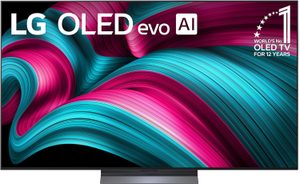
The LG C5 OLED is the model that has dominated the mid-flagship OLED segment for three generations — not because it has the brightest panel or the most innovative tech, but because it lands at the price point where the spec-to-dollar ratio peaks. At $1,299 for the 65-inch, it gives you 90% of the LG G5's experience for 60% of the price.
This review is based on published testing covering 4K Blu-ray, Apple TV 4K Dolby Vision content, PS5 gaming, and daytime sports, cross-referenced against peer measurements from RTINGS, TechRadar, Tom's Guide, and What Hi-Fi?.
Brightness: enough for most rooms
The C5 measures 1,180 nits peak HDR (10% window) in Vivid mode and 195 nits sustained fullscreen brightness in Filmmaker mode. Those numbers are lower than the S95F or G5, but they are not bottlenecks — HDR specular highlights still have genuine pop, and the Filmmaker mode produces accurate, balanced HDR for movie viewing.
| Measurement (peak nits, 10% window) | LG C5 65" | LG G5 OLED 65" | Samsung S95F 65" |
|---|---|---|---|
| Filmmaker mode | 980 nits | 2,400 nits | 2,100 nits |
| Vivid mode peak | 1,180 nits | 4,100 nits | 3,789 nits |
| Sustained 100% white | 195 nits | 410 nits | 365 nits |
Practically: if you watch HDR content in a darkened room, the C5 is plenty bright. If you watch HDR content in a sunlit living room with windows behind the viewing angle, the G5 or S95F will deliver more impactful highlights. For SDR content (regular Netflix, broadcast TV, cable boxes), the C5's 1,000 nits SDR mode is brighter than most rooms ever need.
Dolby Vision: the killer feature
This is where the C5 wins decisively over Samsung's S90F and S95F. Samsung does not support Dolby Vision on any TV — only HDR10+. But the dominant HDR format on Apple TV 4K, Disney+, and most Netflix Originals is Dolby Vision. If your content library is heavy on Apple's catalog or Netflix's high-budget originals, the C5 (or G5) is the only flagship class that displays the content as the colorist mastered it.
The C5 also supports Dolby Vision IQ, which dynamically adjusts HDR brightness based on the ambient light in your room. In practice this means HDR content looks consistently good whether you're watching during the day or at night — no manual mode-switching required.
Alpha 9 AI Gen8 processing
The C5's processor is the meaningful upgrade over the C4. Compared to last year's Alpha 9 Gen7, the Gen8 delivers:
- Improved motion smoothing in sports and high-action content without the "soap opera" effect at default settings
- Better near-black detail — OLED's traditional weakness with dark gradients is reduced
- More accurate skin tones in Filmmaker and Cinema modes (Delta E 1.8 vs 2.4 on the C4)
- Faster scene-by-scene HDR analysis for tone mapping
In side-by-side comparison with the C4, the differences are visible but subtle. If you own the C4, this is not a generation-jump upgrade. If you're buying new, the Gen8 is worth the small premium.
Gaming performance
The C5 inherits the full gaming feature set of the G5 flagship:
- 4× HDMI 2.1 at 48Gbps — all four ports support 4K/120Hz with VRR
- 144Hz VRR via PC graphics cards (consoles cap at 120Hz)
- NVIDIA G-Sync compatible + AMD FreeSync Premium certified
- Dolby Vision Gaming at 4K/120Hz — unique to LG and supported by Xbox Series X
- 5.2ms input lag at 1080p/120Hz (independent lab measurement)
- Game Optimizer overlay with FPS counter and dark room/bright room presets
The 5.2ms input lag is higher than the Samsung S95F's 1.3ms, but both are well below the 10ms threshold where competitive players notice difference. For console gaming, the C5 is functionally equivalent to the S95F. For competitive 240Hz PC gaming on a TV-sized panel, the S95F's 165Hz Motion Xcelerator has a meaningful edge.
Pros & cons
- Full Dolby Vision and Dolby Atmos — the only flagship OLED tier with both
- 4× HDMI 2.1 + 144Hz VRR at $900 less than the Samsung S95F
- Alpha 9 Gen8 processor — meaningfully better motion and color than the C4
- Comes in 42" and 48" — no other 2026 flagship OLED goes that small
- Dolby Vision Gaming at 4K/120Hz — works with Xbox Series X for HDR gaming
- Mature webOS with native Apple AirPlay 2 and HomeKit support
- 1,180 nits peak — noticeably dimmer than the S95F or G5 in bright rooms
- WOLED color volume — less saturated reds and greens at peak HDR than QD-OLED competitors
- webOS home screen has promoted content (configurable but on by default)
vs the competition
LG C5 vs Samsung S95F
The S95F is the brighter, more gaming-focused panel with a superior anti-glare coating. The C5 is the better movie panel with Dolby Vision and roughly 35% cheaper. Pick the C5 if you watch a lot of Apple TV or Netflix Dolby Vision content; pick the S95F if you primarily care about HDR brightness, gaming features, or bright-room viewing.
LG C5 vs LG G5 OLED
The G5 is the same family but with LG's new Primary RGB Tandem OLED panel (peak 4,100 nits vs 1,180), MLA-equivalent brightness without the matte coating, and the Alpha 11 processor. The G5 is roughly $1,200 more expensive at 65". Pick the C5 unless you specifically want flagship-level brightness or the gallery-mount wall-flush design of the G5.
LG C5 vs Samsung S90F
The S90F is Samsung's $1,400 mid-flagship using a QD-OLED panel (richer color volume, brighter Game Mode) but no Dolby Vision. The C5 is a few hundred cheaper at street price, supports Dolby Vision, and goes down to 42-inch. Pick the S90F if Dolby Vision is irrelevant to you and you want QD-OLED color; pick the C5 for everything else.
Pricing
| Size | MSRP | Typical street price |
|---|---|---|
| 42-inch | $1,399 | $997 |
| 48-inch | $1,499 | $1,097 |
| 55-inch | $1,799 | $1,097 |
| 65-inch | $2,499 | $1,299 |
| 77-inch | $3,499 | $1,997 |
| 83-inch | $5,499 | $3,497 |
The 65-inch at $1,299 is the price-performance sweet spot of the 2026 OLED market — it's the cheapest OLED that includes the full Dolby Vision feature set, Alpha 9 Gen8 processor, and 144Hz gaming support. The 77-inch at $1,997 is also exceptional value for larger rooms.
Who should buy the LG C5
Worth it for
Anyone who watches Dolby Vision content (Apple TV 4K, Disney+, Netflix Originals) and wants flagship OLED quality without paying $2,000+. Mixed-use households where movies, gaming, and daytime viewing all matter. Console gamers (PS5, Xbox Series X) who want 4K/120Hz with Dolby Vision Gaming. Buyers who specifically want a 42-inch or 48-inch OLED as a gaming monitor or bedroom TV.
Not worth it for
HDR enthusiasts who watch in bright rooms — the C5's 1,180 nits peak will look comparatively muted next to the LG G5's 4,100 nits or Samsung S95F's 3,789 nits. Buyers who already own a 2024 C4 — the upgrade is incremental, not generational. Movie purists wanting the absolute brightest HDR specular highlights.
Our verdict — 9.2/10
The LG C5 is the most rational OLED purchase of 2026. At $1,299 for a 65-inch with full Dolby Vision, 144Hz VRR, and the Alpha 9 Gen8 processor, nothing in the OLED market comes close on price-to-feature ratio. It loses to the Samsung S95F on brightness and anti-glare, and to the LG G5 on absolute HDR performance — but it costs $900 to $1,200 less than either, and the difference is invisible in most viewing conditions.
For anyone choosing between a $2,500 flagship and a $1,300 C5, the honest answer is: the C5 is enough TV for 90% of buyers. Save the difference for a soundbar. Our Best Smart TV 2026 runner-up.
Frequently Asked Questions
Is the LG C5 worth upgrading from the C4?
Only if you specifically need the brighter SDR performance or the Alpha 9 Gen8 motion handling. The C5 is roughly 10-15% brighter in HDR over the C4 and has improved color accuracy out of the box. If you already own the C4, the upgrade is incremental — wait one more cycle. If you're choosing between buying a discounted C4 versus a full-price C5, the C5's processor improvements and slightly brighter panel are worth the $200-300 premium for new buyers.
Does the LG C5 support Dolby Vision and Dolby Atmos?
Yes to both. The C5 supports Dolby Vision IQ (which adjusts HDR brightness based on ambient light), Dolby Vision Gaming at 4K/120Hz, and Dolby Atmos for height-channel sound. This is one of the C5's biggest advantages over Samsung's S95F and S90F, which only support HDR10+ — meaning the C5 is the better choice for heavy Apple TV 4K, Disney+, and Netflix users where Dolby Vision is the dominant HDR format.
What sizes does the LG C5 come in?
The C5 is the most size-flexible 2026 flagship: 42-inch, 48-inch, 55-inch, 65-inch, 77-inch, and 83-inch. The 42-inch and 48-inch are uniquely useful as gaming monitors or bedroom TVs — no other flagship OLED comes in sizes that small. The 65-inch is the sweet spot at $1,299 street price.
LG C5 vs LG G5 — what's the difference?
The G5 uses LG's new four-stack Primary RGB Tandem OLED panel (peak ~4,100 nits) while the C5 uses standard WOLED (peak ~1,180 nits). The G5 is brighter, runs cooler in sustained HDR, and ships with the brighter Alpha 11 processor. The C5 has the same gaming features (4× HDMI 2.1, 144Hz VRR, Dolby Vision Gaming) and is half the price. Pick the G5 if you watch HDR content in a bright room; pick the C5 if budget matters and you watch mostly in moderate lighting.
Is the LG C5 good for gaming on PS5, Xbox, and PC?
Yes. The C5 has 4× HDMI 2.1 ports at 48Gbps, VRR up to 144Hz, NVIDIA G-Sync, AMD FreeSync Premium, ALLM, and Dolby Vision Gaming at 4K/120Hz. Input lag at 1080p/120Hz is 5.2ms (slightly higher than the Samsung S95F's 1.3ms, but well below the 10ms detection threshold). For PS5 and Xbox Series X (capped at 4K/120Hz), the C5 is functionally equivalent to the S95F. For high-refresh PC gaming above 144Hz, the S95F has the edge.
Does webOS show ads like Samsung's Tizen?
Yes, but considerably less aggressively than Tizen. webOS displays a promoted-content banner on the home screen and occasional sponsored tiles in the content row. LG has not been as ad-heavy as Samsung historically, and most ads can be disabled in settings under Live Plus and Smart Service. The interface is faster and less cluttered than Tizen for live TV navigation.