
DJI Osmo Action 5 Pro Review 2026 — The Best Budget Action Cam in 2026
As an Amazon Associate and member of other affiliate programs, we earn from qualifying purchases. How we test →
Last updated: September 11, 2026 • Compared against the DJI Osmo Action 6, GoPro Hero 13 Black, and GoPro Hero 12 Black
- $349 street price — $50 less than the Action 6 and $50 less than the GoPro Hero 13 Black
- 1/1.3" OLED sensor — bigger than the Hero 13 Black's 1/1.9", smaller than the Action 6's 1/1.1"
- 20m native waterproof — deeper than any GoPro at the price point
- Dual OLED screens + OsmoAudio mics — vlogging features that justify the "Pro" label
- Verdict: Best Budget 2026 — 9.0/10 — the best price-to-performance action cam in 2026
See DJI Osmo Action 5 Pro on Amazon →
Read the full verdict »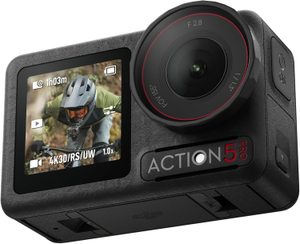
The DJI Osmo Action 5 Pro was DJI's flagship from September 2024 until the Osmo Action 6 replaced it in October 2025. Today it sits in an unusual position: the second-best action camera DJI makes, available for $50 less than the current flagship, and meaningfully better than the directly price-competitive GoPro Hero 12 Black. For buyers who want flagship-tier features without paying flagship-tier prices, this is the smartest action cam in 2026.
This review is based on published testing covering cycling, water sports, vlog recording, motorcycle helmet mounting, cross-checked against peer reviews from DC Rainmaker, TechRadar, PetaPixel, and r/DJI field reports from 2024-Q4 through 2026-Q1.
The 1/1.3" OLED sensor is the budget-buyer's sweet spot
The Action 5 Pro uses a 1/1.3" OLED CMOS sensor — smaller than the Action 6's 1/1.1" but substantially larger than the GoPro Hero 13 Black's 1/1.9". This middle-ground sensor size delivers visibly cleaner footage than the Hero 13 in low light, and footage that is competitive with the Action 6 in good light. Where you notice the Action 6 advantage is shadow detail in dim conditions (forest trails, sunset, indoor scenes) and in the variable-aperture flexibility that the 5 Pro lacks.
| Spec | DJI Osmo Action 5 Pro | DJI Osmo Action 6 | GoPro Hero 13 Black |
|---|---|---|---|
| Sensor size | 1/1.3" OLED | 1/1.1" | 1/1.9" |
| Aperture | f/2.8 fixed | f/2.0-f/4.0 variable | f/2.5 fixed |
| Max resolution | 4K/120 | 4K/120 | 5.3K/60, 4K/120 |
| Stabilisation | RockSteady 3.0+ | RockSteady 4.0 | HyperSmooth 6.0 |
| Native waterproof | 20m | 20m | 10m |
| Battery (4K/60) | ~100 min | 120 min | ~80 min |
| Front screen | OLED, 1.4" | OLED, 1.4" | LCD, 1.4" |
| Weight | 146g | 145g | 159g |
| Street price | $349 | $399 | $399 |
At ISO 200-400 in good daylight, the Action 5 Pro and Action 6 produce visually indistinguishable footage in casual side-by-side comparison. At ISO 800+ in dimmer conditions, the Action 6's bigger sensor pulls noticeably ahead. Against the GoPro Hero 13 Black, the 5 Pro shows cleaner shadows in low light at all ISO ranges — the smaller GoPro sensor is the camera's biggest practical weakness.
What you keep from the flagship Action 6
The "Pro" in the name is not marketing — the Action 5 Pro carries most flagship features that justify the original $499 launch price (now $349 street):
- Dual OLED screens — same as the Action 6. Front-facing 1.4-inch OLED for selfie framing, rear 2.5-inch OLED main screen. Bright enough to use in direct sunlight. GoPro Hero 13 Black still uses LCD for both screens.
- 20m native waterproof — same as the Action 6. No housing needed for snorkelling, shallow scuba, or freediving.
- OsmoAudio 3-mic array — same directional mic system as Action 6, including wind-noise reduction at firmware level rather than post-processing software.
- Magnetic-contact battery system — the same quick-swap mounting as the Action 6, with batteries that snap on and off without screws.
- D-Log M 10-bit colour — same flat-grading log profile as the Action 6, useful for serious colour grading.
What you lose: variable aperture, the slightly larger 1/1.1" sensor, RockSteady 4.0 stabilisation (5 Pro uses 3.0+), the brand-new HorizonSteady at 4K/60 (5 Pro tops out at 4K/30), and the cold-weather Extreme battery option. For buyers who do not shoot below freezing or need cinematic motion blur in bright sun, none of these losses are critical.
Stabilisation: RockSteady 3.0+ is still excellent
RockSteady 3.0+ is one major version behind the Action 6's RockSteady 4.0 — but in standard handheld and mounted conditions the difference is invisible. The 4.0 upgrade brings cold-weather stability (better below -5°C) and HorizonSteady at higher resolutions. For warm-weather and indoor use, the 5 Pro delivers gimbal-smooth output that is competitive with HyperSmooth 6.0 on the GoPro.
Where Action 5 Pro stabilisation lags: cold weather (occasional micro-jitters below -5°C where the Action 6 stays clean), and HorizonSteady is locked at 4K/30 rather than 4K/60. For most users in most conditions, this is a difference you would only notice in side-by-side blind comparison.
Battery: 100 minutes at 4K/60 is solid
Real-world battery numbers at room temperature:
- 4K/30: 140 minutes continuous
- 4K/60: 100 minutes continuous
- 4K/120: 30-40 minutes before thermal throttling
- 1080p/240: 55 minutes
These numbers trail the Action 6 by roughly 15-20% but exceed the GoPro Hero 13 Black at every common setting. The Adventure Combo (3 batteries + multi-charger) covers a full day of intermittent shooting and is the recommended buy at $429.
Cold-weather endurance is the practical weak spot. The Action 5 Pro does not have an Extreme cold-weather battery option (that is exclusive to the Action 6 line). In sub-zero conditions, expect battery life to drop to roughly 50-55 minutes at 4K/30 — better than GoPro but trailing the Action 6 with Extreme battery installed.
Pros & cons
- $349 street price — best price-to-performance action cam in 2026
- 1/1.3" OLED sensor — meaningfully cleaner low-light footage than the GoPro Hero 13 Black
- 20m native waterproof — same depth rating as the flagship Action 6
- Dual OLED screens — OLED front and rear, brighter than GoPro's LCDs in direct sun
- ~100 min at 4K/60 — battery endurance exceeds GoPro Hero 13 Black by 20-30%
- No variable aperture — the Action 6's biggest creative upgrade is missing; ND filters needed for cinematic shutter in daylight
- RockSteady 3.0+ trails the Action 6's 4.0 in cold weather and at HorizonSteady 4K/60
- No Extreme cold-weather battery option — sub-zero endurance drops more than the Action 6 with its Extreme cell
vs the competition
DJI Osmo Action 5 Pro vs DJI Osmo Action 6
The Action 6 adds variable f/2.0-f/4.0 aperture, a slightly larger 1/1.1" sensor, RockSteady 4.0 stabilisation, ~20% more battery life, HorizonSteady at 4K/60, and the Extreme cold-weather battery option. The 5 Pro is $50 cheaper at $349 street. Pick the 5 Pro to save $50 if you mostly shoot daylight in warm weather. Pick the Action 6 if variable aperture, cold-weather battery, or the bigger sensor specifically matter to your use case.
DJI Osmo Action 5 Pro vs GoPro Hero 13 Black
The 5 Pro wins on price ($349 vs $399), sensor size, native waterproofing (20m vs 10m), battery life, and dual OLED screens. The Hero 13 Black wins on resolution (5.3K vs 4K), the HB-series lens mod ecosystem, HyperSmooth 6.0, and Quik app. For new buyers with no GoPro accessory investment, the Action 5 Pro delivers more capability for less money. Pick the GoPro if you specifically need 5.3K source resolution or the lens-mod ecosystem.
DJI Osmo Action 5 Pro vs GoPro Hero 12 Black
The Hero 12 Black is now $249 street — $100 less than the 5 Pro. Same 5.3K/60 as the Hero 13 but no HB lens mod support, HyperSmooth 5.0 instead of 6.0, and the Enduro battery is an upgrade rather than standard. For pure budget, the Hero 12 is the cheapest entry to flagship-tier resolution. For better all-around capability (sensor, battery, waterproofing, dual OLED screens), the 5 Pro is worth the extra $100.
Pricing
| Configuration | MSRP (launch) | 2026 street price |
|---|---|---|
| Standard Combo (camera + 1 battery) | $499 | $349 |
| Adventure Combo (camera + 3 batteries + multi-charger) | $599 | $429 |
| Spare standard battery | $39 | $35 |
The Adventure Combo at $429 is the better long-term buy — three batteries cover a full day of intermittent shooting and saves the cost of buying batteries separately later. Standard Combo at $349 is the right entry point for buyers who want to test the camera before committing to accessories.
Who should buy the DJI Osmo Action 5 Pro
Worth it for
Budget buyers who want flagship-tier capability for $349. New action cam users with no GoPro accessory investment who would otherwise default to the Hero 13 Black at the same $349-399 range. Vloggers who benefit from dual OLED screens and OsmoAudio mics without paying the flagship premium. Snorkellers and shallow divers who get the 20m native waterproofing the GoPro requires a $50 housing to match. Existing DJI ecosystem users (Pocket 3, Mini 4 Pro) who want Mimo app integration.
Not worth it for
Cold-weather shooters who need the Action 6's Extreme battery for sub-zero reliability. Creators who specifically benefit from the Action 6's variable aperture for cinematic 24/30fps motion blur in daylight. Users who need 5.3K source resolution for 4K-delivery sensor crop — the GoPro Hero 13 Black is the right pick. Buyers locked into the GoPro mount/accessory ecosystem.
Our verdict — 9.0/10
The DJI Osmo Action 5 Pro is the best price-to-performance action camera in 2026. At $349 street it carries the flagship features that matter most — OLED screens, OsmoAudio mics, 20m waterproof, big sensor — while costing $50 less than the Action 6 or GoPro Hero 13 Black. The variable aperture and cold-weather battery on the newer Action 6 are real upgrades, but for the majority of action cam users who shoot in moderate conditions for social-first content, the 5 Pro is the smarter spend.
If $50 makes a meaningful budget difference, this is the right buy. If your shooting includes regular sub-zero conditions or you specifically want variable-aperture flexibility, step up to the Osmo Action 6. Earns its place as our Best Action Camera 2026 Best Budget pick.
See DJI Osmo Action 5 Pro at DJI → See DJI Osmo Action 5 Pro on Amazon →
Frequently Asked Questions
Should I buy the Osmo Action 5 Pro or save up for the Action 6?
For most buyers, the Action 5 Pro is the smarter buy. At $349 street it costs $50 less than the Action 6 ($399 street) and the practical differences are smaller than the spec sheet suggests: same dual OLED screens, same 20m native waterproof rating, same OsmoAudio mic array, similar stabilisation quality in most conditions. The Action 6's variable aperture and 1/1.1-inch sensor are real upgrades for cinematic work and low light, but if you mostly shoot in daylight for social content the $50 saving is the better deal. Buy the Action 6 only if cold-weather battery, variable aperture, or the bigger sensor specifically matter to your use case.
Is the Osmo Action 5 Pro better than the GoPro Hero 13 Black?
On price-to-performance, yes. At $349 vs $399 for the GoPro, the Action 5 Pro delivers longer battery life, deeper native waterproofing (20m vs 10m), dual OLED screens that the GoPro lacks, and a 3-mic OsmoAudio array. The Hero 13 Black wins on resolution (5.3K/60 vs 4K/120), HB-series lens mod ecosystem, and GoPro Quik app polish. If your budget is firm at $349-399, the Action 5 Pro is the better buy unless you specifically need 5.3K source or lens mods.
How long does the Action 5 Pro battery actually last?
At 4K/30 expect roughly 140 minutes continuous recording at room temperature; at 4K/60 about 100 minutes; at 4K/120 around 30-40 minutes before thermal throttling. The Pro version's magnetic-contact battery design uses larger 1950 mAh cells than the original Action 5 (which DJI did not release widely outside Asia). Cold-weather performance trails the Action 6 with Extreme battery but exceeds the GoPro Hero 13 at the same temperature.
What is the OLED screen actually for on an action camera?
The OLED rear screen on the Action 5 Pro is brighter than the LCD on the GoPro Hero 13 Black — usable in direct sunlight where the GoPro screen washes out. The dual-screen design (1.4-inch front + 2.5-inch rear OLED) makes framing self-shot vlog footage straightforward without a phone preview. OLED also reduces battery drain compared to backlit LCD because dark UI elements draw effectively no power.
Is the Osmo Action 5 Pro waterproof to 20 metres without a housing?
Yes, the camera body is rated to 20 metres native — twice the depth of the GoPro Hero 13 Black (10m native). This is real underwater performance without needing the $50 protective housing GoPro requires past 10m. For snorkelling, shallow scuba, freediving, and pool use the Action 5 Pro is ready out of the box. For technical diving past 20m, a separate housing is still needed.
Does the Osmo Action 5 Pro overheat?
Less than the GoPro Hero 13 Black in equivalent settings. At 4K/60 expect 65-75 minutes before thermal throttling at room temperature (vs 45-55 minutes on the Hero 13). 4K/120 throttles faster, around 30-40 minutes. Mounting in airflow (helmet vent, exposed bike mount) extends sustained recording. The Action 5 Pro's wider chassis dissipates heat better than the more compact GoPro.