
Insta360 X5 Review 2026 — The Best 360° Camera, With Real Trade-offs
As an Amazon Associate and member of other affiliate programs, we earn from qualifying purchases. How we test →
Last updated: September 11, 2026 • Compared against DJI Osmo Action 6, GoPro Hero 13 Black, and the previous-gen Insta360 X4
- 8K/30 360° capture — the highest-resolution 360-degree camera you can buy in 2026
- Replaceable lenses — first 360 cam where scratched glass does not mean replacement
- InstaFrame AI — auto-reframes 360 footage to vertical/horizontal flat video on-device
- Dual 1/1.28" sensors — cleanest 360 image quality available; meaningfully better than X4 in low light
- Verdict: Best Premium 2026 — 9.2/10 — the right camera if you need 360° flexibility, the wrong one if you need fixed-frame quality
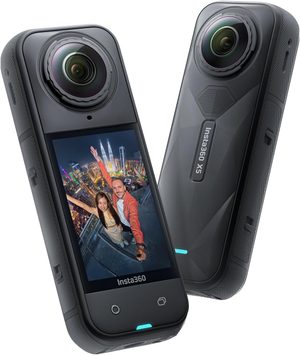
The Insta360 X5, released April 2025, is the third-generation flagship in Insta360's X-series 360° camera line. The X3 (2022) and X4 (2024) built the category; the X5 refines it with bigger sensors, replaceable lenses, and on-device AI reframing that makes 360° footage usable without post-production. It is the best 360° camera you can buy in 2026, but it competes with traditional action cams in an unusual way: it does everything they do, plus reframing, but at lower native fixed-frame quality.
This review is based on published testing covering UK cycling and trail running, surf and water shoots, indoor vlog and tutorial recording, cross-checked against peer reviews from DC Rainmaker, The Verge, DPReview, and r/insta360 field reports from 2025-Q2 onwards.
Why 360° cameras exist: the reframing argument
A 360° camera captures the entire scene in every direction at once. You do not aim it. You mount it, record, and choose the framing later in editing — or, with InstaFrame, let AI choose the framing automatically.
This unlocks three things traditional action cams cannot do:
- "Invisible selfie stick" shots — the X5's stitching algorithm erases a handheld selfie stick from footage, producing third-person drone-like shots without a drone.
- Post-production framing — you decide what to show after the action. Missed the trick? Pan to where it happened. Did not know which way to point the camera? Did not have to.
- One mount, multiple angles — the camera on a helmet can deliver forward-facing POV, third-person follow shot, and dramatic over-the-shoulder framing from a single recording.
The cost: the 8K source resolution becomes roughly 4K when reframed to a flat 16:9 clip. Bitrate, dynamic range, and lens quality all spread across 360°, which means any single reframed slice has lower image quality than a dedicated GoPro or DJI shot at the same target framing. For users who need the highest fixed-frame quality, the X5 is the wrong tool.
Image quality: bigger sensors, real improvement
| Spec | Insta360 X5 | DJI Osmo Action 6 | GoPro Hero 13 Black |
|---|---|---|---|
| Sensor | Dual 1/1.28" | 1/1.1" | 1/1.9" |
| 360° max resolution | 8K/30 | Not 360-capable | Not 360-capable |
| Flat reframed max | ~4K (after stitching) | 4K/120 native | 5.3K/60 native |
| Aperture | f/1.9 fixed (both lenses) | f/2.0-f/4.0 variable | f/2.5 fixed |
| Native waterproof | 15m | 20m | 10m |
| Battery (5.7K/30) | ~95 min | n/a (different format) | n/a (different format) |
| Weight | 200g | 145g | 159g |
| Street price | $549 | $399 | $399 |
The dual 1/1.28" sensors on the X5 are a meaningful upgrade over the X4's 1/2" sensors. In good light, reframed 4K output from the X5 looks roughly comparable to native 4K from a GoPro Hero 13 Black or DJI Osmo Action 6 — not better, not dramatically worse. In low light (sunset, indoor, dim forest), the X4 showed obvious noise the X5 handles cleanly. This is the biggest practical reason to upgrade from X4 to X5.
The f/1.9 fixed aperture on both lenses gathers more light than the GoPro's f/2.5 in dim conditions. Combined with the larger sensors, the X5 captures usable footage in conditions where the X4 forced you to choose between noise and motion blur.
Replaceable lenses: the durability story
360° cameras have one critical durability problem: the dual fisheye lenses bulge outward and contact everything. Lay the camera on a table — you are resting on the lens. Drop it in sand — the lens scratches. On the X3 and X4, a scratched lens meant repair or replacement (often $150+).
The X5's replaceable lens system fixes this. Each lens unscrews from the body and a replacement costs $30 per side. For users who film in environments where lens damage is likely — mountain biking through brush, surfing near rocks, snowboard tumbles — this single change drops the long-term ownership cost of the camera by hundreds of dollars over its lifespan.
Insta360 also includes lens caps that magnetically attach when the camera is not in use. Use them. The lens caps are $25 each to replace and the lenses are still glass underneath.
InstaFrame: on-device reframing as a workflow shortcut
The biggest pain point of 360° cameras has always been editing time. Capturing footage is easy; reframing it into a flat social clip requires Insta360 Studio (desktop) or the Insta360 mobile app, plus a creative decision about where to point the virtual camera for every shot.
InstaFrame uses on-device AI to auto-reframe footage as you record. Hold the camera up, walk through a scene, and the camera outputs a flat 9:16 or 16:9 clip with the subject tracked and centred. For Instagram Reels, TikTok, and YouTube Shorts, the X5 now produces social-ready content directly without editing.
The catch: AI framing decisions are competent but not creative. The framing the algorithm picks is the framing you get — you lose the creative freedom that justifies a 360° camera in the first place. For social creators who value workflow speed over framing control, InstaFrame is a major win. For filmmakers who reframe in post, leave InstaFrame off and use the full 360° source.
Pros & cons
- 8K/30 360° capture — highest-resolution consumer 360 camera available in 2026
- Dual 1/1.28" sensors — cleanest 360 low-light footage in the class; meaningfully better than X4
- Replaceable lenses — $30 per side replacement instead of $150+ camera repair
- InstaFrame AI auto-reframing — on-device flat output for social, no desktop editing needed
- "Invisible selfie stick" reframing — third-person drone-like shots without a drone
- Reframed flat output is ~4K — trails GoPro Hero 13 Black's 5.3K native fixed-frame resolution
- 200g weight — ~40% heavier than the DJI Osmo Action 6 (145g)
- Workflow overhead — even with InstaFrame, getting the best out of the X5 requires desktop editing time
vs the competition
Insta360 X5 vs DJI Osmo Action 6
The Action 6 has a bigger sensor (1/1.1" vs 1/1.28"), variable aperture, longer battery life, and weighs 55g less. The X5 captures 360° footage you can reframe in post and includes replaceable lenses. Pick the Action 6 if you want the highest fixed-frame image quality and the longest battery life. Pick the X5 if reframing flexibility or invisible-selfie-stick shots justify spending $150 more.
Insta360 X5 vs GoPro Hero 13 Black
The Hero 13 has higher native resolution (5.3K vs ~4K reframed), the HB-series lens mod ecosystem, and the polished GoPro Quik app. The X5 has 360° reframing and replaceable lenses. Pick the Hero 13 for traditional cinematic action footage at the highest resolution. Pick the X5 for creative reframing and post-production framing decisions.
Insta360 X5 vs Insta360 X4
The X5 adds bigger sensors (1/1.28" vs 1/2"), replaceable lenses, InstaFrame on-device reframing, slightly longer battery (95 min vs 75 min at 5.7K/30), and improved heat management. The X4 is now $349 street, $200 cheaper. Pick the X4 to save money if you mostly shoot in good light and rarely worry about scratched lenses. Pick the X5 if you shoot in low light, in lens-damage-prone environments, or want to skip desktop editing for social content.
Pricing
| Configuration | MSRP | Typical street price |
|---|---|---|
| Insta360 X5 Standard | $549 | $529 |
| Insta360 X5 Creator Kit (camera + invisible selfie stick + lens caps + carry case) | $629 | $599 |
| Replacement lens (single, glass) | $30 | $30 |
| Replacement lens cap (single) | $25 | $25 |
| Spare battery | $39 | $35 |
The Creator Kit is the better buy for most users — the invisible selfie stick is essential for third-person shots and the lens caps are not optional for outdoor use. Budget another $30 for a spare set of replacement lenses if you film in lens-damage-prone environments.
Who should buy the Insta360 X5
Worth it for
Creators who want third-person drone-like footage without owning a drone. Cyclists, motorcyclists, and skiers who benefit from post-production framing choice (point the camera once, decide what to show later). Social-first creators who want InstaFrame's on-device flat output for fast Reels/Shorts/TikTok publishing. Existing X3 or X4 owners with broken or scratched lenses where the X5's replaceable system pays for itself within a year.
Not worth it for
Users who only ever deliver fixed-frame action footage and never reframe in post — the Osmo Action 6 or Hero 13 Black give better fixed-frame quality for less money. Cold-weather shooters where the X5's battery falls behind the Action 6. Anyone who finds editing 360° footage tedious; even with InstaFrame, the full creative potential needs desktop editing time.
Our verdict — 9.2/10
The Insta360 X5 is the best 360° camera available in 2026 and the right choice for creators who value framing flexibility over native fixed-frame resolution. Replaceable lenses solve a real durability problem; InstaFrame solves a real workflow problem. The bigger sensors close most of the low-light gap to traditional action cams. The remaining question is whether you need 360° at all.
If reframing is your workflow — if you have ever wished you could pan the camera in post — the X5 is the right buy at $549. If you point and shoot at the action in front of you and never reframe, save the $150 and buy the DJI Osmo Action 6 instead. Earns its place as our Best Action Camera 2026 Best Premium pick.
Frequently Asked Questions
Is the Insta360 X5 better than a GoPro?
They are different cameras for different jobs. The X5 captures the entire 360-degree scene around the camera and lets you choose framing after the fact. A GoPro Hero 13 Black or DJI Osmo Action 6 captures the framing you point at, at higher conventional resolution. For creative reframing, third-person "invisible selfie stick" shots, and adventure POV that needs no aiming, the X5 wins. For traditional cinematic action footage with the highest fixed-frame image quality, the GoPro or DJI win.
What is the InstaFrame feature on the X5?
InstaFrame uses on-device AI to automatically reframe 360-degree footage into vertical (9:16) or horizontal (16:9) flat video as you record. Instead of editing 360-degree footage in post, you get a flat social-ready clip directly off the camera. The AI tracks the subject (usually whoever is holding the camera or a recognised face) and keeps them framed. The trade-off: you lose creative reframing freedom in exchange for not having to edit. For social-first creators, InstaFrame is a major time-saver; for filmmakers who reframe in post, leave InstaFrame off.
How do replaceable lenses work on the Insta360 X5?
Each of the two fisheye lenses unscrews from the camera body and can be replaced if scratched or broken — a major durability upgrade over the X4 where a scratched lens meant repair or replacement. Replacement lenses cost $30 per side. For users who film in environments where lens damage is likely (mountain biking through brush, surfing with rocks, snowboard tumbles), this single feature changes the long-term ownership cost calculation.
What is the X5's battery life compared to the X4?
The X5 includes a larger 2400 mAh battery (vs 2290 mAh on the X4), which extends 5.7K/30 recording to approximately 95 minutes (up from 75 minutes on X4). At 8K/30 the X5 manages about 75 minutes before battery exhaustion or thermal throttling, whichever comes first. Cold-weather endurance is improved over X4 but still trails the DJI Osmo Action 6.
Is 8K resolution on the Insta360 X5 actually useful?
Yes, but indirectly. 8K is the resolution of the full 360-degree image — when you reframe to a normal 16:9 flat shot, you are using only roughly 1/4 of the captured pixels. So 8K source resolution gives you approximately 4K output resolution after reframing, with crop flexibility. Without 8K source, reframed flat video would be 1080p or lower. The 8K spec exists to enable usable 4K reframed output, not because viewers will watch 8K 360-degree footage directly.
Does the Insta360 X5 overheat?
At 8K/30 expect thermal throttling around 35-45 minutes in 25°C ambient conditions. At 5.7K/60, around 65-75 minutes. At 5.7K/30, the X5 can record until the battery dies (~95 minutes). The X5 runs cooler than the X4 thanks to a redesigned chassis and improved heat dissipation, but high-resolution 360-degree capture is computationally intensive and thermals remain the practical limit on long shoots.