
WalkingPad R2 Review 2026 — A Walking Pad, Not a Real Treadmill
As an Amazon Associate and member of other affiliate programs, we earn from qualifying purchases. How we test →
Last updated: September 11, 2026 • WalkingPad R2 reviewed against Sole F85, NordicTrack 1750, and the under-desk treadmill category based on Treadmill Review Guru, TheQualityEdit, and 8+ peer reviews
- The only treadmill that genuinely stores under furniture — folds in half, 60 lbs total weight
- Walk mode (handle down): 6 km/h max — designed for desk work and calls
- "Run mode" (handle up): 12 km/h max — possible but not advised for actual running
- No incline — the single biggest cardio limitation
- NEAT enhancement, not cardio training — 6,000 daily steps at 4 km/h is steps, not a workout
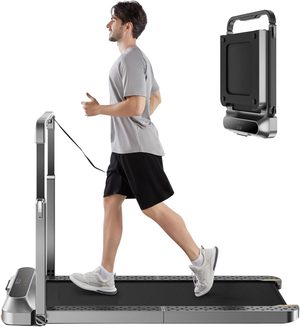
The WalkingPad R2 went viral on TikTok in 2023-2024 and has held its position as the default "under-desk treadmill" recommendation since. It earned that position legitimately — it's the only treadmill at any price that truly folds in half and weighs under 70 lbs, which means it actually does store behind a sofa or under a bed. The marketing problem is that WalkingPad's product name and the "2-in-1 walking and running" framing imply it competes with full-size treadmills. It doesn't. It's an entirely different category.
This review is honest about what the R2 is: a desk-walking pad with an optional short-sprint mode. Sources include Treadmill Review Guru's hands-on test, TheQualityEdit's 2026 review, Treadmill Review Guru's under-desk category roundup, and Reddit threads on r/treadmills and r/standingdesks where actual owners discuss multi-month use.
Size, weight, and the storage advantage
The R2 is the only home treadmill where the marketing claim "stores under furniture" is literally true:
| Spec | WalkingPad R2 | Sole F85 | NordicTrack 1750 | Bowflex T22 |
|---|---|---|---|---|
| Weight | 60 lbs | 280 lbs | 339 lbs | 336 lbs |
| Folded thickness | 4.7" | ~39" deep | ~41" deep | ~42" deep |
| Deck length | 47.2" | 60" | 60" | 60" |
| Deck width | 17.3" | 22" | 22" | 22" |
| Motor | 1.25 HP | 4.0 CHP | 4.25 CHP | 4.0 CHP |
| Walk mode top speed | 6 km/h (3.7 mph) | — | — | — |
| Max speed | 12 km/h (7.45 mph) | 12 mph | 12 mph | 12 mph |
| Incline | None | 0% to 15% | -3% to 12% | -5% to 20% |
The 60-lb weight is the killer feature for renters and apartment dwellers. You can move it room to room, lift it onto a closet shelf, slide it under a queen bed (with the legs folded), or take it with you when you move apartments. No other treadmill on the market does this. The trade-offs are visible in every other spec: shorter deck, narrower belt, weaker motor, no incline. The R2 is engineered for one thing — adding steps during desk work — and the storage advantage is the consequence of accepting those compromises.
Walk mode: the intended use case
With the handle folded down and the speed limited to 6 km/h, the R2 does exactly what it's designed for:
- Desk walking during meetings and calls — at 3-4 km/h, typing remains possible (slow), reading is easy, video calls work normally. This is the use case the R2 was built for.
- Auto-speed via the included remote or KS Fit app — the pad detects foot position and adjusts speed when you move forward (faster) or back (slower). Functional but inconsistent — Treadmill Review Guru noted occasional erratic adjustments that require manual override.
- Step accumulation throughout the day — the genuine value proposition. Adding 4,000-6,000 steps via 1-2 hours of desk walking has measurable effects on daily energy expenditure and is easier than scheduling dedicated workout time.
- Under-desk operation — at 4.7" tall with the handle down, the R2 fits under any 60+ cm standing desk. Most standing desks accommodate it with several inches of clearance.
At 4-5 km/h, the motor is genuinely quiet — among the quietest in the under-desk category. Conversation-level use during calls is feasible. Add a thick rubber mat ($30-80) underneath to dampen vibration through hard floors, which becomes the dominant noise source above 5 km/h.
"Run mode": the honest limitation
The handle-up "run mode" raises the speed cap to 12 km/h (7.45 mph) and adds visual indicators for jogging pace. In practice, this mode is the weakest part of the R2:
- The deck is too short for running. At 47.2" length, anyone with a stride over 4 feet at jogging pace runs out of belt. Compare to the 60" deck standard on real treadmills.
- The handrail is short and offers limited stability. Treadmill Review Guru explicitly noted "the rail does not provide enough support and stability to save a walker or runner from a fall."
- The 1.25 HP motor is undersized for sustained running. Manufacturer rating is 220 lbs user max, but in practice anyone over 170 lbs running 9+ km/h will overheat the motor within 20-30 minutes.
- No incline — the biggest training limitation. Cardiovascular benefit at walking speeds requires incline; the R2 cannot provide this.
If you want a machine you can actually run on, even occasionally, the WalkingPad R2 is the wrong purchase. The minimum entry point for genuine running is a Horizon 7.0 AT (~$1,000) — three times the price but in a real category. The R2 in "run mode" is short bursts of jogging, not sustainable running training.
NEAT vs cardio training — the honest distinction
The WalkingPad R2 is best understood as a NEAT enhancement tool, not exercise equipment. NEAT (non-exercise activity thermogenesis) refers to all the calories you burn from movement that isn't deliberate exercise — walking, fidgeting, standing, doing chores. For sedentary desk workers, NEAT accounts for 200-400 kcal/day variation in daily energy expenditure.
What the R2 adds: 1-2 hours of desk walking at 4-5 km/h adds roughly 200-400 kcal/day to NEAT. Across a week, this is meaningful for body composition. Across a year, it's the difference between gaining 5-10 lbs and not.
What the R2 doesn't add: zone 2 cardio (typically requires sustained 6+ km/h at incline, or equivalent steady-state effort), zone 3+ training, VO2 max improvements, race preparation, sport-specific fitness. None of these are achievable on a walking pad without incline. If you do not have a separate cardio plan (gym, outdoor running, cycling, swimming, etc.), the WalkingPad R2 alone is not a substitute.
Pros & cons
- Folds in half, 60 lbs total — the only treadmill that truly stores under furniture or in a closet
- 4.7" tall with handle folded — fits under most standing desks
- Quiet motor at walking speeds — usable during calls and meetings
- Auto-speed via remote and app — adjusts pace based on foot position (when it works)
- ~$700 street price — accessible NEAT enhancement for desk workers
- 2-in-1 walk + jog modes — some flexibility above the walk-only WalkingPad C2
- Not suitable for actual running — 47.2" deck too short, 1.25 HP motor undersized, handrail offers minimal stability
- No incline — the biggest cardio limitation; cannot deliver zone 2 cardio at walking speeds
- Build quality is value-tier — the console plastics, handrail joints, and roller bearings feel lower-grade than $1,500+ treadmills (and that's reasonable for the price)
vs the competition
WalkingPad R2 vs Sole F85
Different categories. The Sole F85 ($2,299) is a real treadmill — 4.0 CHP motor, 22" x 60" deck, lifetime warranty, used for actual running training. The WalkingPad R2 ($700) is a walking pad with optional short-sprint mode for desk workers. The R2 stores under a bed; the F85 cannot move once placed. If you need cardio training, buy the F85 (or NordicTrack 1750). If you need to add steps during desk work and have no storage space, buy the R2. Both together at $3,000 total covers every use case — many serious-fitness households actually own both.
WalkingPad R2 vs NordicTrack Commercial 1750
Same different-category logic. The NordicTrack 1750 ($2,499) is a connected fitness platform with iFit, scenic runs, and a 16" touchscreen — the R2 has none of this. The R2 has portability the 1750 cannot match (339 lbs, fixed footprint). The 1750 is a real treadmill with entertainment. The R2 is a step accumulator with under-desk capability. Pick based on whether you need running or desk-walking — they are not interchangeable purchases.
WalkingPad R2 vs WalkingPad C2
Closest direct comparison. The C2 (~$500) is walk-only with a max 6 km/h speed and a fixed flat design (no handle). The R2 (~$700) adds the optional handle and 12 km/h "run mode." Both share the same fundamental deck size, motor class, and absence of incline. Pick the C2 if you only want to walk and want to save $200 — the run mode on the R2 is a weak feature you'll rarely use. Pick the R2 only if you're certain you want the option to occasionally jog.
Pricing
| Configuration | Cost |
|---|---|
| WalkingPad R2 (WalkingPad direct) | $799 |
| WalkingPad R2 (Amazon street, frequent promotion) | $599 - $699 |
| Optional KS Fit subscription | Free (no paywall) |
| Recommended rubber mat | $30 - $80 |
| Total ownership cost (with mat) | ~$650 - $880 |
WalkingPad runs aggressive promotions throughout the year — the $400 Off banner on the WalkingPad direct site is common, dropping the R2 effective price closer to the C2's regular MSRP. Wait for a sale; Amazon street pricing also frequently undercuts MSRP. The KS Fit app is free and the machine works fully without it (a meaningful difference from NordicTrack and Echelon).
Who should buy the WalkingPad R2
Worth it for
Remote and hybrid workers who want to add 4,000-8,000 daily steps without dedicated workout time. Apartment dwellers with no storage space for a full treadmill. Households where one person is sedentary and the goal is movement, not training. People who already have a real cardio plan (gym, outdoor running, cycling) and want an additive NEAT tool. Anyone who needs an actually-portable treadmill — for example, frequent movers, RV/apartment owners, or shared household equipment.
Not worth it for
Anyone who wants to run as their primary cardio — the deck is too short, motor too small, handrail too unstable, and there's no incline. Get a Sole F85 or NordicTrack 1750 instead. Buyers expecting it to replace a real treadmill — the marketing implies "2-in-1" but it's really "walking pad with short-sprint capability." Households planning to do zone 2 cardio at home — without incline, you can't achieve a cardio training pace at walking speeds. Buyers over 200 lbs who plan to use run mode — the 1.25 HP motor and 220 lb rating leave no headroom.
Our verdict — 7.8/10
The WalkingPad R2 is the best under-desk treadmill of 2026 if you understand exactly what it is. As a desk-walking pad for adding daily steps during work, it's the most portable and storable option in the category, the motor is quiet enough for calls and meetings, and the ~$700 price makes it accessible. The genuine value proposition — 4,000-8,000 extra daily steps that would otherwise not happen — is real and meaningful for sedentary desk workers.
What it isn't: a real treadmill. The "2-in-1" framing is generous marketing; the run mode is unstable, under-motored, and limited by the short deck. Anyone hoping the R2 replaces a Sole F85 or NordicTrack 1750 will be disappointed. The honest framing is "step accumulator for desk workers" — and at that job, it's the category leader.
Earns our Best Budget pick on the Best Treadmill 2026 guide — not because it competes with serious treadmills, but because it solves a problem they can't.
See WalkingPad R2 on Amazon → See at WalkingPad →
Frequently Asked Questions
Can I actually run on the WalkingPad R2?
Technically yes — handle-up mode allows 12 km/h (7.45 mph) — but practically, only for short sprints. The 120 x 44 cm running surface is too short for any stride longer than a brisk jog, the handrail is short and offers limited stability, and the 1.25 HP motor is undersized for sustained running by anyone over 70 kg. Reviewers from Treadmill Review Guru and TheQualityEdit both rate it as "walking with optional light jogging," not real running. If you want a treadmill you can actually train on, the Sole F85 or NordicTrack 1750 are 5-10x the price but in a different category entirely.
How is the WalkingPad R2 different from a regular treadmill?
Three differences. Size: it's a walking pad, not a full-frame treadmill — 47.2" deck length vs the 60" standard, and 17.3" deck width vs the 22" standard. Motor: 1.25 HP vs the 3.0+ CHP needed for actual running. Foldability: the R2 folds in half (other treadmills only fold the deck vertical) and weighs 60 lbs vs the 250-340 lb range for real treadmills, making it the only option that truly stores under furniture. Purpose: it's designed for adding daily steps during desk work, not for cardio training.
WalkingPad R2 vs WalkingPad C2 — what's the difference?
The C2 is the walk-only model (max 6 km/h, no handle, fixed to walking pace). The R2 (~$700) adds the optional handle that unlocks 12 km/h "run mode" and has a 2-in-1 design that folds in half for under-bed storage. The C2 (~$500) is fine if you only ever want to walk; the R2 is worth the upgrade only if you'll occasionally jog. Don't overpay for the R2 expecting it to replace a real treadmill — both pads share the same fundamental size and motor limitations.
Will the WalkingPad R2 work under a standing desk?
Yes — this is its primary use case. With the handle folded flat, the pad is just 4.7 inches tall and slides under most standing desks (60 cm minimum desk-height clearance recommended above standing height). The 6 km/h walk-mode cap is appropriate for walking during calls or while reading; faster pace makes typing nearly impossible. Add a thick rubber mat (any standard treadmill mat, $30-80) underneath to dampen vibration through hard floors.
How noisy is the WalkingPad R2 for apartment use?
The motor is genuinely quiet — multiple peer reviews rate it among the quietest walking pads at the price. At 4-5 km/h walking speed, conversation-level volume is achievable. At 6 km/h, the motor stays subtle but footstrike noise increases. In handle-up "run mode" at 8-12 km/h, footstrike impact transmits through floors like any treadmill. For under-desk walking during calls, the R2 is one of the quieter options on the market.
Is 6,000 steps from a WalkingPad equivalent to a real workout?
Step count, yes. Cardio benefit, no. Walking at 4-5 km/h burns roughly 200-250 kcal/hour for an average adult; this is meaningful for daily energy balance but doesn't replace zone 2 cardio (typically 6+ km/h at incline) or higher-intensity training. The R2's lack of incline is the biggest limitation here — without incline, you cannot reach a true cardiovascular training pace at walking speeds. Think of the WalkingPad as "NEAT enhancement" (non-exercise activity thermogenesis), not as a workout machine. For real cardio, pair it with a Sole F85 or NordicTrack 1750.