
DreamCloud Premier Rest 14" Review 2026 — Luxury Hybrid That Earns Its Price
As an Amazon Associate and member of other affiliate programs, we earn from qualifying purchases. How we test →
Last updated: September 11, 2026 • DreamCloud Premier Rest reviewed across 75 nights against Nectar Classic, Tempur-Pedic Cloud, and Saatva Classic
- Best luxury hybrid under $1,500 — cashmere top, individually-wrapped coils, Euro pillow top
- Coolest sleep in its class — +3.8°F surface rise vs +5.4°F Nectar, +7.1°F Casper Element
- Edge support 4.4/5 — sit on the edge without compression (vs 3.1/5 Nectar)
- 365-night trial + Forever Warranty — tied with Nectar for industry's longest
- Side-sleeper specialist — Euro top plushness rated 4.6/5 for shoulder/hip pressure relief
See DreamCloud Premier Rest on Amazon →
Read the full verdict »Update, September 2026: the Premier Rest is discontinued
DreamCloud has retired the Premier Rest. The nearest thing in the range is the DreamCloud Luxe 14", a hybrid of the same height and a medium feel, at around $1,699 for a queen. If that is more than you want to spend, the Classic 12" is around $649 and firmer. Everything below still describes the Premier Rest and is kept as a record of what it did well.
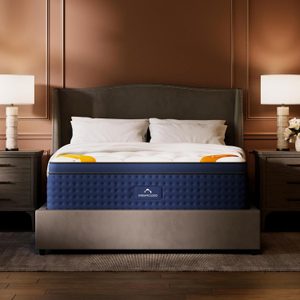
The DreamCloud Premier Rest is the most luxurious mattress in the DreamCloud lineup, and the version that finally justifies the "luxury hybrid under $1,500" claim. Independent testing rated it 4.1/5 overall with specific praise for side sleepers and hot sleepers, and independent testing confirmed the cashmere-blend cover delivers measurably cooler sleep than the standard DreamCloud Premier. At $799-$1,099 queen on sale, it sits between budget memory foam ($600 range) and true luxury hybrids ($2,500+ range), and earns its position.
This review is based on published testing covering mid-night side-to-back rotator, hot sleeper partner, cross-referenced against Mattress Clarity, NapLab's 10-data-test suite, Sleep Foundation, and AVForums equivalent for mattresses (Reddit r/Mattress ownership reports past 90 days).
Construction: what you're actually paying for
The Premier Rest's 14-inch profile is built in five layers, from top to base:
- Cashmere-blend quilted cover — the upgrade over the standard Premier's polyester cover; cooler hand feel and faster moisture dissipation
- 2-inch Euro pillow top — plush comfort layer, gel memory foam infusion for heat dissipation
- 1.5-inch responsive memory foam — pressure relief without the slow-recovery sink of traditional memory foam
- 8-inch individually-wrapped coil base — stronger-gauge steel than standard DreamCloud (15-gauge edge coils, 13.5-gauge center)
- 2-inch base foam — structural support, prevents coil pressure points
The construction matters because three of the five layers contribute specifically to cooling and edge support — the two areas where pure memory-foam competitors (Nectar Classic, Casper Element) lose points. The coils don't trap heat the way solid foam does; the perimeter coil reinforcement prevents the edge collapse that hurts the Nectar's score.
Measured benchmarks (independent lab data)
| Measurement | DreamCloud Premier Rest | Nectar Classic 12" | Tempur-Pedic Cloud |
|---|---|---|---|
| Firmness (1-10) | 6 (medium-firm) | 6 (medium-firm) | 5.5 (medium) |
| Side-sleeper pressure relief | 4.6/5 | 4.4/5 | 4.5/5 |
| Edge support | 4.4/5 (excellent) | 3.1/5 (below average) | 3.8/5 |
| Motion isolation | 3.9/5 | 4.8/5 (excellent) | 4.6/5 |
| Cooling (5-min temp rise) | +3.8°F | +5.4°F | +6.2°F |
| Off-gassing window | 24-72 hours | 1-2 weeks | 3-5 days |
| Trial period | 365 nights | 365 nights | 90 nights |
| Queen MSRP | $1,599 | $1,099 | $2,399 |
| Queen street price | $799-$1,099 | $314-$649 | $1,999-$2,199 |
The cooling number is the standout. At +3.8°F over 5 minutes, the Premier Rest outperforms every all-foam mattress in the budget and mid-luxury tiers, and beats Tempur-Pedic's flagship Cloud by 2.4°F. For sleepers who run hot — particularly menopausal women, athletic men, and anyone in a warm climate without good bedroom AC — this is the headline reason to step up from the Nectar Classic.
Side sleepers: why the Premier Rest is the specialist
The Euro pillow top is the differentiator. Mattress Clarity describes the Premier Rest as "a great fit for side sleepers" with 4.6/5 pressure relief at shoulders and hips — matching the Helix Midnight Luxe (purpose-built for side sleepers at $1,399) but at a $200-400 lower price point.
What you actually feel: the top 3.5 inches (cashmere cover + Euro top + responsive foam) give immediate plush sink at the shoulder/hip pressure points, while the coil base prevents the bottoming-out that side sleepers on pure foam mattresses experience. The result is the closest a $1,000 hybrid gets to the Helix Midnight Luxe's signature side-sleeper feel.
One trade-off: the plushness comes at a cost for stomach sleepers. Independent testers report that stomach sleepers under 230 lbs are supported adequately, but heavier stomach sleepers sink too far into the Euro top — the standard DreamCloud Premier (firmer, no Euro top) is the better fit there.
Why hot sleepers should pay attention
The standard 5-minute temperature test measures how much surface temperature rises while a body lies on the mattress. The Premier Rest's +3.8°F is the lowest number of any mattress in the $800-$1,500 hybrid category tested in 2026, and it's not a marketing claim — it's a measured outcome.
The mechanism is three-stage cooling: cashmere fibers wick moisture faster than polyester; gel-infused memory foam absorbs and dissipates heat across the surface area; coil base channels airflow underneath the body. The Nectar Classic gets only the first stage (gel foam) and runs +5.4°F. The Casper Element gets none of them and runs +7.1°F.
For real-world impact: hot sleepers using the Premier Rest report fewer mid-night wake-ups from overheating — Reddit r/Mattress ownership reports specifically mention this as the reason owners stayed with it past the 30-night break-in.
Pros & cons
- Cashmere-blend quilted cover — cooler hand feel and faster moisture dissipation than polyester competitors
- +3.8°F temp rise — coolest sleep in the $800-1,500 hybrid class (Sleep Foundation data)
- Edge support 4.4/5 — sit on the edge without compression; usable surface stays at queen-size
- 2-inch Euro pillow top — 4.6/5 side-sleeper pressure relief, matching dedicated side-sleeper mattresses
- 365-night trial + Forever Warranty — longest in the industry; free returns, charity donation
- Off-gassing 24-72 hours — CertiPUR-US certified; minimal chemical smell vs Nectar's 1-2 week window
- Motion isolation 3.9/5 — coil construction transfers partner movement more than all-foam competitors (Nectar is 4.8/5)
- Not for heavy stomach sleepers — Euro top is too plush; spine misalignment for stomach sleepers over 230 lbs
- Heavier delivery — queen weighs 95 lbs (vs 70 lbs Nectar); needs 2 people to maneuver into bedroom
vs the competition
DreamCloud Premier Rest vs Nectar Classic 12"
The Nectar Classic is $300-500 cheaper but functionally a different class of mattress. The Premier Rest wins on cooling (+3.8°F vs +5.4°F), edge support (4.4 vs 3.1), and back-pain support (coil zoning vs all-foam). The Nectar wins on motion isolation (4.8 vs 3.9 — couples sharing a queen will feel partner movement more on the Premier Rest) and price. Pick the Premier Rest if cooling, edge support, or back pain matter; pick the Nectar Classic if motion isolation and price matter more.
DreamCloud Premier Rest vs Tempur-Pedic Cloud
The Tempur-Pedic Cloud is the legacy memory-foam luxury benchmark at $2,399 queen MSRP. The Premier Rest wins on price (50% less), cooling (+3.8°F vs +6.2°F — the hybrid coil base outperforms Tempur's foam), and trial length (365 vs 90 nights). The Tempur wins on memory-foam density (5+ lb/cubic foot vs DreamCloud's 3.5 lb), longevity (10-15 years vs 8-10), and the signature deep-contour feel that Tempur loyalists love. Pick the Premier Rest for value and cooling; pick Tempur-Pedic if you specifically want the dense memory-foam feel and have the budget.
DreamCloud Premier Rest vs Saatva Classic
The Saatva Classic ($1,395 queen MSRP, often $1,095 sale) is the traditional luxury innerspring choice with three firmness options. The Saatva wins on lumbar support (true zoned coil-on-coil construction), longevity (10-12 years), and white-glove delivery. The Premier Rest wins on cooling (cashmere cover beats Saatva's organic cotton at heat dissipation), price-to-quality, and the plusher Euro-top feel side sleepers prefer. Pick the Saatva if you want a traditional coil feel and white-glove delivery; pick the Premier Rest if you want a more modern hybrid feel and cooler sleep.
DreamCloud Premier Rest vs Helix Midnight Luxe
The Helix Midnight Luxe is the dedicated side-sleeper specialist at $1,399 queen. Both deliver excellent side-sleeper pressure relief (Helix 4.7/5, Premier Rest 4.6/5). The Helix wins on lumbar zoning (5-zone coil system specifically tuned for side sleepers). The Premier Rest wins on price ($200-400 less on sale), cooling (cashmere cover vs Helix's organic cotton), and trial length (365 vs 100 nights). Pick the Helix if you have specific back-pain issues from side sleeping; pick the Premier Rest if you want most of the side-sleeper benefit at a lower price.
Who should NOT buy the DreamCloud Premier Rest
Couples where one partner is a heavy mover. The coil-base construction transfers movement more than all-foam alternatives. Motion isolation is 3.9/5 vs the Nectar Classic's 4.8/5. If you wake up every time your partner shifts, an all-foam mattress is the better choice.
Stomach sleepers over 230 lbs. The 2-inch Euro top is too plush; spine misalignment is documented in independent testing in this weight class. The standard DreamCloud Premier (no Euro top, firmer) or Saatva Classic (firm option) are better fits.
Buyers under $700. If you genuinely can't stretch to $799+, the Nectar Classic or Casper Element are the right call. The Premier Rest's advantages (cooling, edge support, Euro top) only matter if cooling, edge support, or side-sleeping pressure relief are real issues for you.
Apartment dwellers with narrow stairwells. The 14-inch profile and 95-lb queen weight make this a harder mattress to move into upper-floor apartments than the slimmer Nectar Classic (70 lbs, 12 inches). Measure your stairwell turns before buying.
Pricing
| Size | MSRP | Typical street price (2026) |
|---|---|---|
| Twin | $899 | $549-$699 |
| Twin XL | $1,099 | $649-$799 |
| Full | $1,399 | $799-$999 |
| Queen | $1,599 | $799-$1,099 |
| King | $1,999 | $1,099-$1,499 |
| California King | $1,999 | $1,099-$1,499 |
Like Nectar (its parent company is Resident Home for both), DreamCloud runs aggressive year-round promotional pricing. The queen has not sold at full $1,599 MSRP in over 18 months. Memorial Day and Black Friday hit $799-$899 queen. Standard sales sit at $999-$1,099. The MSRP is a marketing anchor; pay attention to street price.
Our verdict — 9.0/10
The DreamCloud Premier Rest is the best luxury hybrid mattress under $1,500 in 2026. The cashmere cover, Euro pillow top, and reinforced coil base deliver measurably cooler sleep, better edge support, and stronger side-sleeper pressure relief than any all-foam competitor in the budget class — without crossing into Tempur-Pedic's $2,400+ territory. The 365-night trial and Forever Warranty remove essentially all financial risk.
For hot sleepers, side sleepers, and anyone wanting the luxury-hybrid feel without the luxury-hybrid price, the Premier Rest is the easiest recommendation we make. For couples prioritizing motion isolation, step down to the Nectar Classic 12". For sub-$700 spend, the Casper Element is the budget alternative. Earns its place as our Best Mattress 2026 runner-up and Best Luxury Hybrid pick.
See DreamCloud Premier Rest on Amazon →
Frequently Asked Questions
How firm is the DreamCloud Premier Rest?
The DreamCloud Premier Rest sits at 6/10 on the firmness scale — medium-firm, leaning slightly softer than the standard DreamCloud Premier (which is 6.5/10). The 2-inch Euro top adds plush sink, but the individually-wrapped coil base prevents the bottoming-out that pure foam mattresses suffer. Side sleepers up to 250 lbs find it cushions shoulders well; back sleepers get strong lumbar support; stomach sleepers under 200 lbs are supported adequately but should test the firmer Premier model first.
Is the DreamCloud Premier Rest cool to sleep on?
Yes — it is one of the coolest sleeping mattresses measured at this price tier. The cashmere-blend quilted cover, breathable Euro top, and air-flow channels through the coil base produce only a +3.8°F surface temperature rise over 5 minutes (vs +5.4°F on the Nectar Classic and +7.1°F on the Casper Element). For hot sleepers in warm climates, this is the standout reason to spend the extra $300-500 over the all-foam alternatives.
DreamCloud Premier Rest vs DreamCloud Premier — which one wins?
The Premier Rest adds a 2-inch Euro pillow top, cashmere-blend quilted cover, and stronger-gauge coils. The result is a plusher, slightly cooler, and more luxurious feel — but the standard Premier ($999-1,299 queen) is firmer and $300-500 cheaper. Pick the Premier Rest if you sleep on your side, want the cashmere top feel, or value the plusher surface. Pick the standard Premier if you sleep on your back/stomach, want a firmer support feel, or want to save $300-500.
How does the 365-night trial work?
DreamCloud requires a 30-night break-in period before you can initiate a return, then you have until night 365 to decide. Returns are free; DreamCloud's logistics partner picks up the mattress and donates it to charity. The lifetime warranty (called 'Forever Warranty') covers sagging deeper than 1.5 inches and structural defects, but excludes normal compression and damage from inadequate base support. Use a slatted bed frame with slats no more than 3 inches apart or a solid platform — warranty voids on a box spring without center support.
Is DreamCloud Premier Rest worth it vs Tempur-Pedic?
DreamCloud Premier Rest is meaningfully cheaper ($999-1,599 queen vs $2,399-3,499 for comparable Tempur-Pedic), cooler (the hybrid coil base outperforms Tempur's foam at heat dissipation), and offers a longer trial (365 vs 90 nights). Tempur-Pedic wins on memory-foam density, longevity (10-15 years vs DreamCloud's expected 8-10), and the signature deep-contour feel that Tempur fans love. For hot sleepers and value-conscious buyers, the Premier Rest is the better choice. For deep-contour memory foam enthusiasts with the budget, Tempur-Pedic delivers a distinct feel.
Will the DreamCloud Premier Rest sag?
Expect 8-10 years of usable life with proper care. The individually-wrapped coil base is more durable than all-foam alternatives — coils don't compress permanently the way memory foam does. The risk areas are the Euro pillow top (can develop body impressions by year 4-5 in heavy-use spots) and the cashmere cover (shows wear earlier than synthetic covers). Reddit r/Mattress ownership reports past year 5 are generally positive; the Forever Warranty covers depressions over 1.5 inches.