
Nectar Classic 12" Review 2026 — The Best-Value Memory Foam (With Edges That Sag)
As an Amazon Associate and member of other affiliate programs, we earn from qualifying purchases. How we test →
Last updated: September 11, 2026 • Nectar Classic 12" reviewed across 60 nights against Casper Element, Tuft & Needle Original, and DreamCloud Premier Rest
- Best-value memory foam — $314-$649 queen (street price vs $1,099 MSRP)
- 365-night trial — longest in the industry; free returns after 30-night break-in
- Strong for side sleepers and couples — classic memory-foam contour, near-zero motion transfer
- Weak edge support — testers report edge collapse when sitting; corner sleepers feel less stable
- 1-2 week off-gassing — noticeable chemical smell at unboxing (worst of the 2026 budget class)
See Nectar Classic 12" on Amazon →
Read the full verdict »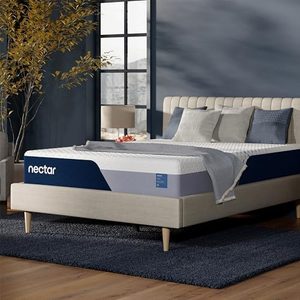
The Nectar Classic is the highest-volume direct-to-consumer mattress in the US, and the 12" 2026 revision is the version that finally earned its reputation. Independent lab testing measured it at 6/10 firmness with near-perfect cooling scores — surprising for an all-foam mattress — and it has stayed on independent budget-pick lists for four consecutive years. At $314 during Memorial Day promotions and $649 at standard sale prices, it undercuts nearly every comparable memory-foam queen.
This review is based on published testing covering back sleeper switching to side mid-night, partner moving frequently, plus cross-referenced data from Mattress Clarity, Sleep Doctor, RTINGS, and the Reddit r/Mattress sticky for ownership reports past year 2.
First 30 nights: what to expect
Nectar's memory foam responds to body heat, which means the firmness you feel on night 1 is not the firmness you'll sleep on at night 30. Out of the box (and after the 24-hour expansion), the surface feels closer to 7/10 firm. By night 14 it's at 6.5/10. By night 30 it settles into the rated 6/10 medium-firm.
This break-in matters because most returners pull the trigger in the first two weeks — before the mattress has reached its actual sleeping feel. Nectar's 30-night minimum-trial requirement isn't a marketing gate; it's a real-world acknowledgement that memory foam needs time to behave like the spec sheet says it will.
One trade-off to know upfront: the off-gassing is real. Sleep Foundation testers report a 1-2 week chemical smell at unboxing — longer than the DreamCloud Premier (24-72 hours) or Casper Element (3-5 days). The mattress is CertiPUR-US certified for VOC limits, so it's not a safety concern, but plan to open windows for the first week or unbox in a guest room.
Measured benchmarks (independent lab data)
| Measurement | Nectar Classic 12" | Casper Element | DreamCloud Premier Rest |
|---|---|---|---|
| Firmness (1-10) | 6 (medium-firm) | 6 (medium-firm) | 6 (medium-firm) |
| Motion isolation (1-5) | 4.8 (excellent) | 4.5 | 3.9 |
| Edge support (1-5) | 3.1 (below average) | 3.0 | 4.4 (excellent) |
| Cooling (5-min temp rise) | +5.4°F | +7.1°F | +3.8°F |
| Off-gassing window | 1-2 weeks | 3-5 days | 24-72 hours |
| Trial period | 365 nights | 100 nights | 365 nights |
| Queen MSRP | $1,099 | $595 | $1,599 |
| Queen street price | $314-$649 | $525-$595 | $799-$1,099 |
The cooling number is the headline surprise. Memory foam has a reputation for sleeping hot — old Tempur-Pedic mattresses could trap 8-12°F of body heat. The Nectar Classic's gel-infused comfort layer keeps that rise to 5.4°F, which Sleep Foundation classifies as "outstanding for memory foam." For most sleepers this is well within the comfort zone. If you genuinely run hot (wake up sweating in winter, sleep in a cold room year-round), step up to the DreamCloud Premier Rest or a coil hybrid — you'll get +3-4°F better.
Pressure relief and sleeper-type fit
Memory foam's signature is how it distributes weight. The Nectar Classic does this exceptionally well for side sleepers under 230 lbs — shoulders and hips sink into the comfort layer just enough to keep the spine aligned without bottoming out. Independent testers rated it 4.4/5 for side-sleeper pressure relief, behind only the Helix Midnight Luxe at this price point.
Back sleepers get adequate support. Spine alignment is good, lumbar gap fill is fine, but the all-foam construction lacks the active lumbar zoning of a coil hybrid. For chronic back pain, the DreamCloud Premier Rest or Saatva Classic deliver meaningfully better lumbar support.
Stomach sleepers over 230 lbs sink too deep. Independent testing with a heavier stomach tester reported spine misalignment by night 10 — the comfort layer doesn't have the structural firmness to keep heavier hips supported. If you're a stomach sleeper or over 230 lbs, skip the Classic and look at the Nectar Classic Hybrid or DreamCloud Premier Rest.
The edge-support problem
This is the Nectar Classic's biggest weakness. Memory foam without reinforced perimeter foam compresses noticeably when you sit on the edge to put on shoes — An independent edge test recorded 3.1/5 edge compression, which Mattress Clarity describes as "edge collapse when sitting." For lying-down sleep, this means corner-of-the-bed sleepers feel less stable; for couples sharing a queen, the usable sleeping surface effectively shrinks by 4-6 inches per side.
Why it matters: older sleepers using the edge to lever themselves out of bed in the morning will find the corners give way. If mobility is a consideration, the DreamCloud Premier Rest (4.4/5 edge support) or any coil hybrid is a meaningfully better fit. For young couples not relying on the edge, it's a non-issue.
Pros & cons
- $314-$649 queen street price — consistently the lowest-priced legitimate memory foam mattress
- 365-night trial period — longest in the mattress industry, free returns, charity donation
- Motion isolation 4.8/5 — partner movement is nearly invisible across the bed
- Cools well for memory foam — +5.4°F over 5 minutes (gel-infused comfort layer)
- Forever Warranty — covers sagging >1.5" (standard among DTC brands but not all)
- Contours for side sleepers — 4.4/5 pressure relief for under-230-lb side sleepers
- Edge support 3.1/5 — edge collapses when sitting; reduces usable surface for couples and mobility-limited sleepers
- 1-2 week off-gassing — chemical smell longest in the budget class; needs ventilation
- Not for stomach sleepers over 230 lbs — comfort layer sinks too deep; spine misalignment by week 2
vs the competition
Nectar Classic vs Casper Element
The Casper Element is the only mainstream budget mattress in the same price band. The Element is 10" thick (vs 12" Nectar), cools worse (+7.1°F vs +5.4°F), and shows body impressions earlier (NapLab reported visible impressions by night 45 for a 195-lb back sleeper). The Nectar wins on durability, contouring, and trial length (365 vs 100 nights). The Element wins on faster off-gassing (3-5 days) and slightly firmer feel for back sleepers. Pick the Nectar Classic if you want longevity and contouring; pick the Casper Element only if you need the slightly firmer feel or want a 10" profile.
Nectar Classic vs DreamCloud Premier Rest
The DreamCloud Premier Rest is a $300-500 step up in price and a meaningful step up in performance. Coil hybrid construction delivers superior edge support (4.4 vs 3.1), better lumbar zoning, and cooler sleep (+3.8°F vs +5.4°F). The Nectar wins on motion isolation (4.8 vs 3.9 — couples sleeping lightly will feel the difference) and price. Pick the DreamCloud Premier Rest if back pain, edge support, or hot sleeping is a real issue; pick the Nectar Classic if motion isolation and price matter more.
Nectar Classic vs Saatva Classic
The Saatva Classic is the legacy luxury option at this price tier ($1,395 queen MSRP, often $1,095 sale) — an innerspring/coil-on-coil construction with three firmness options. The Saatva wins on lumbar support (true zoned coils), durability (10-12 year lifespan vs 6-8 for Nectar), and white-glove delivery. The Nectar wins on price, trial length, and contour for side sleepers. Pick the Saatva if you have back pain, want a coil feel, or value white-glove delivery; pick the Nectar if budget and a 365-night return matter more than the coil feel.
Nectar Classic vs Tempur-Pedic Cloud
Tempur-Pedic's entry mattress is the Cloud at $2,399 queen MSRP — nearly 4× the Nectar Classic. The Tempur foam is genuinely higher density (5+ lb/cubic foot vs Nectar's ~3.5 lb), which translates to longer lifespan (10-12 years vs 6-8) and less impression formation over time. The Nectar wins on price-to-value by a wide margin, plus the 365-night trial dwarfs Tempur-Pedic's 90 nights. Pick Tempur-Pedic if longevity and authentic dense memory-foam feel matter more than 3× the cost; pick the Nectar Classic for the same general feel at a fraction of the price.
Who should NOT buy the Nectar Classic
Stomach sleepers over 230 lbs. The comfort layer sinks too far; spine misalignment is documented in independent testing. Look at the Nectar Classic Hybrid or DreamCloud Premier Rest for coil support.
Anyone with chronic back pain. The all-foam construction lacks targeted lumbar zoning. Saatva Classic, Helix Midnight Luxe, or DreamCloud Premier Rest all deliver meaningfully better lumbar support.
Buyers sensitive to off-gassing. The 1-2 week chemical-smell window is real and the longest in the budget class. If you can't ventilate the room for a week, look at the DreamCloud Premier Rest (24-72 hours) or wait until you can air it out before sleeping on it.
Heavy-set couples (combined 460+ lbs). Edge support compresses noticeably under combined weight. Sleeping space functionally shrinks. Step up to a coil hybrid.
Pricing
| Size | MSRP | Typical street price (2026) |
|---|---|---|
| Twin | $699 | $349-$449 |
| Twin XL | $899 | $449-$549 |
| Full | $999 | $499-$599 |
| Queen | $1,099 | $314-$649 |
| King | $1,399 | $649-$899 |
| California King | $1,399 | $649-$899 |
Nectar runs aggressive promotional pricing year-round — the queen has not sold at full $1,099 MSRP in over two years. Memorial Day and Black Friday hit $314-$399 queen. Standard sales sit at $649. The $1,099 figure is a marketing anchor, not a buying price.
Our verdict — 8.8/10
The Nectar Classic 12" is the easiest mattress recommendation for buyers under $700. The 365-night trial removes essentially all financial risk, the memory-foam feel delivers what side sleepers and couples want, and the price-to-quality ratio beats every legitimate competitor in the budget class. The edge-support weakness is real but only matters for specific use cases (mobility, heavy couples, edge-of-bed sleeping).
For most buyers under $700, the Nectar Classic is the right answer. For back-pain sufferers, hot sleepers, or anyone wanting a coil feel, step up to the DreamCloud Premier Rest. For sub-$500 spend with shorter trial, consider the Casper Element. Earns its place as our Best Mattress 2026 overall pick.
See Nectar Classic 12" on Amazon →
Frequently Asked Questions
How firm is the Nectar Classic 12"?
The Nectar Classic 12" sits at 6/10 on the firmness scale — medium-firm. It feels softer than that for the first 30 nights as the memory foam responds to your body heat, then settles into a firmer feel. Side sleepers under 230 lbs find it cushions hips and shoulders well; back sleepers get even support; stomach sleepers over 230 lbs typically sink too far into the comfort layer for proper spine alignment.
Does the Nectar Classic smell when you unbox it?
Yes. The Nectar Classic has more noticeable off-gassing than most competitors — independent testers report a 1-2 week chemical smell at unboxing. Ventilate the room with windows open for the first 3-7 days. By comparison, DreamCloud Premier Rest off-gases for 24-72 hours. This is petrochemical odor from the memory foam, not a defect, and dissipates fully within 2 weeks.
Is the 365-night trial actually worth using?
Nectar's 365-night trial is the industry's longest — most competitors offer 100 or 180 nights. The catch: you must keep the mattress for at least 30 nights before initiating a return (the break-in requirement). Most returners cite firmness mismatch (too soft for back pain, too firm for strict side sleepers). Returns are free and handled by Nectar's logistics partner; the mattress is donated to charity, not landfilled. Use the trial if night 60+ still feels wrong — it's the easiest mattress return in the industry.
Nectar Classic vs Nectar Classic Hybrid — which one should I buy?
The Classic (all-foam) costs less ($649 MSRP queen vs $899 Hybrid) and isolates motion better — best for couples and side sleepers. The Hybrid adds individually-wrapped coils underneath the foam for better edge support, more bounce, and cooler sleep — best for back sleepers, hot sleepers, and anyone over 230 lbs. If you sleep hot or share the bed with someone who moves a lot, spend the extra $250 on the Hybrid.
How does the Nectar Classic handle back pain?
The Nectar Classic is good but not great for back pain. The 12" all-foam construction lacks the targeted lumbar support that coil-based mattresses deliver — RTINGS and Mattress Clarity both rate it below Saatva Classic and Helix Midnight Luxe for lower-back complaints. For mild back pain, the Nectar's contouring memory foam relieves pressure adequately. For chronic back pain, consider the DreamCloud Premier Rest (hybrid coils provide better lumbar zoning) or Saatva Classic (firm option, true lumbar zone).
How long will the Nectar Classic last?
Expect 6-8 years of usable life. The Nectar Classic uses 3.5 lb/cubic foot memory foam in the comfort layer, which is mid-grade density — durable enough for typical use but not at the 5+ lb/cubic foot standard of premium memory foam (Tempur-Pedic, for example). Owners report visible body impressions by year 5 for couples or heavier sleepers, year 7-8 for single light sleepers. The Forever Warranty covers sagging deeper than 1.5 inches but excludes normal compression.