
Best Espresso Machine 2026 — 5 Options for Every Budget
As an Amazon Associate and member of other affiliate programs, we earn from qualifying purchases. How we test →
Last updated: May 26, 2026 • 5 machines compared
- Breville Bambino Plus — Best overall (4.8/5)
- Breville Barista Express — Best all-in-one with grinder (4.7/5)
- De'Longhi La Specialista Touch — Best for beginners (4.5/5)
A great espresso machine pulls a consistent shot with full crema, balanced extraction, and the right temperature — without requiring a barista apprenticeship. In 2026, the best home machines close the gap significantly on café quality. These five cover the full range from compact beginner-friendly to fully automatic luxury.
Quick Overview
| Machine | Best for | Score |
|---|---|---|
| Breville Bambino Plus | Best overall Best Pick | ★★★★☆ 4.8 |
| Breville Barista Express | Best all-in-one with grinder Runner-up | ★★★★½ 4.7 |
| De'Longhi La Specialista Touch | Best for beginners | ★★★★½ 4.5 |
| Jura E6 | Best fully automatic bean-to-cup | ★★★★½ 4.6 |
| Nespresso Vertuo Plus | Best pod machine Best Budget | ★★★★½ 4.3 |
1. Breville Bambino Plus — Best Overall

→ Read our full Breville Bambino Plus review (54mm portafilter + automatic milk)
The Breville Bambino Plus is the best-value espresso machine for most people — a compact 7.7" wide body, 3-second heat-up time (ThermoJet heating system), and an auto-steam wand that produces consistent microfoam without needing manual technique. At ~$299–$399 it delivers genuine 9-bar extraction with pre-infusion, and the auto milk steamer makes latte art accessible without advanced skill. No built-in grinder: you will need a separate burr grinder, but reviewers consistently note the Bambino Plus outperforms machines costing two to three times as much on espresso quality.
- 3-second heat-up (ThermoJet) — faster than any other machine in this comparison
- Auto-steam wand — consistent microfoam without manual technique
- Compact 7.7" wide — fits smaller kitchen counters
- 9-bar extraction with pre-infusion — café-grade shot quality at ~$299
- No built-in grinder — requires separate burr grinder purchase
- Smaller water tank (64 oz) than larger machines
The Bambino Plus is the recommended starting point for home espresso. Pair it with a dedicated burr grinder (even a modest one at ~$50–100) and the results rival machines costing $700+. The auto-steam function specifically makes consistent milk texturing repeatable — a genuine differentiator over manual steam wand machines at this price.
2. Breville Barista Express — Best All-in-One
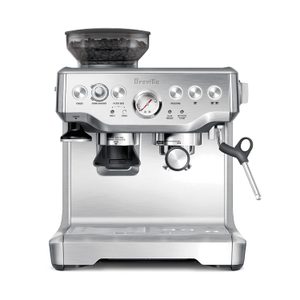
→ Read our full Breville Barista Express review (Built-in grinder, manual control)
The Barista Express packs a conical burr grinder, dose control, pre-infusion, and a manual steam wand into one machine — the complete bean-to-shot workflow without a separate grinder. At ~$599–$699 it is the natural upgrade from the Bambino Plus for those who want to consolidate counter space. The grinder is genuinely capable with 25 settings, though dialling in the correct grind for your beans requires patience. The steam wand produces excellent microfoam once you develop technique — unlike the Bambino Plus, it is fully manual.
- Built-in conical burr grinder with 25 settings — complete bean-to-shot workflow
- Dose control and pre-infusion for optimised extraction
- Manual steam wand — higher ceiling for milk texturing once skills develop
- Grind dial-in requires patience — not immediate-use out of box
- Manual steam wand — less forgiving than Bambino Plus auto wand for beginners
3. De'Longhi La Specialista Touch — Best for Beginners with Grinder

The La Specialista Touch is De'Longhi's attempt to make semi-automatic espresso more approachable — Sensor Grinding Technology measures and dispenses the dose automatically, reducing one of the most common variables beginners get wrong. My LatteArt steam wand is easier to produce consistent microfoam than a traditional steam wand. Active Temperature Control maintains stable extraction temperature. At ~$499–$599, it sits between the Barista Express and Jura E6 and is the most guided experience among machines with manual steaming.
- Sensor Grinding Technology — automatic dose measurement reduces beginner errors
- My LatteArt steam wand — easier microfoam than traditional steam wands
- Active Temperature Control for consistent extraction temperature
- Grinder quality slightly below Breville Barista Express at comparable price
- Large footprint for the counter space it requires
4. Jura E6 — Best Fully Automatic
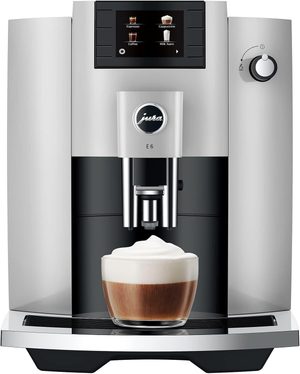
The Jura E6 is a fully automatic bean-to-cup machine — load beans, add water, press a button, and it grinds, tamps, and extracts automatically. Jura's Pulse Extraction Process (PEP) pulses water through the grounds in optimised intervals for both shorter and longer espresso variants. Swiss-made reliability with automatic rinsing and descaling prompts. At ~$849–$999, it is the choice for households where convenience is the absolute priority and no one wants to develop espresso technique.
- Fully automatic — one button from beans to finished espresso
- Pulse Extraction Process (PEP) for optimised short and long espresso
- Swiss-made reliability — automatic maintenance cycles
- ~$849–$999 — significantly more expensive than any semi-automatic
- No manual control over extraction for enthusiasts who want it
5. Nespresso Vertuo Plus — Best Pod Machine
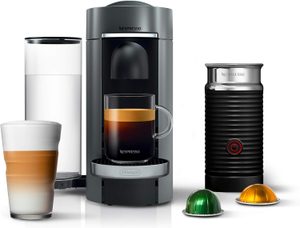
→ Read our full Nespresso Vertuo Plus review (Pod-based, $200 budget pick)
The Nespresso Vertuo Plus is the most convenient coffee experience in this comparison — Centrifusion technology spins each pod at 7,000rpm, and a barcode reader automatically sets the optimal extraction for that blend. The result is consistent espresso with genuine crema at the press of one button. Available in five cup sizes from espresso to 14oz mug. At ~$149 the machine itself is accessible, but ongoing pod costs are higher per cup than ground coffee. For households prioritising zero-effort consistency, nothing matches it.
- Centrifusion at 7,000rpm — consistent crema from every pod, zero technique
- Barcode-controlled extraction — optimised automatically per pod
- 5 cup sizes from single espresso to 14oz mug
- Ongoing pod cost — higher per cup than ground coffee
- Locked to Nespresso Vertuo capsules — no grounds compatibility
What to Look for in an Espresso Machine
Pump pressure
9 bars is the optimal extraction pressure for espresso — the same used in professional café machines. Machines advertising 15 or 19 bars typically regulate down to 9 bars during extraction. Ignore the headline bar number — what matters is stable 9-bar pressure throughout the shot, which the Breville machines and the Jura all deliver.
With or without a built-in grinder
The Bambino Plus has no grinder but delivers the best espresso quality per dollar — pair it with a $50–100 burr grinder. The Barista Express and La Specialista Touch include grinders and are the more convenient single-purchase setups. Separate components give more flexibility to upgrade each independently over time.
Manual vs. automatic steam
The Bambino Plus auto-steam wand makes consistent microfoam repeatable for beginners immediately. Manual steam wands (Barista Express, La Specialista Touch) have a higher ceiling for skilled baristas but require practice. If you want lattes and cappuccinos immediately without a learning curve, auto-steam is the practical choice.
Our Verdict
The Breville Bambino Plus is the best espresso machine for most people — excellent shot quality, auto-steam for immediate latte capability, compact size, and a price that doesn't require months of justification. For an all-in-one with a built-in grinder, the Breville Barista Express is the logical step up. When zero effort is the priority, the Jura E6 is the reference fully automatic machine.
Frequently Asked Questions
Manual espresso machine or fully automatic?
Manual/semi-automatic (Breville Bambino Plus, Barista Express): you grind, dose, tamp, and pull shots manually — better espresso for engaged users who enjoy the process. Fully automatic (De'Longhi La Specialista Touch, Jura Z10): one-touch espresso from beans — convenience over quality. For coffee enthusiasts: semi-automatic. For convenience-first households or office: fully automatic.
How much should I spend on a home espresso machine?
£300-500: entry semi-automatic (Breville Bambino Plus) — capable of great espresso with practice. £600-1000: prosumer (Breville Barista Express, Rocket Appartamento) — closer to café quality with better build. £1500-3000: fully automatic high-end (Jura Z10) or commercial-grade semi-automatic. Below £200: avoid — these can't pull true espresso. Spend £400-800 for the best price-to-quality ratio.
Do I need a separate grinder?
Yes for separate semi-automatic machines (Bambino Plus). The grinder matters more than the machine — uneven grind ruins extraction. Built-in grinder machines (Breville Barista Express) simplify setup but the grinder is usually less capable than a dedicated one. Budget split: spend 50% on machine, 50% on grinder. £500 machine + £300 grinder beats £800 machine + £30 grinder dramatically.
How long does it take to make espresso at home?
From cold start: 5-10 minutes warm-up + 30 seconds to grind and pull = 6-11 minutes for first shot. With machine left on: 30 seconds to make a shot. Fully automatic machines (Jura Z10) are 90 seconds from button press to finished drink. The De'Longhi La Specialista Touch reaches operating temperature in 4 minutes — among the fastest semi-automatic machines.