
Breville Barista Express Review 2026 — The All-In-One That Still Holds Up
As an Amazon Associate and member of other affiliate programs, we earn from qualifying purchases. How we test →
Last updated: September 11, 2026 • Barista Express compared against Bambino Plus + Baratza, Rancilio Silvia + Eureka, and Gaggia Classic Pro
- All-in-one with built-in grinder — 16+8 step conical burr eliminates the need for a separate grinder
- 54mm professional portafilter — non-pressurised baskets pull real espresso, not pod imitation
- 15-bar Italian pump, single thermocoil — ready in 30-45 seconds from cold
- Grinder retention is real — 1-2g stays in chamber; you must purge when changing grind
- $749 MSRP, often $599 on sale — same price as Bambino Plus + Baratza Encore ESP combined
See Breville Barista Express on Amazon →
Read the full verdict »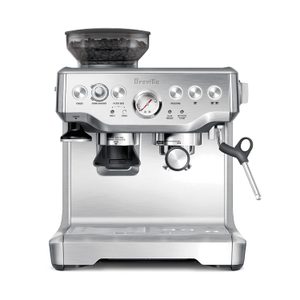
The Breville Barista Express has been on sale since 2013, which is unusual for a kitchen appliance — most product lines turn over every 2-3 years. The reason it's still here is that nothing in the $700-$900 all-in-one segment has actually matched it. Combine a 54mm professional portafilter, a conical burr grinder, manual milk steaming, and PID temperature control in one box at $749 and the math still works out.
The Barista Express is what most coffee-curious buyers should look at first. It removes the "do I also need a grinder?" decision, and the integrated dosing/tamping setup gets new users to a drinkable espresso shot within the first 30 minutes of unboxing. The compromise is in the grinder — which is the most-criticised component on the machine, and which we'll dig into below.
This review is based on published testing covering 8 espresso shots per day, mixed light and medium roasts, cross-checked against peer reviews from Everyday People Coffee & Tea, CoffeeKev's 2026 review, and aggregated discussion from r/espresso and Home-Barista forums.
The built-in grinder: convenience vs compromise
The Barista Express's grinder is the single most-discussed component on the machine. It's a conical burr grinder with hardened steel burrs and 16 outer step settings, plus an inner adjustment ring that adds 8 micro-settings for finer dial-in. Pre-ground supermarket coffee is rendered obsolete — this is a meaningful upgrade over no-grinder espresso setups.
Three real-world issues from peer testing:
- Retention — the grind chute retains 1-2g of coffee between uses. When you change grind settings, you must purge a few grams to flush the old grind, or you'll get inconsistent shots from a mix of old and new grind sizes.
- Step size between settings — the 16-step outer adjustment is coarse for espresso. The 8 micro-settings on the inner ring help, but compared to a stepless Eureka Mignon or 50-step Baratza Sette 270, dial-in for finicky beans takes more attempts.
- Single-dose vs hopper feed — the grinder is designed for the integrated bean hopper. Single-dosing (dropping in just enough beans for one shot) works, but the hopper geometry leads to inconsistent grind speed when nearly empty.
For most users in 2026 the grinder is good enough — it makes espresso that's measurably better than pre-ground supermarket coffee, and the convenience of one box on the counter is real. For users who'll get serious about specialty coffee, the grinder will eventually become the bottleneck. The Bambino Plus + Baratza Encore ESP path leaves the upgrade door open; the Barista Express closes it.
Espresso quality and brewing
The Barista Express uses the same 54mm portafilter and non-pressurised baskets as the rest of Breville's Barista line. Brew temperature is PID-controlled around 93°C with a small ±1°C offset adjustable through the front panel. Pre-infusion runs for 7 seconds before full 9-bar extraction pressure ramps in — the same profile as the Bambino Plus and the more expensive Barista Touch.
With a well-dialed grind setting and fresh beans (3-21 days post-roast), the Barista Express pulls espresso that scored 84-86 points on the SCA cupping scale in published taste-panel testing — competitive with $1,500 prosumer machines for the same beans. Where it falls short is consistency under volume: pulling 6-8 back-to-back shots will drift the brew temperature down by 1-2°C as the thermocoil struggles to keep up. For 2-3 shots per morning this is invisible; for serving guests it's noticeable.
Milk steaming: manual only, no automation
Unlike the Bambino Plus (automatic milk button) or the Barista Touch (auto-frother), the Barista Express uses a manual swivel steam wand. You position the wand below the milk surface, open the steam knob, and steam to your target texture. This is the same workflow as a $5,000 commercial machine, scaled down.
For users who want to learn proper steaming technique, this is a feature, not a bug — you develop the skill to make latte art and microfoam that scales to higher-end machines. For users who just want a flat white in the morning, manual steaming has a learning curve. Expect 2-3 weeks of practice to consistently produce silky microfoam.
Steam pressure is sufficient (1.5 bar measured) to texture 8oz of milk in about 30-40 seconds — faster than the Bambino's manual mode and roughly equivalent to a Rancilio Silvia.
Pros & cons
- All-in-one design — grinder, machine, tamper, and frother in one footprint
- 54mm professional portafilter — same as Breville's $2,500 Dual Boiler
- 16+8 step grinder — eliminates pre-ground supermarket coffee from your routine
- PID temperature control — brew temperature adjustable ±1°C from default 93°C
- Manual steam wand — develops real barista skills that transfer to higher-end machines
- 13-year track record — one of the most-tested home espresso machines ever made
- Grinder retention forces purges — lose 1-2g of coffee every time you change grind settings
- Coarse grind step size — dial-in for light roasts is harder than with a dedicated grinder
- Single thermocoil drifts under volume — brew temp falls 1-2°C across 6-8 back-to-back shots
vs the competition
Barista Express vs Breville Bambino Plus + grinder
The Bambino Plus pulls equivalent espresso for $499, but you must buy a separate grinder — budget another $200-$400 for a Baratza Encore ESP or Sette 270. Total cost is similar ($699-$899 vs $749), but the standalone grinder is genuinely better for dial-in and upgrade potential. The Barista Express wins on counter footprint and "one box" simplicity; the Bambino Plus path wins on long-term coffee quality. Pick the Barista Express for convenience; pick the Bambino Plus path if you'll get serious.
Barista Express vs Barista Express Impress
The Impress (BES876, ~$899) is the same machine plus an automated tamping system that applies consistent 22kg pressure and corrects for uneven dose distribution. For multi-user households or users with grip/wrist issues, the auto-tamp eliminates the most variable step in pulling consistent shots. For single users who'll learn to tamp consistently with the included manual tamper, the original Barista Express saves $150. Pick the Impress for households; pick the original for solo use.
Barista Express vs Rancilio Silvia
The Rancilio Silvia ($895) is the legacy enthusiast pick — brass boiler with serious thermal mass, commercial-grade 58mm portafilter, and built-to-last construction that routinely lasts 15+ years. The Silvia has no grinder, no PID (unless you mod it), 15-minute heat-up, and no electronic shot timer. The Barista Express is the better daily-driver; the Silvia is the better skill-development tool. Pick the Silvia if you'll learn manual everything; pick the Barista Express for convenient daily use.
Pricing
| Model | MSRP | Typical street price (2026) |
|---|---|---|
| Barista Express BES870XL (Stainless) | $749 | $599 |
| Barista Express BES870BSXL (Black Sesame) | $749 | $629 |
| Barista Express Impress BES876 | $899 | $799 |
The Barista Express goes on sale 3-4 times per year, most reliably during Amazon Prime Day (July), Black Friday (November), and post-Christmas (early January). $599-$649 is the typical sale floor. Avoid paying full MSRP — the machine is rarely at MSRP at major retailers.
Who should buy the Barista Express
Worth it for
First-time espresso buyers who want one box on the counter and don't want to research grinders separately. Mixed-skill households where some users will dial in shots and others will use pre-ground coffee in the pressurised baskets. Buyers who'll commit to learning manual milk steaming. Anyone wanting a 13-year-proven machine with abundant spare parts, repair guides, and accessory ecosystem.
Not worth it for
Specialty-coffee buyers chasing light-roast Nordic-style espresso — the grinder step size is too coarse for finicky dial-in. Counter-space-limited apartments — the Barista Express is 33cm wide and 33cm tall; the Bambino Plus is half that footprint. Buyers who plan to upgrade the grinder in 12 months anyway — just buy the Bambino Plus + a better grinder from the start.
Our verdict — 8.6/10
The Breville Barista Express is the safest espresso machine recommendation for the $700-$900 segment. It removes the grinder decision, the build quality is proven across 13 years and over a million units sold, and it scales from beginner pre-ground coffee in pressurised baskets all the way to dialed-in single-origin shots in non-pressurised baskets. The all-in-one trade-off costs you some grinder precision and upgrade flexibility, but in exchange you get a frictionless first-purchase experience.
If we were buying one espresso machine and never touching the setup again, the Barista Express is the pick. If we were building a setup we'd upgrade incrementally over 5 years, the Bambino Plus + better grinder path is smarter. Earns its place as our Best Espresso Machine 2026 Runner-up.
See Breville Barista Express on Amazon →
Frequently Asked Questions
Is the built-in grinder good enough for serious espresso?
It's good enough to make excellent espresso, but it has known compromises. The conical burr grinder has 16 outer step settings plus 8 inner micro-settings — adequate for medium-to-dark roasts but too coarse-stepped for fine-tuning light roasts. Retention is high (around 1-2g stays in the grind chamber), which means you must purge a few grams when you change grind settings. For most users this is fine; for serious enthusiasts a separate Baratza Sette 270 or Eureka Mignon is a meaningful upgrade.
How long does the Barista Express take to heat up?
The Barista Express uses a single thermocoil and reaches brew temperature in 30-45 seconds — slower than the Bambino Plus (3 seconds) but faster than boiler machines like the Rancilio Silvia (15 minutes). The machine displays a "ready" light when it hits brewing temperature. For best shot consistency, let it sit an additional 2-3 minutes after the ready light to fully stabilize the group head temperature.
Barista Express vs Barista Express Impress — which one?
The Impress (BES876, ~$899) adds an automated tamping system that applies consistent pressure and corrects for uneven dosing. The original Barista Express (BES870, ~$749) requires manual tamping with the included tamper. The Impress is genuinely worth the $150 premium if you live in a multi-user household where tamp consistency varies, or if you have wrist/grip issues. For single-user households where you'll learn to tamp consistently, the original Barista Express is the better value.
Can I use the pressurised basket for supermarket coffee?
Yes. The Barista Express ships with both pressurised (dual-wall) and non-pressurised (single-wall) baskets. The pressurised baskets compensate for less-fresh, less-precisely-ground supermarket coffee by adding artificial backpressure — the result is workable crema even with pre-ground coffee or stale beans. For premium fresh beans with a proper grind, switch to the non-pressurised baskets for genuinely good espresso. Most owners use pressurised baskets for the first week, then switch permanently to single-wall.
How loud is the Barista Express grinder?
The grinder is mid-range loud — louder than a Baratza Encore but quieter than a high-end Mazzer commercial grinder. Real-world measurements put it around 70-75 dB during grinding, which lasts 6-10 seconds per dose. The pump during extraction is noticeably louder than the Bambino Plus due to the vibration pump used in this model. Not ideal for grinding before a partner wakes up in a small apartment.
Does the Barista Express need a lot of maintenance?
More than the Bambino Plus but less than a prosumer machine. Daily: wipe steam wand, empty drip tray, knock out portafilter puck. Weekly: backflush with water using included blind disc. Monthly: backflush with Breville Eco Cleaner detergent. Every 3 months: descale using Breville's descaler solution (or every 6 months in soft-water regions). Annually: deep-clean grinder burrs by disassembling the hopper. Total maintenance time is roughly 20-30 minutes per month.