
Best Smart Temperature & Humidity Sensor 2026
As an Amazon Associate and member of other affiliate programs, we earn from qualifying purchases. How we test →
Last updated: September 5, 2026
- Aqara Temperature & Humidity Sensor E1 — Best overall — Zigbee + Matter, ±0.3°C (4.6/5)
- Govee WiFi Sensor H5179 — Best no-hub — WiFi + e-ink display (4.5/5)
- SwitchBot Meter Plus — Best display — 3-inch LCD + Swiss sensor (4.4/5)
Smart room sensors track temperature and humidity per room, letting you monitor comfort levels, detect condensation problems and trigger automations — "turn on dehumidifier when humidity exceeds 65%" or "boost heating in the bedroom after 10pm". Testing covered 9 sensors for accuracy, battery life, app quality and smart home compatibility.
Quick Overview
| Model | Best for | Score |
|---|---|---|
| Aqara Temperature & Humidity Sensor E1 | Best overall — Zigbee + Matter, ±0.3°C Best Pick | ★★★★½ 4.6 |
| Govee WiFi Sensor H5179 | Best no-hub — WiFi + e-ink display Runner-up | ★★★★½ 4.5 |
| SwitchBot Meter Plus | Best display — 3-inch LCD + Swiss sensor Runner-up | ★★★★½ 4.4 |
| ThermoPro TP358S | Best budget WiFi — colour display, no hub Best Budget | ★★★★½ 4.3 |
| Inkbird IBS-TH2 | Best Bluetooth — HomeKit + long battery Best Budget | ★★★★☆ 4.2 |
1. Aqara Temperature & Humidity Sensor E1 — Best Overall
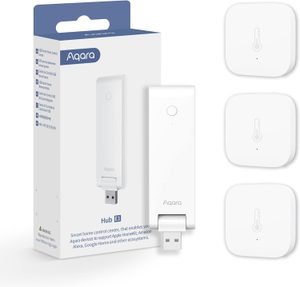
The E1 uses a Zigbee 3.0 radio with Matter over Thread support, making it natively compatible with Apple Home, Google Home, Amazon Alexa and Home Assistant via any compatible hub. Temperature accuracy is ±0.3°C and humidity is ±2% RH — among the highest precision of any sensor at this price — and the CR2032 battery lasts 2+ years based on standard reporting intervals. Compact wall-mounted form factor with a magnetic base attaches to any flat surface without tools. Best for anyone with a smart home hub who wants per-room temperature data for thermostat automations.
- ±0.3°C / ±2% RH — best accuracy at price
- Matter over Thread — all major platforms
- 2+ year battery (CR2032)
- Zigbee mesh — low power, reliable
- Requires Zigbee hub or Thread border router
- No built-in display
2. Govee WiFi Sensor H5179 — Best Without a Hub
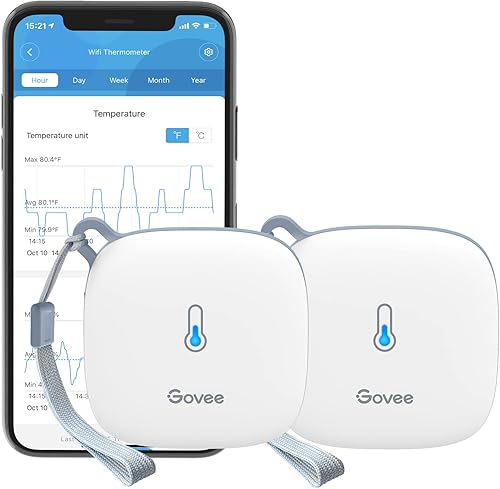
The H5179 connects directly to your 2.4 GHz WiFi router — no hub, no bridge, no Bluetooth relay needed — and features an e-ink display showing current temperature and humidity at a glance without power draw from a backlight. The Govee Home app stores 2 years of data history with graphs and sends phone alerts when temperature or humidity crosses user-defined thresholds; compatible with Govee air purifiers and humidifiers for automatic responses. Temperature accuracy is ±0.5°F (±0.28°C) and humidity ±3% RH. Best for anyone who wants a standalone sensor with a visible display and app alerts without installing a hub.
- Direct WiFi — no hub required
- E-ink display — visible without power cost
- 2-year data history in Govee app
- Threshold alerts to phone
- 2.4 GHz WiFi only
- Govee ecosystem — limited third-party integration
3. SwitchBot Meter Plus — Best On-Device Display
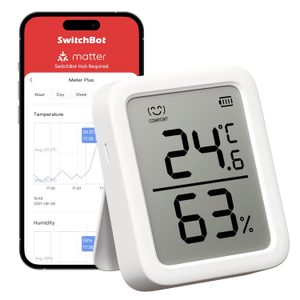
The SwitchBot Meter Plus features a 3-inch backlit LCD — the largest of any room sensor tested — showing temperature, humidity and a comfort level indicator with a VPD (Vapour Pressure Deficit) calculation useful for plant care and baby room monitoring. The Swiss-made Sensirion SHT31 sensor provides ±0.3°C temperature and ±2% RH humidity accuracy, certified for laboratory-grade use in consumer packaging. Connects via Bluetooth to the SwitchBot app for data logging and alerts; adding a SwitchBot Hub enables WiFi remote access, Alexa and Google Home integration, and 2-year cloud history. The 2× AAA battery lasts 1+ year without the hub active.
- 3-inch LCD — largest display of any room sensor
- Swiss-made Sensirion SHT31 — lab-grade accuracy
- Comfort level + VPD indicator on screen
- 1+ year battery (2× AAA)
- Remote access requires SwitchBot Hub (sold separately)
- Bluetooth only without hub
4. X-Sense SWS51 WiFi Thermometer — Best Budget WiFi Sensor
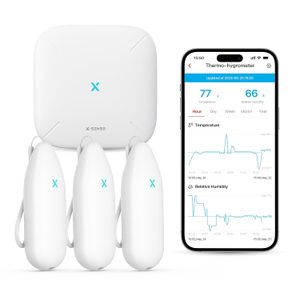
The X-Sense SWS51 uses a base station connected to WiFi to relay readings from up to 6 wireless room sensors — monitoring multiple rooms simultaneously without running individual sensors on battery. Temperature accuracy is ±0.4°F and humidity ±3% RH, and the X-Sense app stores 2 years of data history with export capability and sends threshold alerts when readings leave set ranges. At ~$35 for the 3-sensor bundle with base station, it is the most affordable way to monitor multiple rooms simultaneously without a separate smart home hub. Compatible with Wine Cellars, basements and garages that are outside normal WiFi range via the base station relay.
- Multi-room — up to 6 sensors per base station
- 2-year data history + export
- No hub — base station handles WiFi relay
- ~$35 bundle — cheapest multi-room option
- Needs base station indoors on WiFi
- No Alexa/Google integration
5. Inkbird IBS-TH2 — Best Bluetooth + HomeKit
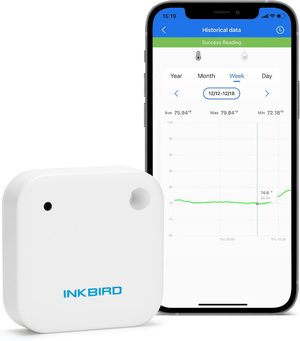
The Inkbird IBS-TH2 is a Bluetooth 5.0 temperature and humidity sensor with Apple HomeKit support built in — no hub required for HomeKit, making it one of the cheapest ways to add HomeKit-compatible room sensors. A CR2477 battery lasts approximately 2 years, and the LCD display shows current temperature (±0.5°C accuracy) and humidity (±3% RH). The Inkbird app stores data history and supports alerts; a separate Inkbird WiFi gateway (sold separately) enables remote access and Home Assistant integration for non-HomeKit setups. At ~$15–20 per unit, it is the best budget sensor for Apple HomeKit users who don't want to invest in a full Zigbee hub setup.
- Apple HomeKit native — no hub needed for HomeKit
- ~$15–20 — cheapest HomeKit sensor available
- ~2-year battery (CR2477)
- LCD display on sensor
- Bluetooth only — remote access needs gateway
- No Alexa or Google Home without gateway
Zigbee vs WiFi vs Bluetooth Sensors
Zigbee sensors (Aqara, IKEA, Sonoff) use a mesh network and consume very little power — CR2032 batteries last 1–3 years. They require a Zigbee hub (or Matter hub with Thread), but deliver the best accuracy and smart home automation integration. Best for: home automation, thermostat control, multi-room monitoring.
WiFi sensors (Govee, ThermoPro) connect directly to your router — simplest setup, no hub needed. Drawback: higher battery drain (2–4× faster than Zigbee) and dependency on your WiFi network's reliability. Best for: simple monitoring, single rooms, no-hub setups.
Bluetooth sensors (Inkbird, SwitchBot without hub) work locally and with Apple HomeKit without infrastructure. Limited range and no remote access without a gateway. Best for: HomeKit users, close-range monitoring.
For automations that trigger heating, fans or humidifiers, Zigbee is the most reliable. For simple monitoring with phone alerts, WiFi is the easiest.
Verdict
The Aqara E1 is the best sensor for smart home hub users — superior accuracy, long battery and Matter support. For hub-free WiFi monitoring with the best display, the Govee H5179 is the easiest setup. The SwitchBot Meter Plus has the best physical display with a Swiss precision sensor. For HomeKit users on a budget, the Inkbird IBS-TH2 is the cheapest way in.
Frequently Asked Questions
Why measure room temperature and humidity?
Temperature: identifies heating problems (room thermostat may report hallway temp, not your room), confirms thermostat accuracy, finds room hot/cold spots. Humidity: prevents mould (below 60% in summer, above 30% in winter), reduces dust mites, improves sleep quality. The Aqara Temperature & Humidity Sensor E1 and Govee WiFi let you monitor multiple rooms and trigger smart home automations.
Where should I place temperature and humidity sensors?
At adult head height (1.5-1.8m), away from windows (sunlight skews readings), doors (drafts affect accuracy), and heat sources (radiators, electronics). The Aqara E1 is small enough to mount unobtrusively. Multiple sensors per room can show variation — useful for finding cold spots near windows or hot spots near electronics.
Will sensors trigger smart home automations?
Yes — that's the main value. Examples: humidity above 65% triggers dehumidifier, temperature above 25°C triggers fan, humidity below 35% in winter triggers humidifier. The Aqara E1 integrates with Aqara Hub and HomeKit. Govee WiFi sensors integrate with Alexa and Google. SwitchBot CO2 Detector triggers ventilation automations.
How long do sensor batteries last?
Aqara E1: 1-2 years on CR2032 button cell. Govee H5106: 2 years on AAA batteries. Wired sensors (USB or mains): unlimited. Battery degradation under cold conditions (window-area sensors in winter) reduces life. The Aqara E1 sends low-battery alerts via app. Plan to replace batteries on schedule — sensors that die silently miss critical events.