
Best Air Quality Monitor 2026 — CO2, PM2.5 & Radon
As an Amazon Associate and member of other affiliate programs, we earn from qualifying purchases. How we test →
Last updated: September 5, 2026
- Govee Air Quality Monitor H5106 — Best value PM2.5 monitor (4.4/5)
- Airthings View Plus — Best premium — 7 metrics + radon (4.7/5)
- SwitchBot CO2 Detector — Best dedicated CO2 monitor (4.2/5)
Indoor air quality is often 2–5× worse than outdoors. Fine particles from cooking, CO2 from poor ventilation and volatile compounds from furniture all build up unnoticed. A good monitor shows you when to act — open a window, run a purifier or increase ventilation — before levels affect your health or concentration.
Quick Overview
| Model | Best for | Score |
|---|---|---|
| Govee Air Quality Monitor H5106 | Best value PM2.5 monitor Best Pick | ★★★★½ 4.4 |
| Airthings View Plus | Best premium — 7 metrics + radon Premium | ★★★★½ 4.7 |
| SwitchBot CO2 Detector | Best dedicated CO2 monitor Best Budget | ★★★★☆ 4.2 |
| Temtop M10+ | Best budget CO2 + PM2.5 combo Runner-up | ★★★★½ 4.3 |
| IQAir AirVisual Pro | Best display — real-time + outdoor AQI Premium | ★★★★½ 4.6 |
1. Govee Air Quality Monitor H5106 — Best Value PM2.5 Monitor
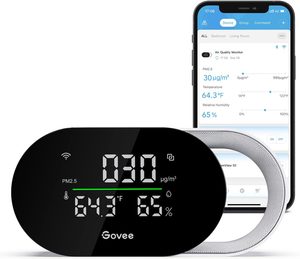
The H5106 tracks PM2.5 fine particles, temperature and humidity on a clear LED display with a colour-coded AQI indicator, making it the most accessible starting point for home air monitoring under $60. It integrates with the Govee Home app for 30-day history graphs, threshold alerts and compatibility with Govee air purifiers — which can trigger automatically when PM2.5 rises above your set level. Best suited to homes with cooking, candles or pets where particle levels fluctuate most. Note: no CO2 sensor — if you need CO2 monitoring, step up to the SwitchBot or Temtop M10+.
- PM2.5 + temperature + humidity — core indoor metrics
- Colour-coded AQI LED indicator at a glance
- Works with Govee smart purifiers for auto-response
- 30-day history and threshold alerts in app
- No CO2 or VOC sensors
- Govee ecosystem only — no third-party integration
2. Airthings View Plus — Best Premium Monitor
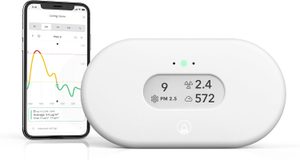
Seven sensors in one device: radon, CO2, PM2.5, TVOC, humidity, temperature and air pressure — the most comprehensive residential air quality monitor available at this price. Radon is the second leading cause of lung cancer and almost no other consumer device tracks it; the View Plus uses a passive alpha particle counter that delivers statistically stable readings after 7 days of placement. Battery-powered (up to 2 years), e-ink display, WiFi and Bluetooth connect to the Airthings app for long-term trend analysis and Alexa integration. At ~$180 it is significantly more expensive than basic monitors, but covers metrics that a single-use radon test kit cannot match for ongoing peace of mind.
- Radon detection — unique at consumer price point
- CO2 + PM2.5 + TVOC + pressure — 7 metrics total
- E-ink display + Alexa + long-term trend analysis
- Up to 2-year battery life
- ~$180 — premium price
- Radon data needs 7 days to stabilise
→ Read our full Airthings View Plus review (6 sensors including radon)
3. SwitchBot CO2 Detector — Best Dedicated CO2 Monitor
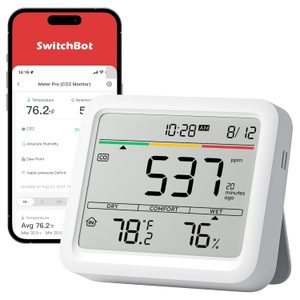
The SwitchBot CO2 Detector uses an NDIR (non-dispersive infrared) CO2 sensor — the same type used in professional building management systems — providing ±50 ppm accuracy across a 400–9,999 ppm range. CO2 above 1,000 ppm causes measurable drowsiness and concentration loss; this sensor alerts you before it becomes a problem with a large backlit LCD and audible alarm. It integrates with the SwitchBot ecosystem for automations: open smart windows, trigger fans or send phone alerts when CO2 climbs after 30 minutes of poor ventilation. A SwitchBot Hub is needed for remote access and automations beyond local alerts.
- NDIR CO2 sensor — professional accuracy standard
- CO2 + temperature + humidity
- SwitchBot ecosystem automations
- Large backlit display + audible alarm
- No PM2.5 or radon sensing
- SwitchBot Hub needed for remote access
→ Read our full SwitchBot CO2 Detector review (Best-budget CO2 monitor)
4. Temtop M10+ — Best Budget CO2 + PM2.5 Combo
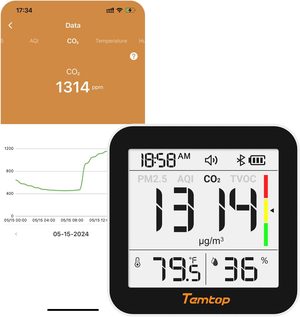
Temtop has retired the P1000 and the M10+ is its replacement. It covers the same six readings — CO2, PM2.5, TVOC, temperature and humidity — but on an e-ink display rather than a backlit touchscreen, which is what gets it to 60 days on a charge instead of a day or two. No WiFi and no subscription: it pairs over Bluetooth when you want history on your phone, and works standing alone when you do not. The alarm mutes completely, which matters in a bedroom. Around $95.
- CO2 + PM2.5 + TVOC — key metrics in one device
- NDIR CO2 sensor — ±50 ppm accuracy
- No WiFi or account needed — portable use
- ~$80 — most affordable CO2+PM2.5 combo
- No smart home integration
- No radon — need Airthings View Plus for that
5. Aranet4 Home CO2 Sensor — Best Portable CO2 Monitor
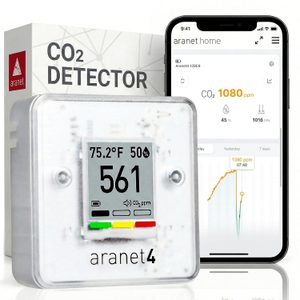
The Aranet4 Home uses a dual-wavelength NDIR CO2 sensor with ±50 ppm accuracy — among the most precise of any consumer CO2 monitor — and displays CO2, temperature, humidity and atmospheric pressure on a circular e-ink screen that shows traffic-light colour coding at a glance. Battery-powered with up to 4 weeks per charge, Bluetooth 5.0 syncs readings to the Aranet app with 2-year data history and customisable alert thresholds. Portable and wall-mountable, it is the standard CO2 monitor recommended by building scientists and IAQ professionals for home assessments. At ~$100 it is more expensive than basic sensors, but the NDIR precision and long history make it the most reliable standalone CO2 option available.
- Dual-wavelength NDIR CO2 — ±50 ppm accuracy
- E-ink display with traffic-light CO2 colour coding
- 4-week battery — fully portable
- 2-year data history via Bluetooth app
- ~$100 — premium price for CO2-only sensor
- No WiFi — Bluetooth only, short range
Which Metrics Actually Matter?
CO2 — above 1,000 ppm causes drowsiness and reduced cognitive performance. Common in bedrooms and home offices with poor airflow overnight. NDIR sensors give the most accurate readings; electrochemical sensors are less reliable.
PM2.5 — fine particles from cooking, candles, incense and traffic. Linked to respiratory issues with long-term exposure. Most noticeable when frying or using a wood-burning stove. Laser particle counters are the most accurate method for home use.
TVOC — volatile organic compounds from paint, new furniture, cleaning products and adhesives. High levels in the weeks after renovation work or new furniture delivery.
Radon — radioactive gas from soil and building materials. Long-term exposure is the second leading cause of lung cancer after smoking. Only the Airthings View Plus tracks it at this price point. Highest in ground-floor rooms and basements.
Verdict
For most homes, the Govee H5106 covers the most common concern — PM2.5 — at the best price, especially useful alongside Govee purifiers. For CO2 monitoring specifically, the SwitchBot CO2 Detector is the most accurate standalone option. For a single device that covers both CO2 and PM2.5 without WiFi, the Temtop M10+ at around $95 is the best value. If radon is a concern, the Airthings View Plus is the only sensible choice. The Aranet4 Home is the professional-grade CO2 monitor recommended by IAQ specialists when accuracy is the priority.
Frequently Asked Questions
What pollutants do air quality monitors detect?
Quality monitors track: PM2.5 (fine particles, fires, traffic), PM10 (larger particles, dust), VOCs (chemicals from furniture, cleaning, cooking), CO2 (occupied space air quality), temperature, and humidity. The Airthings View Plus also measures radon (long-term cancer risk) — important in some UK areas. The Govee H5106 covers basics; the View Plus is the complete picture.
Why measure CO2 in my home?
High CO2 (over 1000ppm) causes drowsiness, headaches, reduced concentration. Standard occupied rooms can hit 1500-2500ppm with closed windows. The SwitchBot CO2 Detector and Airthings View Plus track this. Solutions: open windows for 15-30 minutes, use HRV systems, or simply move to better-ventilated rooms. For home offices, CO2 monitoring transforms focus and energy levels.
How often do air quality monitors need calibration?
Most consumer monitors don't require user calibration but drift over 2-3 years (becoming less accurate). Quality monitors (Airthings, Awair) auto-calibrate. Cheap monitors ($30-60) may show false readings within a year. The Airthings View Plus has lab-grade calibration; the Govee H5106 is consumer-grade — sufficient for general awareness.
Will an air quality monitor work with smart home?
Most premium models (Airthings View Plus, Govee H5106) integrate with Alexa, Google Home, and HomeKit. Automation example: when PM2.5 exceeds threshold, turn on air purifier. The SwitchBot integrates with their app for automation. For full smart-home automation around air quality, the Airthings View Plus has the best ecosystem support.