
Airthings View Plus Review 2026 — Only Consumer Radon + 6 Other Pollutants
As an Amazon Associate and member of other affiliate programs, we earn from qualifying purchases. How we test →
Last updated: September 11, 2026 • Airthings View Plus assessed against BreatheSafeAir 30-day reference test, LeafScore 18-month field report, and Wirecutter consensus
- Only consumer device tracking radon credibly — passive alpha sensor with 7-day, 30-day, 365-day rolling averages
- 7 pollutants in one device — radon, CO2, PM2.5, TVOC, pressure, temperature, humidity
- NDIR CO2 sensor ±50ppm ±3% — reference-class accuracy in 30-day peer test
- Up to 2 years on 6 AA batteries — 18 months confirmed in independent field test
- e-ink display + Alexa + Airthings cloud — best smart-home support in the category
See Airthings View Plus on Amazon →
Read the full verdict »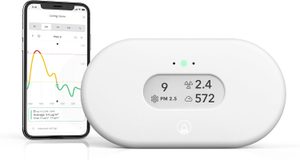
The Airthings View Plus is the only consumer air quality monitor under $500 that measures radon credibly — and that single capability is what justifies the price. Radon is the second leading cause of lung cancer after smoking according to the US EPA, and a $20 short-term lab kit only gives you one measurement on one weekend. The View Plus gives you a continuous, recalibrating reading for years.
This review is based on the View Plus product sensor specifications, BreatheSafeAir's 30-day reference test against SenseAir S8 LPs and Plantower PMS5003s, LeafScore's 18-month long-term field test, and the consensus 9.1 expert score that Wirecutter, Reviewed, and Smart Home Explorer have separately published.
Radon: the feature nothing else has
Radon is invisible, odorless, and statistical — it does not exist as "the radon level right now," it exists as a probability distribution that you need at least seven days of placement to measure meaningfully. The View Plus uses a passive alpha-particle counter inside a sealed diffusion chamber. Alpha decays from radon's daughter isotopes hit a silicon detector, get counted, and the rolling average updates every 24 hours after the initial 7-day window.
This matters because most radon you read about ("my level was 4 pCi/L last weekend") comes from one-shot lab kits that capture a single ~48-hour sample. Radon levels in a basement vary dramatically with weather, pressure, and ventilation. A weekend reading at 1.2 pCi/L can become a winter weekday reading at 6.0 pCi/L when the house is sealed up. The View Plus catches that variance — one-shot kits do not.
Two practical notes from long-term independent testing:
- First reliable reading after 7 days minimum. Anything sooner is noise.
- Place the unit at breathing height in the lowest occupied floor. Basement bedroom > basement utility room > ground floor living room.
CO2 and PM2.5 accuracy: where it sits in the pack
Radon is the headline feature; CO2 and PM2.5 are the daily-use sensors. Both are good but not best-in-class:
| Sensor | Airthings View Plus | Aranet4 Home | IQAir AirVisual Pro |
|---|---|---|---|
| CO2 method | NDIR single-wavelength | NDIR dual-wavelength | NDIR single-wavelength |
| CO2 accuracy | ±50 ppm ±3% | ±50 ppm ±3% | ±50 ppm ±5% |
| PM2.5 method | Laser scattering | (no PM2.5) | Laser scattering (AVPM25b) |
| PM2.5 accuracy | ±(5 µg/m³ + 15%) | n/a | ±8% of reading |
| Radon | Yes (passive alpha) | No | No |
An independent 30-day comparison against two SenseAir S8 LP reference monitors found the View Plus tracked within roughly 50–100 ppm across the 400–2,500 ppm range that covers normal residential conditions. For PM2.5 the same test against two Plantower PMS5003s showed acceptable agreement in everyday concentrations (under 50 µg/m³) with some divergence during cooking spikes — the View Plus tends to read slightly lower than the Plantower at peak events.
The Aranet4 Home is tighter on CO2 specifically (dual-wavelength NDIR self-corrects for sensor drift). The IQAir AirVisual Pro is tighter on PM2.5. Neither does radon. The View Plus loses head-to-head on individual metrics and wins on coverage.
Battery and connectivity
Six AA batteries, Airthings rates the View Plus at up to 2 years of operation with 5-minute sample intervals. An independent long-term field test reported one battery change in 18 months. That is the longest battery life of any continuous IAQ monitor in this review — the Govee H5106 is wired only, the SwitchBot CO2 needs USB power, the Temtop P1000 has 6 hours portable runtime.
Connectivity is dual-mode: Bluetooth for direct phone pairing and initial setup, WiFi for cloud sync and Alexa integration. The unit is functional standalone via the e-ink display, but the Airthings web dashboard is where the long-term trends become useful. Alexa announces threshold crossings ("CO2 is high in the living room") which is more useful than it sounds for actually getting people to open windows.
The honest cons
1. Radon needs 7 days for first reading. This is physics, not a defect, but new owners are routinely confused by the View Plus showing "Calculating..." for radon during the first week. The CO2, PM2.5, TVOC, temperature, and humidity readings start immediately — only the radon channel needs the calibration window.
2. Sensor accuracy drifts over years. All consumer laser PM2.5 sensors and most NDIR CO2 sensors drift with age. The View Plus does automatic baseline corrections, but Airthings does not offer a user-replaceable sensor module — when the unit's accuracy degrades, the unit is the replacement. Expect 5-7 years of useful life under normal indoor conditions before measurable drift.
3. ~$300 price tag. The View Plus is the most expensive device in this review. Justified if you want radon; harder to justify if you only need CO2 and PM2.5, where the Temtop P1000 (~$80) and SwitchBot CO2 Detector (~$80) split the same functionality at a quarter of the cost.
vs the competition
Airthings View Plus vs Govee H5106
The H5106 is a single-pollutant device (PM2.5 only) at roughly one-sixth the price. For pure PM2.5 in everyday indoor conditions, the two devices are surprisingly close. The View Plus adds radon, CO2, TVOC, atmospheric pressure, a much longer battery life, and Alexa integration. Buy the H5106 if PM2.5 is the only metric you care about. Buy the View Plus if you want the complete picture or if radon is a concern in your area.
Airthings View Plus vs IQAir AirVisual Pro
The AirVisual Pro is tighter on PM2.5 specifically (±8% manufacturer spec, 86% accuracy in 12-month independent study) and includes outdoor AQI station-pull data. It does not measure radon or atmospheric pressure. The View Plus measures both. Pick the AirVisual Pro if PM2.5 precision and outdoor data matter most. Pick the View Plus if radon is the deciding factor.
Airthings View Plus vs Temtop P1000
The Temtop P1000 covers CO2 + PM2.5 + TVOC in one battery-powered device for roughly $80. It does not measure radon, atmospheric pressure, or integrate with smart-home platforms. The View Plus does all three. Pick the P1000 if budget is the constraint and you want a portable solution. Pick the View Plus if smart-home integration and radon matter.
Pros & cons
- Only consumer radon monitor under $500 — passive alpha sensor with 7/30/365-day averages
- 7 sensors in one device — radon, CO2, PM2.5, TVOC, pressure, temperature, humidity
- NDIR CO2 sensor ±50 ppm ±3% — reference-class accuracy
- Up to 2-year battery life — 18 months confirmed in independent long-term test
- e-ink display + Alexa + Airthings cloud — best smart-home support in the category
- Airthings web dashboard — long-term trend analysis no rival matches
- Radon needs 7-day calibration before first reliable reading
- ~$300 premium price — four times more expensive than the Govee H5106
- PM2.5 less tight than IQAir AirVisual Pro at peak cooking events
Who should NOT buy the Airthings View Plus
Anyone living in a high-rise or upper-floor apartment. Radon enters from soil and concentrates in ground-floor and basement spaces. If you live above the second floor, the View Plus' defining feature is wasted. The Temtop P1000 or SwitchBot CO2 Detector covers your real needs at far lower cost.
Budget-conscious buyers who only need PM2.5. The Govee H5106 measures PM2.5 within ~5 µg/m³ of $200 reference monitors at one-sixth the View Plus price. Paying for radon, CO2, and TVOC sensors you will not use is wasted budget.
Mixed smart-home users without Alexa. Airthings integrates with Alexa best, with limited HomeKit and Google Home support. If you run a HomeKit-only or Google-only ecosystem, you will get less out of the View Plus than the marketing implies.
Buyers expecting instant radon answers. The 7-day calibration window is not optional. If you need a quick "is my house OK?" answer this weekend, a short-term lab kit is faster and cheaper for the one-shot question. Use the View Plus for continuous monitoring over years.
Our verdict — 9.1/10
The Airthings View Plus is the most complete consumer air quality monitor of 2026 if you weight radon detection alongside CO2 and PM2.5. The 7-sensor coverage, 2-year battery life, e-ink display, and Airthings cloud dashboard together justify the $300 price tag — but only if you actually use the radon channel. For anyone living in an EPA Zone 1 radon area, a basement bedroom, or a Scandinavian-style heated-floor home where radon ingress is elevated, the View Plus is the easiest single-device recommendation.
The View Plus does not win head-to-head on PM2.5 precision (IQAir AirVisual Pro is tighter) or CO2 precision (Aranet4 Home is tighter), but it covers all three at near-reference accuracy and adds the one metric nothing else measures. That breadth is the value proposition.
Earns its place as the Best Air Quality Monitor 2026 Premium pick.
See Airthings View Plus on Amazon →
Frequently Asked Questions
How does the Airthings View Plus measure radon?
The View Plus uses a passive alpha particle counter inside a sealed chamber. Air diffuses into the chamber and any radon present decays into alpha-emitting daughter products that the sensor counts. Because radon is a statistical phenomenon (not a continuous reading), the device needs 7 days of placement before delivering its first reliable measurement. After that, readings update every 24 hours with rolling 7-day, 30-day, and 365-day averages. Long-term trend is more meaningful than any single hour.
How accurate is the Airthings View Plus CO2 sensor?
The CO2 sensor is NDIR technology rated at ±50 ppm ±3% within 10–35°C and 0–80% relative humidity, after the initial 7-day calibration period. An independent 30-day comparison test against two SenseAir S8 reference sensors found the View Plus tracked within roughly 50–100 ppm across the 400–2,500 ppm range that covers normal residential conditions. That is good but not best-in-class — the standalone Aranet4 Home uses a dual-wavelength NDIR sensor that is slightly tighter.
How long does the Airthings View Plus battery last?
Airthings rates the View Plus at up to 2 years on six AA batteries with default 5-minute sample intervals. An independent multi-year field test reported one battery change in 18 months of continuous use. WiFi-only mode drains faster than Bluetooth-only mode — if you do not need real-time WiFi sync, the Bluetooth-only setting extends battery life meaningfully. Battery status is visible in the Airthings app.
Does the Airthings View Plus work without WiFi?
Yes for the e-ink display and local readings. The unit shows current values, colour-coded health bands, and basic trend arrows on the e-ink screen standalone via Bluetooth pairing with your phone. WiFi is required for cloud history beyond the device's local 30-day buffer, for Alexa integration, and for the Airthings web dashboard. The View Plus is not crippled offline — it simply loses long-term cloud storage.
Airthings View Plus vs Airthings Wave Plus — which to buy?
The View Plus is the Wave Plus' newer sibling with two material upgrades: an e-ink display (the Wave Plus has none, requiring the phone app to see readings) and a PM2.5 sensor (the Wave Plus does not measure particles). For the same radon and CO2 coverage but with PM2.5 and a glanceable display, the View Plus is worth roughly the extra $80–100. The Wave Plus remains valid for radon and CO2 only at lower cost.
Is the Airthings View Plus worth $300 vs cheaper monitors?
It depends on whether radon matters to you. No other consumer device under $500 measures radon credibly — this is the View Plus' defining feature and the answer to whether the price is justified. For everything else (CO2, PM2.5, TVOC, temperature, humidity), cheaper devices like the Temtop P1000 (~$80) or SwitchBot CO2 Detector (~$80) cover the basics. If you live in a known radon zone (US EPA Zone 1, UK indicative areas, Scandinavia) the View Plus pays for itself versus repeat lab-test radon kits.