
SwitchBot CO2 Detector Review 2026 — Sensirion NDIR Accuracy For Half The Aranet Price
As an Amazon Associate and member of other affiliate programs, we earn from qualifying purchases. How we test →
Last updated: September 11, 2026 • SwitchBot CO2 Detector assessed against Sensirion SCD40 datasheet, HomeTechHacker hands-on, TrustedReviews, and AirPurifierFirst peer testing
- Sensirion SCD40 NDIR sensor — same Swiss-made tech used in HVAC building-management systems
- ±(50 ppm + 5%) accuracy across 400–9,999 ppm range — responds within seconds to exhaled breath
- SwitchBot ecosystem automations — trigger smart windows, purifiers, fans on CO2 threshold
- ~$80 standalone — roughly half the Aranet4 Home price for comparable accuracy
- CO2 + temperature + humidity only — no PM2.5, no VOC, no radon
See SwitchBot CO2 Detector on Amazon →
Read the full verdict »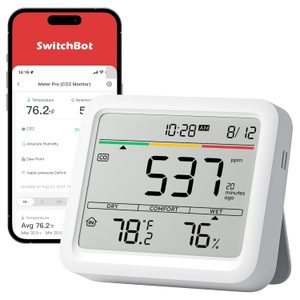
The SwitchBot CO2 Detector is what you buy when you want one number that matters: CO2 in the room you spend the most time in. CO2 climbs above 1,000 ppm in any closed bedroom or home office within an hour or two, and the resulting drowsiness, brain fog, and headaches account for more "I just feel off today" complaints than most people realize. The SwitchBot, like the Aranet4 Home, exists to make that invisible problem visible.
This review is based on the publicly available Sensirion SCD40 datasheet, HomeTechHacker's hands-on testing, TrustedReviews' multi-week test, and the AirPurifierFirst review. CO2 monitoring is unusually well-served by independent peer testing because the underlying sensor (Sensirion SCD40) is documented and widely benchmarked.
Accuracy: what the Sensirion SCD40 actually delivers
The SwitchBot CO2 Detector uses a Sensirion SCD40 NDIR sensor — the same Swiss-made sensor family used in commercial HVAC building-management systems and many published academic studies. The published accuracy is ±(50 ppm + 5% of reading), which translates to:
| CO2 level | Worst-case error | Practical impact |
|---|---|---|
| 400 ppm (outdoor air) | ±70 ppm | Invisible — well within "fresh air" band |
| 800 ppm (typical occupied room) | ±90 ppm | Trivial — doesn't change ventilation decision |
| 1,500 ppm (closed bedroom) | ±125 ppm | Reading is clearly in "open the window" zone regardless |
| 3,000 ppm (severely under-ventilated) | ±200 ppm | Decision is "leave the room" at any value in this range |
The point is that NDIR accuracy specifications widen at high readings, but the practical decision threshold (open window? leave room?) is the same whether you're at 1,425 ppm or 1,550 ppm. The Sensirion SCD40 is tight enough that you never make the wrong decision because of sensor error.
HomeTechHacker's hands-on test specifically called out the responsiveness: exhaling near the unit drives the reading from baseline to over 3,000 ppm within seconds, then drops back to baseline within 2–3 minutes once you step away. This is the behaviour you want — it confirms the sensor is actually measuring air, not running an averaged simulation.
Display and standalone use
The front-facing LCD shows three readouts: large CO2 ppm value, temperature, and humidity. There is no AQI colour band — SwitchBot opted for the precise number instead. A small icon indicates whether CO2 is in the safe (green), caution (yellow), or alert (red) zone, with user-configurable threshold values.
The audible alarm is loud enough to notice but not jarring — closer to a microwave beep than a smoke alarm. It triggers when CO2 crosses the configured threshold and stops when it drops back below. For overnight use, the alarm can be muted via the app while the LCD continues showing values.
SwitchBot ecosystem: where it goes beyond a meter
The SwitchBot CO2 Detector's defining advantage over the Aranet4 Home is the SwitchBot smart-home ecosystem. With a SwitchBot Hub 2 or Hub Mini, the CO2 reading becomes a trigger:
- Open smart windows or blinds automatically when CO2 crosses 1,200 ppm
- Turn on a smart fan or purifier when CO2 climbs above threshold
- Push notifications to your phone when you're away ("CO2 high in bedroom")
- Trigger Alexa/Google Home routines ("Alexa, what's the CO2 level?")
- IFTTT integration for cross-ecosystem automations
The Aranet4 Home does none of this. It is a dedicated meter with Bluetooth-only sync and 2-year data history, designed for building scientists and IAQ professionals who do not want automation. The SwitchBot is designed for smart-home users who want CO2 to do something, not just be visible.
The honest cons
1. CO2 only. No PM2.5, no VOCs, no radon, no formaldehyde. If cooking, candles, wildfires, or new furniture are concerns, the SwitchBot is blind to them. Pair with a Govee H5106 for PM2.5, or step up to the Temtop P1000 which covers CO2 + PM2.5 in one device for similar money.
2. USB-powered, not portable. Unlike the Aranet4 Home (4 weeks per AA charge) the SwitchBot needs constant USB power. You cannot do quick room-to-room CO2 spot checks. Move the unit means find a new outlet.
3. Hub required for full functionality. Standalone the SwitchBot is a competent CO2 meter, but the automation features that justify it over the Aranet4 require a SwitchBot Hub 2 (~$70) or Hub Mini (~$40). Budget the full ecosystem cost when comparing.
vs the competition
SwitchBot CO2 Detector vs Govee H5106
These two devices measure different things. The Govee H5106 tracks PM2.5 only. The SwitchBot tracks CO2 only. Neither is a substitute for the other. Pick the H5106 if your home has frequent cooking, candles, or wildfire concerns. Pick the SwitchBot if your bedroom/office feels stuffy and you suspect ventilation is the problem. For both, see the Temtop P1000.
SwitchBot CO2 Detector vs Airthings View Plus
The View Plus measures everything the SwitchBot measures plus PM2.5, TVOC, atmospheric pressure, and radon — at four times the price. The View Plus has 2-year battery life; the SwitchBot is wired. The SwitchBot has better automation in its ecosystem. Buy the SwitchBot if CO2 is the only metric you care about and SwitchBot ecosystem matters. Buy the View Plus if you want the complete picture or live in a radon-risk area.
SwitchBot CO2 Detector vs Aranet4 Home
Both use NDIR sensors. The Aranet4 uses dual-wavelength NDIR (slightly tighter accuracy and self-correcting for sensor drift); the SwitchBot uses single-wavelength NDIR with automatic self-calibration. The Aranet4 runs on AA batteries for up to 4 weeks (portable); the SwitchBot needs USB power. The SwitchBot integrates with smart home automations; the Aranet4 is Bluetooth-only with no automation hooks. Pick the Aranet4 if you want maximum portability and accuracy in a meter. Pick the SwitchBot if you want CO2 to trigger something.
Pros & cons
- Sensirion SCD40 NDIR sensor — Swiss-made, used in commercial HVAC systems
- ±(50 ppm + 5%) accuracy across 400–9,999 ppm
- Fast response time — reads exhaled breath within seconds
- SwitchBot Hub automations — trigger windows, fans, purifiers, alerts
- ~$80 standalone — roughly half the Aranet4 Home
- Audible alarm + configurable thresholds + Alexa, Google Home, IFTTT
- CO2 only — no PM2.5, VOC, radon, or formaldehyde
- USB-powered, not portable — cannot do room-to-room spot checks
- Hub required for full ecosystem features — adds ~$40–70 to total cost
Who should NOT buy the SwitchBot CO2 Detector
Households where cooking, candles, or smoke are the primary concern. CO2 monitoring will not help — PM2.5 is the metric you need. The Govee H5106 (PM2.5-only) or Temtop P1000 (PM2.5 + CO2) is the right buy.
Anyone in a known radon area. The SwitchBot cannot see radon. The Airthings View Plus is the only consumer monitor that does.
Building scientists and IAQ professionals. The Aranet4 Home is the recognized standard for portable, battery-powered, dual-wavelength NDIR measurement. The SwitchBot is calibrated for smart-home use, not for documentation-grade IAQ assessments.
Smart-home users with no SwitchBot devices. Without a SwitchBot Hub, the SwitchBot CO2 Detector is just a wired meter with no automation hooks — and the Aranet4 Home does that job better at the same price with batteries.
Our verdict — 8.4/10
The SwitchBot CO2 Detector is the best CO2 monitor for SwitchBot smart-home owners, and a competitive standalone CO2 meter for anyone who wants reference-class accuracy without paying the Aranet4 premium. The Sensirion SCD40 sensor is genuinely good — it is the same NDIR tech that drives commercial HVAC systems — and the ±50ppm + 5% spec holds up in peer testing.
What loses it points is the deliberate single-metric scope and the wired-only power. CO2 monitoring solves one specific class of problems (closed-room ventilation, bedroom drowsiness, home-office focus). It does not help with cooking, smoke, off-gassing, or radon. The Temtop P1000 covers CO2 + PM2.5 in one device for similar money — if you want both, the P1000 is the better single purchase.
Earns its place as the Best Air Quality Monitor 2026 Best Budget pick for CO2-focused smart-home setups.
See SwitchBot CO2 Detector on Amazon → See at SwitchBot →
Frequently Asked Questions
How accurate is the SwitchBot CO2 Detector?
The SwitchBot CO2 Detector uses a Sensirion SCD40 NDIR sensor with rated accuracy of ±(50 ppm + 5% of reading) across the 400–9,999 ppm range. In hands-on testing reported by HomeTechHacker, AirPurifierFirst, and TrustedReviews, the unit responded within seconds to exhaled breath and tracked closely against reference NDIR sensors in everyday residential conditions. The Sensirion SCD40 is the same NDIR technology used in research and HVAC building-management systems.
Does the SwitchBot CO2 Detector measure PM2.5 or radon?
No. The SwitchBot CO2 Detector measures CO2, temperature, and humidity only. For PM2.5 (fine particles from cooking, smoke, candles), pair it with a Govee H5106 or step up to a Temtop P1000 that covers both. For radon, the Airthings View Plus is the only credible consumer choice. The SwitchBot is a single-purpose CO2 device, deliberately scoped.
Do I need a SwitchBot Hub to use the CO2 Detector?
Not for basic readings. The SwitchBot CO2 Detector shows current CO2, temperature, and humidity on its built-in LCD standalone via Bluetooth pairing with the SwitchBot app. A SwitchBot Hub 2 or Hub Mini is required for remote access outside Bluetooth range, for automations triggering other smart devices (open smart windows, run purifiers, send alerts when away from home), and for Alexa, Google Home, and IFTTT integration.
SwitchBot CO2 Detector vs Aranet4 Home — which to buy?
The Aranet4 Home uses a dual-wavelength NDIR sensor that is slightly tighter on accuracy (especially at very high CO2 levels) and runs on AA batteries for up to 4 weeks per charge, making it more portable. The SwitchBot uses single-wavelength NDIR, runs on USB power, and integrates with the SwitchBot smart-home ecosystem for automations. Pick the Aranet4 for portability and absolute accuracy. Pick the SwitchBot if you already own SwitchBot devices and want CO2-triggered automations.
What CO2 levels should trigger action at home?
Outdoor air is roughly 420 ppm. Indoor levels under 800 ppm are considered fine. 800–1,000 ppm is acceptable but ventilation is advised. Above 1,000 ppm causes measurable drowsiness, reduced concentration, and headaches in many people. Above 1,400 ppm is unhealthy for extended occupancy. The SwitchBot CO2 Detector's audible alarm threshold is user-configurable — 1,000 ppm is the typical health-conscious setting. Bedrooms with closed doors routinely hit 1,500–2,500 ppm overnight without active ventilation.
Does the SwitchBot CO2 Detector need calibration?
The Sensirion SCD40 uses automatic self-calibration (ASC) which assumes the lowest CO2 reading over a multi-day period represents outdoor air (~400 ppm) and recalibrates the baseline accordingly. This works correctly in normally-ventilated homes where windows are opened periodically. In tightly sealed homes that never reach outdoor baseline, the ASC can drift. Manual calibration via the SwitchBot app by exposing the unit to outdoor air for 15–20 minutes resets the baseline if drift is suspected.