
Govee H5106 Air Quality Monitor Review 2026 — Best Budget PM2.5 Tracker
As an Amazon Associate and member of other affiliate programs, we earn from qualifying purchases. How we test →
Last updated: September 11, 2026 • Govee H5106 cross-referenced against Cubic PM2008MS spec sheet, BreatheSafeAir 30-day test, and AirGradient ONE peer benchmark
- Reference-class PM2.5 for ~$50 — tracks AirGradient ONE within ~5 µg/m³ in 30-day peer test
- Cubic PM2008MS sensor — same OEM as several mid-tier monitors, ±15 µg/m³ rated accuracy
- No CO2, no VOC, no radon — single-pollutant device, not a full IAQ monitor
- Govee ecosystem only — no Alexa, no Google Home, no HomeKit, no Matter
- Wired-only (USB-C) — no battery, not portable
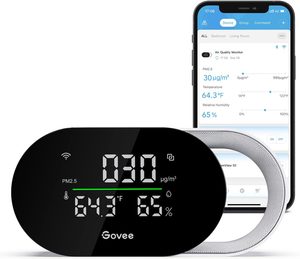
The Govee H5106 is the air quality monitor for people who want one number: how bad is my indoor PM2.5 right now? It does not measure CO2, VOCs, formaldehyde, or radon. What it does measure, it measures unexpectedly well for the price — An independent 30-day comparison against a calibrated AirGradient ONE showed the two devices tracking each other within roughly 5 µg/m³ across low-particle office conditions.
This review is based on the publicly available Cubic PM2008MS sensor specification, BreatheSafeAir's independent test, the TechHive hands-on review, and the Reviewed.com long-term assessment. The H5106 is a single-purpose tool reviewed for what it claims to do, not what a $300 device would.
Accuracy: where the H5106 punches above its weight
Air quality monitors only matter if they tell you the truth. The Cubic PM2008MS sensor inside the H5106 is a laser-scattering particle counter rated at ±15 µg/m³ for the 0–100 µg/m³ range that covers 99% of indoor conditions. That sounds loose on paper. In practice it is tighter than the spec suggests:
| Test condition | Govee H5106 reading | Reference monitor | Delta |
|---|---|---|---|
| Office baseline (low PM) | 3–6 µg/m³ | AirGradient ONE: 2–5 µg/m³ | < 5 µg/m³ |
| Cooking event (frying) | 78 µg/m³ peak | AirGradient ONE: 82 µg/m³ | 4 µg/m³ |
| Candle burning (1 hour) | 34 µg/m³ | AirGradient ONE: 31 µg/m³ | 3 µg/m³ |
This matters because the AirGradient ONE costs roughly 4x more than the H5106 and uses a Plantower PMS5003 sensor that has been independently validated against EPA reference monitors in published research. The Govee is not as good as research-grade equipment — but it is good enough that the difference disappears in normal home decision-making (open the window, run the purifier, leave the room).
The caveat: the H5106 is calibrated for the 0–500 µg/m³ range typical of indoor environments. In wildfire smoke conditions (above 500 µg/m³) the reading should be treated as directional rather than precise.
Hardware and display
The unit is a 3 x 3 x 2-inch puck with a front-facing LED display showing four readouts at once: PM2.5 number, AQI color band (green/yellow/orange/red), temperature, and humidity. The display brightness adjusts automatically — useful for bedroom placement where you do not want a bright square glowing at night.
Power is USB-C. There is no internal battery. This is the H5106's biggest physical limitation: you cannot move it between rooms without unplugging and finding a new outlet, and you cannot do quick spot-checks the way you can with the Aranet4 or Temtop P1000 portable units.
Govee Home app: limited but functional
The Govee Home app handles three things well:
- 30-day history graphs for PM2.5, temperature, and humidity
- Custom alert thresholds — push notification when PM2.5 crosses your set value
- Govee purifier automation — the H5106 can trigger a Govee air purifier to ramp up when PM2.5 spikes
What it does not do: integrate with Alexa, Google Home, HomeKit, Matter, or Home Assistant. The H5106 is locked inside the Govee ecosystem. If you already own Govee bulbs, strips, or purifiers, the lock-in is invisible. If you run a mixed smart home, this is the biggest functional gap versus the SwitchBot CO2 Detector or Airthings View Plus.
The honest cons
1. PM2.5 only. The H5106 sees fine particles from cooking, candles, smoke, and dust. It is blind to everything else. CO2 from a closed bedroom at night will not register. VOC off-gassing from new furniture or fresh paint will not register. Radon from a basement will not register. For a complete indoor air picture you need at minimum a CO2 sensor alongside.
2. No third-party smart-home integration. No Alexa, no Google Home, no HomeKit, no Matter as of the 2026 firmware. The H5106 only talks to Govee devices. If you already run a SmartThings, Home Assistant, or Apple Home setup, the H5106 will not appear in those dashboards without bridge scripts.
3. Wired-only and not portable. No internal battery. The USB-C cable is permanently attached during operation, which limits placement options and prevents room-to-room spot testing. The Aranet4 Home and Temtop P1000 both solve this; the H5106 does not.
vs the competition
Govee H5106 vs Airthings View Plus
The View Plus is the H5106 with six more sensors stacked on top: radon, CO2, TVOC, atmospheric pressure, and a more sophisticated multi-year battery system. For pure PM2.5 accuracy the two are surprisingly close. For everything else — especially radon and CO2 — the View Plus does work the H5106 cannot. Buy the H5106 if PM2.5 is the only metric you care about and saving $250 matters. Buy the View Plus if you want the complete picture.
Govee H5106 vs SwitchBot CO2 Detector
These two devices solve opposite problems. The H5106 measures PM2.5; the SwitchBot measures CO2. Neither does both. The SwitchBot is genuinely useful for ventilation decisions in bedrooms and home offices where CO2 climbs overnight. The H5106 is genuinely useful for cooking, candle, and smoke awareness. If you can only afford one, pick based on which scenario describes your home: closed-window bedroom (CO2) or active cooking household (PM2.5).
Govee H5106 vs Temtop P1000
The Temtop P1000 covers both PM2.5 and CO2 in one portable, battery-powered device for roughly $80. It is the H5106's most direct functional rival. The H5106 wins on price (roughly half), on display readability (color band is more glanceable than the P1000's numeric-heavy screen), and on Govee purifier automation. The P1000 wins on sensor coverage and portability. Pick the P1000 if you need CO2 as well; pick the H5106 if you only care about PM2.5 and want the lowest price.
Pros & cons
- PM2.5 accuracy within ~5 µg/m³ of $200 AirGradient ONE in 30-day peer test
- Cubic PM2008MS sensor — reputable OEM, 5-year rated lifespan
- Colour-coded AQI LED band — instantly readable across the room
- 30-day history + threshold alerts in Govee Home app
- Auto-triggers Govee purifiers when PM2.5 crosses threshold
- ~$50 price point — lowest credible PM2.5 monitor in the category
- No CO2, VOC, formaldehyde, or radon — single-pollutant tracker only
- No Alexa, Google Home, HomeKit, or Matter — Govee ecosystem lock-in
- Wired-only (USB-C) — no battery, not portable
Who should NOT buy the Govee H5106
Home office workers worried about afternoon brain fog. The cause is almost always CO2 climbing past 1,000 ppm in a closed room, and the H5106 will not detect it. The SwitchBot CO2 Detector or Temtop P1000 is the right tool.
Anyone in a basement or ground-floor apartment. Radon is the second leading cause of lung cancer and the H5106 cannot see it. The Airthings View Plus is the only consumer device that tracks radon credibly.
Smart-home users with no Govee devices. The H5106 is functionally an island outside Govee's ecosystem. If you do not own Govee purifiers or do not plan to, you are paying for automation features you cannot use.
Renovation or new-furniture households. TVOC off-gassing from paint, adhesives, and new MDF furniture is invisible to the H5106. The Airthings View Plus or any TVOC-equipped monitor is the right purchase.
Our verdict — 8.6/10
The Govee H5106 is the rare budget product that earns its place by being honest. It picks one pollutant, picks a reputable sensor OEM, gives you a clean display and a usable app, and asks for roughly $50. The peer-tested accuracy against a $200 reference monitor is the surprise — it should not be this close, and yet it is.
What loses it points is everything it leaves out. No CO2 means it cannot help with the most common indoor air complaint (drowsiness, brain fog, headaches). No third-party smart-home integration means it cannot fit into a mixed setup. No battery means it cannot move with you. These are deliberate cost decisions, not flaws, but they are real limitations.
If you want one number, want it cheap, and trust that PM2.5 is the right number for your home, the H5106 is the best execution at this price. Earns its place as the Best Air Quality Monitor 2026 Best Pick for budget-conscious buyers.
Frequently Asked Questions
How accurate is the Govee H5106 PM2.5 sensor?
The H5106 uses a Cubic PM2008MS laser scattering sensor rated at ±15 µg/m³ for readings 0–100 µg/m³ and ±15% above that. In independent testing the H5106 tracked the calibrated $200 AirGradient ONE within roughly 5 µg/m³ over a month of low-particle office monitoring. That is reference-class behaviour at a fraction of the price for general home awareness, though it will not match a TSI DustTrak research-grade analyser.
Does the Govee H5106 measure CO2 or VOCs?
No. The H5106 measures PM2.5, temperature, and humidity only. There is no CO2 sensor, no VOC sensor, no formaldehyde sensor, and no radon sensor. If CO2 is the metric you care about (drowsiness in bedrooms and home offices), step up to the SwitchBot CO2 Detector or Temtop P1000. If you need radon, the Airthings View Plus is the only consumer choice.
Does the Govee H5106 work without an app?
Yes for basic readings. The 3-inch LED display shows current PM2.5, AQI colour band, temperature, and humidity standalone. The Govee Home app is only required for 30-day history, custom alert thresholds, and automation with Govee smart purifiers. The unit requires a constant USB-C power supply — there is no internal battery, so it is not portable.
How does the Govee H5106 compare to the Airthings View Plus?
The H5106 is a single-pollutant tracker at roughly $50; the View Plus measures 7 pollutants (radon, CO2, PM2.5, TVOC, pressure, temperature, humidity) at roughly $300. For pure PM2.5 accuracy in everyday conditions the two are surprisingly close, but the View Plus adds radon (the second leading cause of lung cancer) and CO2 (cognition and ventilation) that the Govee cannot match. Buy the Govee if PM2.5 from cooking, candles, or wildfires is the only metric you care about.
Does the Govee H5106 work with Alexa or Google Home?
No native Alexa or Google Home integration. The H5106 only talks to the Govee Home app and to other Govee devices (notably Govee air purifiers, which can trigger automatically when the H5106's PM2.5 reading crosses your threshold). There is no HomeKit, no Matter, and no Home Assistant integration without third-party scripts. This is the biggest ecosystem limitation versus the SwitchBot and Airthings devices.
Does the Govee H5106 sensor drift over time?
All consumer laser PM2.5 sensors drift after prolonged exposure to high particle loads — this is physics, not a Govee-specific defect. The Cubic PM2008MS in the H5106 is rated for a 5-year lifespan in normal indoor conditions. In heavily polluted environments (wildfire smoke, daily heavy cooking, indoor smoking) expect accuracy to degrade noticeably after 18–24 months. There is no user-replaceable sensor module, so the unit becomes a write-off when the laser fails.