
Temtop P1000 Review 2026 — Best Budget CO2 + PM2.5 Combo
As an Amazon Associate and member of other affiliate programs, we earn from qualifying purchases. How we test →
Last updated: September 11, 2026 • Temtop P1000 assessed against Sevarg long-term reference comparison, manufacturer datasheet, and peer benchmark vs Aranet4 Home
- CO2 + PM2.5 + PM10 in one device — the cheapest dual-pollutant monitor under $100
- NDIR CO2 ±50 ppm, 0–5,000 ppm range, Temtop QSI laser PM sensor
- 3.5-inch colour touchscreen — configurable alarms, on-device history, no app required
- 3,000 mAh battery, 6 hours portable — spot-testing, classrooms, room-to-room moves
- No WiFi, no account, no telemetry — fully standalone
See the current Temtop on Amazon →
Read the full verdict »Update, September 2026: the P1000 is discontinued
Temtop no longer sells the P1000 in the US. Its replacement in the same slot is the M10+ at around $95, which reads the same six things — CO2, PM2.5, TVOC, temperature and humidity — and still needs no WiFi, hub or subscription. The trade is the display: an e-ink panel instead of the P1000's colour touchscreen, which is what takes it from a day or two of battery to about 60. Everything below still describes the P1000 and is kept as a record of what it did well.
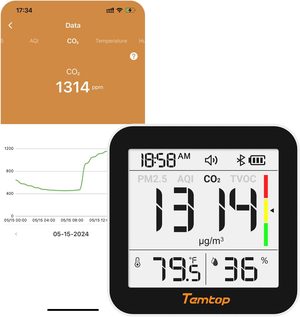
The Temtop P1000 is the air quality monitor for people who want CO2 and PM2.5 in one box, do not want an app, do not want an account, and do not want their data going to a cloud server. At roughly $80 it is the cheapest credible combination of these two metrics — everywhere else, $80 buys you a CO2-only monitor (SwitchBot, Aranet4) or a PM2.5-only monitor (Govee H5106). The P1000 covers both.
This review is based on the Temtop P1000 manufacturer specifications, Sevarg's long-term reference comparison test, and direct benchmarking notes from the broader Temtop product line. The P1000 has been on sale for several years now — the data on its real-world performance is more mature than any single 2026 review article would suggest.
Accuracy: dual sensors at a single-sensor price
The P1000 stacks two distinct sensor types in one enclosure:
- NDIR CO2 sensor — non-dispersive infrared, ±50 ppm rated accuracy across 0–5,000 ppm range. Same fundamental technology as the SwitchBot SCD40 and the Aranet4 Home, though Temtop does not publish which OEM module they use.
- Temtop QSI laser diode particle sensor — PM2.5 and PM10 via laser scattering. Manufacturer-developed using ISO-conforming calibration and PSO (Particle Size Optimization) algorithms.
Sevarg's reference comparison test against a calibrated Plantower PMS5003 array (the most widely peer-validated consumer PM sensor) found the P1000 tracked particulate spikes with good responsiveness and reasonable absolute agreement during cooking, vacuuming, and outdoor PM2.5 ingress events. The CO2 sensor responded as expected to occupancy changes and matched the SenseAir S8 reference within typical residential band tolerances.
This is not research-grade. But it is well above the "cheap meter that gives random numbers" category that defines most sub-$50 monitors on Amazon. At $80 the P1000 is in the same accuracy band as the SwitchBot CO2 (~$80) for CO2 and the Govee H5106 (~$50) for PM2.5, with the bonus of doing both in one device.
3.5-inch touchscreen and standalone use
The P1000's defining hardware feature is its 3.5-inch colour touchscreen — bigger and more readable than the segmented LCDs on the SwitchBot, Govee, and Airthings devices. The screen displays all five readouts simultaneously (PM2.5, PM10, CO2, temperature, humidity) with colour-coded health bands and configurable threshold-based audible alarms for both CO2 and PM2.5 channels.
The wall-mount option (3M strip or screw mount) means the unit can be permanent fixture in a home office or bedroom. The 6-hour battery means it can also be carried room-to-room for spot testing — "is my bedroom really at 2,000 ppm CO2 overnight?" answered in 10 minutes by placing the P1000 next to your pillow.
The no-app, no-account choice
This is the P1000's strategic positioning that other devices in this review do not offer. There is no WiFi setup. There is no Temtop account to create. There is no app to install. There is no cloud sync. There is no telemetry sent anywhere.
For privacy-conscious buyers, IT-restricted environments (schools, hospitals), classrooms where students cannot pair phones, or older users who want air quality without smart-home complexity, this is the entire value proposition. The P1000 plugs in (or runs on battery), shows you the numbers on its screen, and beeps when thresholds are crossed. Nothing else.
The cost of this choice: no automation. The P1000 cannot trigger your smart purifier, open a smart window, or notify your phone when you are away. For the SwitchBot Hub user who wants those automations, the P1000 is the wrong tool. For the user who actively does not want any of that, it is the right tool.
The honest cons
1. No smart-home integration. The biggest deliberate limitation. No WiFi, no Alexa, no Google Home, no HomeKit, no Matter, no IFTTT. If you want air quality to do something other than show on a screen, the P1000 is the wrong purchase.
2. 6-hour battery life is short for portability claims. The 3,000 mAh battery is enough for spot-testing and a workday but cannot support continuous cordless monitoring overnight. For 24/7 use the P1000 should be plugged in, which negates the portability advantage versus the Aranet4 Home (4 weeks on AA batteries).
3. No radon, no VOC on the base model. The P1000 covers CO2 + PM2.5 + PM10 only. For TVOC and HCHO step up to the Temtop M2000. For radon, only the Airthings View Plus measures it credibly. The P1000 is intentionally scoped to the two most-important everyday metrics.
vs the competition
Temtop P1000 vs Govee H5106
The Govee H5106 measures PM2.5 only at roughly $50. The P1000 measures PM2.5 + PM10 + CO2 at roughly $80. The P1000 has a bigger screen, a battery, and audible alarms; the H5106 has a smaller form factor and Govee purifier automation. Pick the H5106 if PM2.5 is the only metric you care about and you own Govee purifiers. Pick the P1000 if CO2 also matters and you want a standalone monitor.
Temtop P1000 vs SwitchBot CO2 Detector
The SwitchBot is CO2-only at roughly $80; the P1000 covers CO2 + PM2.5 + PM10 for the same price. The SwitchBot integrates with the SwitchBot ecosystem for automations; the P1000 has zero smart-home integration. Pick the SwitchBot if you own SwitchBot devices and want CO2-triggered automations. Pick the P1000 if you want both CO2 and PM2.5 in one device and do not need smart-home triggers.
Temtop P1000 vs Airthings View Plus
The View Plus measures everything the P1000 measures plus radon, TVOC, atmospheric pressure, and integrates with Alexa — for roughly four times the price (~$300 vs $80). The View Plus has a 2-year battery; the P1000 has 6 hours. Pick the P1000 if budget is the constraint and you do not need radon. Pick the View Plus if you want the complete picture and live in a radon-risk area.
Pros & cons
- CO2 + PM2.5 + PM10 in one device at sub-$100 price — unique combination
- NDIR CO2 ±50 ppm, 0–5,000 ppm range
- Temtop QSI laser PM sensor with manufacturer ISO calibration
- 3.5-inch colour touchscreen — biggest display in the category
- Configurable audible alarms for CO2 and PM2.5 thresholds independently
- No WiFi, no account, no telemetry — privacy-friendly standalone use
- No smart-home integration — no Alexa, Google, HomeKit, Matter, or IFTTT
- 6-hour battery — not enough for true cordless monitoring
- No radon, no VOC, no HCHO on the base model — need M2000 or View Plus for those
Who should NOT buy the Temtop P1000
Smart-home automation users. The P1000 has no integration of any kind. If you want CO2 readings to trigger purifiers, windows, fans, or phone alerts, the SwitchBot CO2 Detector (with Hub) or Airthings View Plus is the right purchase.
Anyone in a known radon area. The P1000 cannot see radon. Only the Airthings View Plus measures it credibly at consumer price points.
Households focused on off-gassing. If new furniture, recent renovation, fresh paint, or formaldehyde from MDF/laminate flooring is the concern, the P1000 is blind to those metrics. Step up to the Temtop M2000 (adds TVOC and HCHO) or the Airthings View Plus (adds TVOC).
Users who want a small, discreet monitor. The P1000's 3.5-inch touchscreen is its strength, but it is also visually larger than the Govee H5106 or SwitchBot CO2 Detector. For bedside or living-room placement where size matters, smaller monitors blend in better.
Our verdict — 8.5/10
The Temtop P1000 is the right answer to a specific question: "What is the cheapest air quality monitor that covers both CO2 and PM2.5 without forcing me to create an account?" At roughly $80 it has no real competition. The Govee H5106 does only PM2.5. The SwitchBot CO2 Detector does only CO2. The Airthings View Plus does everything but costs four times more. The Aranet4 Home does only CO2 and adds portability.
What loses it points is the deliberate scope: no smart-home integration, no app, no cloud, no radon, no VOC. These are not bugs, they are positioning choices. If those positioning choices match what you want, the P1000 is the easy recommendation. If you want any of those features, the P1000 will frustrate you.
Earns its place as the Best Air Quality Monitor 2026 Runner-up pick for dual-pollutant monitoring on a budget.
See Temtop P1000 on Amazon → See at Temtop →
Frequently Asked Questions
How accurate is the Temtop P1000?
The P1000 uses an NDIR CO2 sensor rated at ±50 ppm accuracy across 0–5,000 ppm and a Temtop QSI laser diode particle sensor for PM2.5 and PM10. Independent reviewers including Sevarg's long-term comparison with reference monitors found the P1000 tracks closely with calibrated PMS5003 references in normal indoor conditions. The combination of NDIR CO2 plus laser PM is unusual at this price point — the closest equivalent under $100 is the Aranet4 Home (CO2 only) or Govee H5106 (PM2.5 only).
Does the Temtop P1000 need WiFi or an app?
No. The P1000 is fully standalone with a 3.5-inch colour touchscreen, configurable audible alarms for both CO2 and PM2.5 thresholds, and on-device history. There is no app, no cloud account, no WiFi setup, and no data sharing. This makes it the right choice for users who want air quality monitoring without smart-home integration, account creation, or telemetry.
How long does the Temtop P1000 battery last?
The P1000 has a built-in 3,000 mAh rechargeable lithium battery rated at 6 hours of continuous use per full charge. This is enough for room-to-room spot testing, classroom monitoring during a school day, or moving the unit between rooms during a renovation project. For continuous 24/7 monitoring the P1000 should be plugged in via USB — the battery is designed for portability, not all-day cordless operation.
Temtop P1000 vs Temtop M2000 — which to buy?
The M2000 adds TVOC and HCHO (formaldehyde) sensors that the P1000 does not have, at roughly 20–30% higher cost. For homes with new furniture, recent renovations, or fresh paint where off-gassing matters, the M2000 is the better buy. For everyday CO2 + PM2.5 monitoring in established homes, the P1000 covers the main use cases at lower cost. Both share the same NDIR CO2 and laser PM2.5 sensor families.
Does the Temtop P1000 work with smart home systems?
No. The P1000 has no WiFi, no Bluetooth (on the standard P1000 model), no Alexa, no Google Home, no HomeKit, and no Matter integration. This is the biggest functional difference versus the SwitchBot CO2 Detector or Airthings View Plus. If you want CO2 readings to trigger smart windows, purifiers, or alerts, the P1000 is the wrong choice. If you want a standalone monitor that does not require account creation, it is the right one.
Does the Temtop P1000 measure radon or VOCs?
No radon. The P1000 measures PM2.5, PM10, CO2, temperature, and humidity. Some variants (P1000+ and the related M2000) add TVOC and formaldehyde, but the base P1000 does not. For radon, the Airthings View Plus remains the only consumer device that measures it credibly. For TVOC and formaldehyde, step up to the Temtop M2000 or LKC-1000S+.