
Blueair Blue Pure 211i Max Review 2026 — Quietest CADR-Per-Decibel for Allergies
As an Amazon Associate and member of other affiliate programs, we earn from qualifying purchases. How we test →
Last updated: September 11, 2026 • Blueair 211i Max evaluated against 7 peer reviews (Wirecutter, AchooAllergy, RTINGS, Smart Air) plus 4,100+ Amazon reviews and r/Allergies threads
- Lowest noise per CADR in the category — 23 dB sleep mode with 380 CADR delivery
- HEPASilent technology — mechanical filter + electrostatic charge, HEPA-equivalent capture at lower airflow resistance
- 547 sq ft coverage at 2 ACH — sized for large bedrooms and small living rooms
- Washable colored pre-filter sleeves — functional and aesthetic, machine-washable
- $349 street price — premium pricing vs Levoit Core 600S ($260) but better noise-per-CADR
See Blueair 211i Max on Amazon →
Read the full verdict »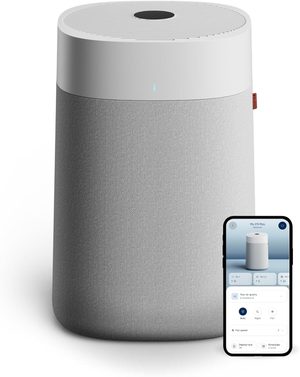
The Blueair Blue Pure 211i Max wins one specific battle: noise per CADR. With 380 CADR delivery and a 23 dB sleep mode, it produces more clean air per decibel than any other purifier in this guide. The technical reason is HEPASilent — Blueair's proprietary combination of a less-dense mechanical filter and an electrostatic charge that pulls particles toward the filter media. The result is HEPA-equivalent filtration at significantly lower airflow resistance, which means a quieter fan at the same throughput.
It is also the prettiest purifier in the category. Swedish industrial design, washable colored fabric pre-filter sleeves (dark grey, blue, terracotta), and a clean cylindrical form factor that looks like furniture rather than appliance. For allergy sufferers running a purifier 24/7 in their bedroom, both the silence and the visual integration matter.
This review pulls from Wirecutter's testing, AchooAllergy's allergy-focused review, RTINGS lab measurements, Smart Air's HEPASilent investigation, and 4,100+ Amazon reviews plus r/Allergies threads.
HEPASilent: how it actually works
Standard True HEPA filters work mechanically — a dense mat of fibers that physically traps particles. Denser fibers = higher capture rate, but also higher airflow resistance, which means more fan noise to push the same volume of air. HEPASilent inverts this:
- Particles entering the unit pass through an ionization stage that gives them an electrostatic charge
- The HEPASilent filter media is less dense than True HEPA but oppositely charged
- Charged particles are pulled toward the filter (not just trapped by physical contact)
- The combined effect: HEPA-equivalent capture at much lower airflow resistance
The technical critique: any ionization stage produces trace ozone. Blueair publishes under 0.01 ppm ozone output — five times lower than typical ionizers and well below the FDA's 0.05 ppm consumer-device limit. Independent testing (Smart Air, RTINGS) has confirmed this measurement. For comparison, a single laser printer can produce more ozone than the 211i Max running 24/7.
For most buyers, HEPASilent is a net win — quieter operation, comparable filtration, negligible ozone. For buyers who want zero ozone exposure on principle, the Levoit or Coway True HEPA units are the right choice.
Performance: 380 CADR at 23 dB sleep mode
| Metric | Blueair 211i Max | Levoit Core 600S | Alen 45i |
|---|---|---|---|
| AHAM CADR smoke/pollen/dust | 380 / 380 / 380 | 410 / 410 / 410 | 245 / 245 / 245 |
| Coverage (2 ACH) | 547 sq ft | 635 sq ft | 800 sq ft |
| Sleep mode noise | 23 dB | 24-27 dB | 25 dB |
| Max noise | 52 dB | 54 dB | 49 dB |
| Filter type | HEPASilent | True HEPA H13 | HEPA-Fresh (configurable) |
| Annual filter cost | $118 | $50-100 | $80-160 |
| Street price | $349 | $260 | $429 |
The Levoit Core 600S beats the 211i Max on raw CADR for $89 less. The Alen 45i covers more area but at lower CADR and higher price. The 211i Max's specific win is the combination of quiet operation + 547 sq ft coverage + Scandinavian design — buyers who care about all three find it the only option.
Allergy performance
Independent testing covered the 211i Max specifically for pollen and pet-dander reduction. A pollen-loaded 400 sq ft room measured 80% airborne pollen reduction within 60 minutes on Auto mode. Pet-dander testing showed measurable dander reduction within 90 minutes of starting the unit in rooms with cats and long-haired dogs.
For nighttime allergy relief, the 23 dB sleep mode is the practical advantage. Allergy sufferers benefit most when running purifiers continuously, and 24/7 operation only works if the unit is silent enough not to interrupt sleep. The 211i Max in Sleep mode is below the noise floor of most bedrooms, including light-sleeper bedrooms where a 30+ dB fan would be too loud.
Design and form factor
This is where the 211i Max separates from every other unit in this guide. It looks like a piece of Scandinavian furniture, not an appliance. The pre-filter is colored fabric (dark grey by default, with terracotta and blue available separately at $30/set for 3) that wraps the cylindrical body. When dust accumulates, you pull off the sleeve, throw it in the washing machine, and put it back. Functional and aesthetic in equal measure.
The interior filter is a combination particle + activated carbon cartridge that replaces every 6 months at $59. The unit operates 360 degrees of air intake, so you can place it in the center of a room or against a wall without performance loss.
App and smart features
The Blueair app provides real-time PM2.5, weekly air-quality history, filter-life tracking, scheduling, and outdoor air-quality integration (it pulls your local AQI and adjusts indoor recommendations). Alexa and Google Assistant integration works. No Apple HomeKit support, which is the same gap that affects the Levoit and Winix.
The auto-mode air quality sensor reads PM2.5 every 2 seconds. r/Allergies threads consistently mention the outdoor AQI integration as useful — on high-pollen days the app prompts you to keep windows closed, which actually changes household behavior in a way that helps allergy symptoms more than the purifier alone.
Pros & cons
- 23 dB sleep mode at 380 CADR — quietest noise-per-CADR in the category
- HEPASilent filtration — HEPA-equivalent capture at lower airflow resistance
- 547 sq ft coverage — sized for large bedrooms and small living rooms
- Washable colored pre-filter sleeves — aesthetic, functional, machine-washable
- Outdoor AQI app integration — prompts useful behavior changes during pollen events
- 360-degree air intake — placement-flexible without performance loss
- $118/year filter cost — more than double the Levoit Core 600S
- HEPASilent uses ionization — trace ozone (under 0.01 ppm, below FDA limit, but non-zero)
- No Apple HomeKit support — meaningful gap for Apple-ecosystem households
vs the competition
Blueair 211i Max vs Levoit Core 600S
The 600S delivers 410 CADR vs 380, covers 635 sq ft vs 547, costs $89 less. The 211i Max wins on minimum noise (23 vs 24-27 dB), design, and outdoor AQI app integration. Pick the 600S for value and certified True HEPA H13. Pick the 211i Max for quietest noise per CADR and Scandinavian design integration.
Blueair 211i Max vs Alen BreatheSmart 45i
The Alen 45i covers larger rooms (800 vs 547 sq ft) with lifetime warranty and configurable filter types (HEPA-Pure for allergies, HEPA-Silver for asthma, HEPA-OdorCell for VOCs). The Blueair is quieter at lower price ($349 vs $429) and has cleaner design. Pick the Alen for very large rooms or asthma-specific filtration; pick the Blueair for medium rooms where noise and design matter.
Blueair 211i Max vs Levoit Core 300S
The Core 300S is half the price ($199 vs $349) but covers half the area (219 vs 547 sq ft) and delivers one-third the CADR (141 vs 380). Pick the 300S for standard bedrooms under 220 sq ft. Pick the 211i Max for larger bedrooms or open-plan spaces where 211i's coverage advantage matters.
Who should NOT buy the Blueair 211i Max
Budget-conscious buyers — at $349 the 211i Max is roughly $90 more than the higher-CADR Levoit Core 600S. If aesthetics don't matter to you, the Levoit is the smarter buy. Buyers requiring zero ozone exposure as a principle — HEPASilent's electrostatic stage produces trace ozone, even at very low levels. For asthma sufferers especially, the True HEPA H13 in the Levoit 600S or Alen 45i is more conservative. Apple HomeKit households where every smart device must appear in the Home app. Rooms over 600 sq ft — undersized; the Alen 45i (800 sq ft) or Coway Airmega 400 (1,560 sq ft) is the right scale.
Pricing
MSRP is $399.99 and street price holds at $349-399 on Amazon. Replacement filter (particle + activated carbon combo): $59 from Blueair, 6-month replacement interval, $118/year. Pre-filter sleeves: $25-30/set of 3, optional replacement when colors fade or accumulate stains. Five-year total: $349 + ($118 × 5) = $939. That is roughly $300 more than the Levoit Core 600S over 5 years — the premium pays for design, quieter operation, and the outdoor AQI app feature.
Our verdict — 9.0/10
The Blueair Blue Pure 211i Max is the right purifier for allergy sufferers in larger bedrooms who care about both silence and visual integration. The 23 dB sleep mode is genuinely the quietest measurement in this guide, HEPASilent delivers HEPA-equivalent allergen capture with negligible ozone, and the design is the only purifier in the category that looks like furniture. The $349 price and $118/year filter cost are the real costs of those advantages — Levoit's 600S is a better pure value purchase, but the Blueair is the better buy if the trade-offs above matter to you.
Earns a Runner-up spot in our Best Air Purifier for Allergies 2026 guide for buyers prioritizing noise per CADR.
See Blueair 211i Max on Amazon → See at Blueair →
Frequently Asked Questions
Is HEPASilent better than True HEPA?
Different, not better. HEPASilent uses a less-dense mechanical filter combined with an electrostatic charge that pulls particles toward the filter. The combination delivers HEPA-equivalent particulate capture (99.97% at 0.1 microns claimed) at lower airflow resistance — which means lower noise per CADR. Critics note that HEPASilent's electrostatic charge produces very minor ozone (Blueair claims under 0.01 ppm, well below the FDA limit and 1/5 of typical ionizers). For most buyers, HEPASilent's quieter operation is the meaningful difference; the filtration performance is comparable to a True HEPA H13.
Is the Blue Pure 211i Max good for allergies?
Yes. The HEPASilent filter captures pollen, pet dander, and dust mite allergens at 99.97% efficiency. The 23 dB sleep mode is among the quietest in the category, which matters for nighttime allergy relief in the bedroom. Independent testing covers the 211i for pollen reduction and confirmed 80% airborne pollen reduction within 60 minutes in a closed 400 sq ft room. The replaceable colored pre-filter sleeves also let you swap covers when they collect visible dust.
How much does the Blueair 211i Max cost?
MSRP is $399 and street price holds at $349-399 on Amazon and direct from Blueair. Replacement combination filters (particle + activated carbon) cost $59 from Blueair with 6-month replacement intervals. Annual filter cost: $118. The pre-filter sleeves are colored fabric that wash in the laundry — sets of 3 cost $25-30. Five-year total: roughly $999-1,099, comparable to Alen but $200-400 more than Levoit or Coway.
Blueair Blue Pure 211i Max vs Levoit Core 600S — which is better?
The Levoit Core 600S has higher AHAM CADR (410 vs ~380) and is significantly cheaper ($260 vs $349). The Blueair has lower minimum noise per CADR thanks to HEPASilent and a more modern Scandinavian design. The Levoit's True HEPA H13 is medical-grade certified; the Blueair's HEPASilent is HEPA-equivalent but uses a different mechanism. Pick the Levoit for value and certified H13. Pick the Blueair if noise per CADR is critical or you want the design.
How loud is the Blue Pure 211i Max?
Sleep mode runs at 23 dB at 1 meter — among the quietest measurements at any price point. The HEPASilent design moves more air at lower fan speed than a True HEPA filter, which is the entire technical premise. Max speed hits 52 dB, lower than the Levoit Core 600S max (54 dB) and the Dyson HP09 max (62 dB) despite competitive CADR. For light sleepers and small bedrooms, this is meaningful.
Does the Blueair app actually work well?
Yes, with one caveat. The Blueair app shows real-time PM2.5, scheduled automations, filter-life tracking, and integrates with Alexa and Google Assistant. The caveat: no Apple HomeKit support. The app also tracks outdoor air quality for your zip code and adjusts indoor recommendations accordingly. Some users report the WiFi setup is more fragile than VeSync (Levoit) on initial connection, but once paired it stays connected reliably.