
Best Air Purifier for Allergies 2026
As an Amazon Associate and member of other affiliate programs, we earn from qualifying purchases. How we test →
Last updated: September 5, 2026 • Ranked for pollen, dust & pet dander
- Levoit Core 300S — Best for bedrooms — 24 dB sleep mode (4.7/5)
- Coway AP-1512HH Mighty — Best value — proven HEPA under $100 (4.5/5)
- Blueair Blue Pure 211i Max — Best for open-plan — HEPASilent quiet (4.6/5)
Allergies are triggered by airborne particles — pollen (15–100µm), dust mite waste (5–30µm), pet dander (0.5–100µm) and mould spores (1–30µm). A True HEPA filter captures all of these. For allergy relief, aim for at least 4 air changes per hour — which means buying a purifier rated for roughly twice your room size.
Quick Overview
| Model | Best for | Score |
|---|---|---|
| Levoit Core 300S | Best for bedrooms — 24 dB sleep mode Best Pick | ★★★★½ 4.7 |
| Coway AP-1512HH Mighty | Best value — proven HEPA under $100 Best Budget | ★★★★½ 4.5 |
| Blueair Blue Pure 211i Max | Best for open-plan — HEPASilent quiet Runner-up | ★★★★½ 4.6 |
| Winix 5500-2 | Best mid-range — PlasmaWave + HEPA Runner-up | ★★★★½ 4.4 |
| Alen BreatheSmart 45i | Best for large allergy spaces — CADR 347 Premium | ★★★★½ 4.5 |
1. Levoit Core 300S — Best for Bedrooms
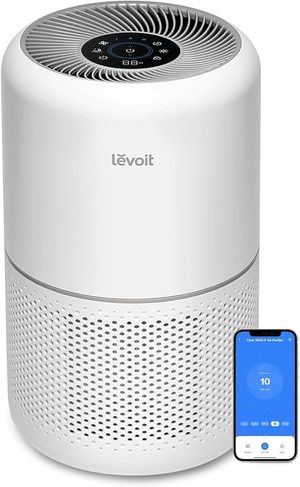
The Core 300S covers bedrooms up to 219 sq ft with H13 True HEPA filtration, running at a genuine 24 dB on sleep mode — quiet enough that you won't notice it's on. An automatic air quality sensor adjusts fan speed throughout the night, and the VeSync app allows scheduling, smart home integration with Alexa and Google Home, and air quality history tracking. Replacement filters cost under $15, making it the lowest running-cost allergy purifier for bedrooms. For allergy sufferers, running it 24/7 in the bedroom during pollen season has the greatest measurable impact on symptom reduction.
- 24 dB sleep mode — won't disturb sleep
- H13 True HEPA — 99.97% at 0.3µm
- Auto mode + Alexa / Google Home
- Under $15 filter replacements
- 219 sq ft coverage — bedrooms only
- No particle count display
→ Read our full Levoit Core 300S review (Allergy-tuned True HEPA H13)
2. Coway AP-1512HH Mighty — Best Value
→ Read our full Coway AP-1512HH Mighty review (Budget allergy filter)
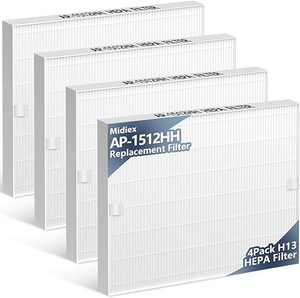
The Coway Mighty is the most consistently recommended allergy purifier under $100 — True HEPA + activated carbon + washable pre-filter for rooms up to 360 sq ft with a CADR of 246 CFM (dust). A colour-coded air quality indicator shows real-time PM2.5 levels, and three fan speeds plus auto mode keep it near-silent on low. Washable pre-filter and affordable ~$25 HEPA replacements keep year-one running costs under $35. The optional ioniser can be disabled for those sensitive to ozone.
- 246 CFM CADR — proven allergy performance
- Washable pre-filter — lowest running cost
- Colour AQI indicator at a glance
- Under $100 — best value for allergy use
- No app or smart home integration
- Ioniser produces trace ozone (can be turned off)
3. Blueair Blue Pure 211i Max — Best for Open-Plan Rooms
→ Read our full Blueair Blue Pure 211i Max review (HEPASilent particle capture)
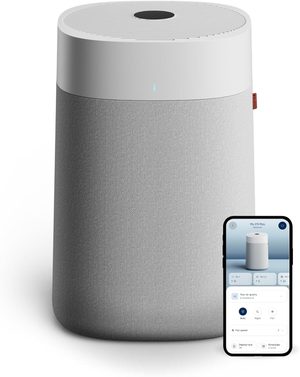
The Blue Pure 211i Max uses Blueair's HEPASilent Ultra technology — electrostatic + mechanical filtration — to deliver 250 CFM of clean air while running significantly quieter than equivalent HEPA-only units in the same coverage class. It covers 635 sq ft (59 m²) with 5 air changes per hour, and a washable fabric pre-filter (available in multiple colours) captures larger particles before the main filter. The Blueair app tracks real-time AQI, supports auto mode and voice assistants, and sends alerts when air quality drops. Best for open-plan living rooms and kitchen-diners where allergens from cooking and outdoor air need constant filtering.
- HEPASilent Ultra — quiet for 635 sq ft coverage
- 250 CFM CADR — 5 air changes/hour
- Washable pre-filter + Blueair app
- Fabric pre-filter in multiple colours
- HEPA filter replacement ~$50 every 6 months
- No VOC sensor on base model
4. Winix 5500-2 — Best Mid-Range

The Winix 5500-2 adds PlasmaWave to True HEPA + activated carbon filtration — a three-stage approach that removes particles, gases and bacteria simultaneously for rooms up to 360 sq ft with a CADR of 243 CFM. PlasmaWave generates hydroxyl radicals to neutralise mould spores, bacteria and VOCs that activated carbon alone may not fully address — useful for allergy sufferers with sensitivity to mould and chemical odours. A smart particle and odour sensor runs auto mode at 27.8 dB, and the washable pre-filter cuts filter costs to around $25/year. At ~$150 it offers genuinely more odour-fighting capability than the Coway at a modest premium.
- HEPA + carbon + PlasmaWave — three-stage filtration
- Mould spore + bacteria neutralisation via PlasmaWave
- Auto mode at 27.8 dB
- Washable pre-filter — ~$25/year running cost
- PlasmaWave generates trace ozone (can be disabled)
- No WiFi or app
→ Read our full Winix 5500-2 review (True HEPA + carbon for allergens)
5. Alen BreatheSmart 45i — Best for Serious Allergy Sufferers
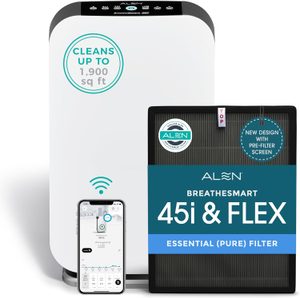
The BreatheSmart 45i covers rooms up to 800 sq ft with a True H13 HEPA filter and CADR of 347 CFM — one of the highest in its class — making it suitable for large master bedrooms and combined living spaces without noise compromise. HEPA-OdorCell filtration uses a proprietary activated charcoal layer that targets pet dander proteins and chemical VOCs more aggressively than standard activated carbon panels. A built-in air quality sensor drives auto mode, and it runs at 49 dB at max speed — quiet for its output level. Alen backs this with a lifetime warranty, making it a long-term investment for severe allergy sufferers.
- 347 CFM CADR — covers 800 sq ft
- HEPA-OdorCell — enhanced pet dander + VOC removal
- Lifetime warranty — no replacement purifier cost
- Built-in auto mode from air quality sensor
- ~$450 — premium price point
- Proprietary filter replacements (~$80)
→ Read our full Alen BreatheSmart 45i review (Lifetime warranty, premium allergy filter)
The Right Way to Use a Purifier for Allergies
Run it continuously
An air purifier only helps if it's actually running. In allergy season, run it 24/7 in your bedroom on auto or medium speed. The electricity cost is roughly £1–3/week.
Place it correctly
Position the purifier near your breathing zone — close to your bed or desk, not in a corner. Keep it at least 30cm from walls for proper airflow. For bedrooms: 1–1.5m from the pillow.
Change filters on schedule
A clogged HEPA filter loses effectiveness significantly after 6 months of continuous use. Follow the manufacturer's schedule — skipping filter changes is the most common reason purifiers stop working for allergy sufferers.
Size for 4+ air changes per hour
Manufacturer room-size claims are usually based on 2 air changes per hour. For allergy relief, you need at least 4 — which means buying a purifier rated for twice your actual room size, or one with an exceptionally high CADR.
Verdict
For the bedroom, the Levoit Core 300S is outstanding: genuinely silent, effective H13 HEPA and affordable running costs. For a living room or open plan, step up to the Blueair 211i Max for its HEPASilent quiet operation. The Coway Mighty is the best choice under $100 with no sacrifices on HEPA quality. For severe allergies in large rooms, the Alen BreatheSmart 45i with its lifetime warranty is the long-term investment worth making.
Frequently Asked Questions
Are air purifiers effective for hay fever and seasonal allergies?
Yes significantly. True HEPA filters (Levoit Core 300S, Coway AP-1512HH Mighty) capture 99.97% of pollen — sized 10-100 microns, easily filtered. Running purifiers in bedroom (closed windows during pollen season) gives night-time relief from outdoor allergens. The Blueair Blue Pure 211i Max has superior pollen filtration at lower noise.
Which is better for pet allergies — air purifier or pet shampoo?
Both, used together. Air purifiers (Levoit Core 300S) remove airborne dander — the primary allergen source. Regular pet bathing reduces dander production. Vacuum with HEPA filter for embedded dander in carpets. For severe pet allergies, a combination approach reduces allergen exposure by 80-90%. Air purifier alone helps significantly — pet bath alone has limited daily impact.
Can air purifiers help with dust mite allergies?
Partially. Dust mites themselves live in bedding and upholstery (where they don't become airborne). However, dust mite allergens (proteins from waste) DO become airborne — air purifiers capture these. The strategy: HEPA air purifier (Coway AP-1512HH Mighty) + dust mite-proof bedding covers + washing bedding weekly at 60°C+. Combined approach significantly reduces symptoms.
How fast do air purifiers help allergy symptoms?
Within hours for acute relief, days for sustained improvement. Running a HEPA purifier in the bedroom overnight typically improves morning congestion within 1-2 nights. For full benefit, 24-48 hours of continuous operation is needed to clear airborne particulates and maintain clean air. Sleep with bedroom door closed during operation.