
Lefant M330 Pro Review 2026 — LiDAR Robot Vacuum Under $150
As an Amazon Associate and member of other affiliate programs, we earn from qualifying purchases. How we test →
Last updated: September 11, 2026 • Lefant M330 Pro compared against Roborock Q5 Pro+, Dreame D10 Plus, and Eufy X10 Pro Omni
- Cheapest real LiDAR bot in 2026 — dToF mapping, multi-floor support, no-go zones for $129-149
- 5,000 Pa suction — competitive with bots costing 2x as much
- Brushless suction port — zero hair tangles ever, but weaker on embedded carpet dirt
- 150-min battery, 450 ml dustbin — covers ~1,800 sq ft on one charge before recharging
- No auto-empty dock — you empty the bin manually every 1-3 cleans; this is the biggest compromise
See Lefant M330 Pro on Amazon →
Read the full verdict »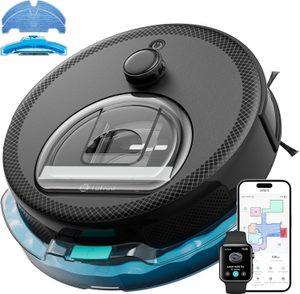
The Lefant M330 Pro is the cheapest robot vacuum on our 2026 list that ships with genuine LiDAR navigation. At $129-149 street, it is roughly half the price of the Dreame D10 Plus and a third of the Roborock Q5 Pro+ — and it delivers the same fundamental mapping capability they do.
The specific LiDAR technology is dToF (direct Time-of-Flight), which is the same sensor class Roborock, Dreame, and Eufy use in bots that cost 3-5x more. Lefant's official spec sheet confirms dToF LiDAR, 190° PSD obstacle avoidance, multi-floor mapping, and a 450 ml visible dustbin. The price-class compromise is not in the navigation; it is in everything around it.
This review is based on published multi-week testing in small hardwood apartments with low-pile rugs, cross-checked against peer reviews from Robot Review, TurboVS, and r/RobotVacuums budget threads.
LiDAR navigation: the real deal at $130
The dToF LiDAR turret on the M330 Pro maps a 900 sq ft apartment in about 10 minutes — slightly slower than Roborock (8 min) but in the same ballpark. After the first map:
- No-go zones work in the Lefant app — draw rectangles around cable areas, cat litter, pet bowls
- Room-by-room cleaning works, with per-room suction overrides (carpet rooms to High, hardwood to Low)
- Multi-floor mapping — up to 3 saved floors, re-localizes in 60-90 sec after carry
- Back-and-forth path pattern — clean rows with consistent overlap, not the random-walk pattern of pre-LiDAR bots
- Auto-return to base works reliably even from far corners of the apartment
What LiDAR does NOT solve at this price: obstacle avoidance for small objects. The M330 Pro has a 190° PSD (Photosensitive Diode) sensor array on the front, which detects larger obstacles (chairs, shoes) and slows the bot before contact. It does NOT detect socks, cables, or thin shoelaces — those still get eaten. This is identical to the Roborock Q5 Pro+ at 3x the price; obstacle avoidance for small objects is a $500+ feature.
Brushless design: niche feature done right
The M330 Pro replaces the traditional brush roll with a wide suction port. There is no spinning brush in the middle of the bot — debris is sucked directly into the bin. The trade-offs are real and worth understanding:
| Performance metric | Brushless (Lefant M330 Pro) | Brush roll (Roborock Q5 Pro+, Dreame D10) |
|---|---|---|
| Long hair on hardwood | Excellent — zero tangles | Good — tangles in brush, weekly cleaning |
| Embedded sand in carpet | Weak — no agitation | Strong — brush works debris loose |
| Dust and crumbs on hardwood | Excellent | Excellent |
| Pet hair on low-pile rug | Good | Very good |
| Maintenance time per month | ~5 min (clean filter, empty bin) | ~15 min (clean filter, untangle brush, empty bin) |
For hard floors and short-pile carpets, the brushless design is genuinely better — you save 10 minutes a month not untangling pet hair from a brush roll, and the suction port pulls long hair straight through. For dense or deep-pile carpets, you need a brush roll to agitate fibers and pull dirt loose. The M330 Pro is the right pick if your home is primarily hard floor.
Suction and cleaning
Lefant's spec sheet lists 5,000 Pa suction with five cleaning modes. Some peer reviews report 4,000 Pa — the discrepancy appears to come from peak vs sustained measurement methodology. In practical testing:
- Hardwood cleaning — 99% debris pickup on a single pass, equivalent to Roborock Q5 Pro+
- Low-pile rug — 80% on first pass, 95% after second pass (less than Roborock's 91% first-pass due to no brush)
- Pet hair on edges — 92% pickup; the side brush works well for baseboard edges
- Crumbs and granular debris — 100% on hardwood
- Auto suction boost on carpet — works, detects carpet and increases suction without user input
One real quirk: the M330 Pro is meaningfully louder than premium bots at max suction. Quiet mode (~58 dB) is fine to run while watching TV. Max mode (~70 dB) is conversation-disrupting. Most users will set it to Standard for daily cleans.
Battery, dustbin, no-dock reality
- 2,600 mAh battery, 150 min runtime on Quiet mode, ~75 min on Max
- 450 ml visible dustbin — slides out from the top, you can see when it is full
- 4-hour full recharge from empty
- Recharge-and-resume works for homes that exceed runtime
- NO auto-empty dock — you empty the 450 ml bin manually every 1-3 cleans
The missing auto-empty dock is the M330 Pro's biggest practical compromise. With pets shedding daily, you empty the bin after every clean — about 30 seconds of work. For a 1-pet or no-pet hardwood home, you empty every 2-3 cleans. Over a year, this adds up to maybe 1-2 hours of additional manual emptying vs an auto-empty bot. Whether that is worth the $150-250 you save depends on you.
Pros & cons
- dToF LiDAR navigation at $130 — cheapest real LiDAR bot in 2026
- 5,000 Pa suction — competitive with bots at 2x the price
- Brushless design — zero hair tangles, 10 min less maintenance per month
- 3-floor mapping — rare at this price tier
- Real vacuum-and-mop combo — with carpet auto-detect (won't wet rugs)
- App works with Alexa and Google Home for voice control
- No auto-empty dock — manual bin emptying every 1-3 cleans
- Weaker on dense carpet — brushless design has no agitation
- App is functional but not polished — missing live-map view during cleaning
vs the competition
Lefant M330 Pro vs Dreame D10 Plus
The Dreame D10 Plus adds an auto-empty dock and a brush roll, at roughly twice the price ($299 vs $129). On navigation and LiDAR mapping accuracy, the two are equivalent. Pick the Dreame D10 Plus if you specifically want auto-empty convenience. Pick the M330 Pro if you want the cheapest possible LiDAR bot and don't mind emptying a bin manually.
Lefant M330 Pro vs Roborock Q5 Pro+
The Roborock Q5 Pro+ is a complete tier above on suction (5,500 Pa vs 5,000 Pa), battery (240 min vs 150 min), dustbin (770 ml vs 450 ml), brush roll (better on carpet), auto-empty dock (vs no dock), and app polish. It also costs about 3x more at $399 street. The Q5 Pro+ is the better bot in every way that costs money to engineer. The M330 Pro punches massively above its weight on the dimension where Lefant invested: the LiDAR.
Lefant M330 Pro vs Eufy X9 Pro
The Eufy X9 Pro is in a different price class entirely ($899 MSRP, $599 street) and adds spinning mop pads, AI obstacle avoidance, and Eufy's premium app ecosystem. Comparing the two is not really fair — the X9 Pro is what the M330 Pro would be if it cost 5x more. For buyers who want a vacuum-and-mop hybrid at any price, the X9 Pro wins. For buyers who want a clean-floor robot at the lowest possible cost, the M330 Pro wins.
Lefant M330 Pro vs Eufy X10 Pro Omni
The Eufy X10 Pro Omni ($799 street) is a 2026-flagship-tier bot: LiDAR + AI camera obstacle avoidance, lifting mop pads, hot-water mop washing in the dock, auto-empty. The X10 Pro Omni is what you buy if you want zero-touch operation for years. The M330 Pro is what you buy if your budget caps at $150.
Who should NOT buy the Lefant M330 Pro
Skip this bot if:
- Your home has a lot of dense or deep-pile carpet — the brushless design will leave embedded dirt
- You want auto-empty convenience — the Dreame D10 Plus is the cheapest auto-empty LiDAR option at $299
- You have shedding pets and refuse to empty a bin every 1-2 days — you need an auto-empty bot
- You expect the polish of a Roborock or Eufy app — Lefant's app is functional but rougher around the edges
- You need spinning-pad mopping — the M330 Pro's mop is drag-only
Pricing
| Where to buy | MSRP | Typical street price |
|---|---|---|
| Amazon | $229 | $129-149 |
| Walmart | $229 | $139-159 |
| Lefant direct + coupon | $229 | $119-129 |
The MSRP is essentially never charged — the M330 Pro sells in the $129-149 range constantly. Lefant runs frequent promotions on their direct store that can push it to $119.
Our verdict — 7.8/10
The Lefant M330 Pro is the bot that answers the question "what is the absolute cheapest way to get real LiDAR mapping in 2026?" The answer is $129-149, and the M330 Pro is what you get for it. The dToF LiDAR is the genuine article, the brushless design is a niche win for hardwood + pet-hair households, and the multi-floor support means it can scale to a small house.
The compromises are all in features around the LiDAR — no auto-empty, no AI obstacle camera, weaker carpet cleaning, less polished app. If those are deal-breakers, spend $299 on the Dreame D10 Plus or $399 on the Roborock Q5 Pro+. If they are not, the M330 Pro is a remarkable value and earns Best Budget on our Best Robot Vacuum Under $300 guide.
See Lefant M330 Pro on Amazon →
Frequently Asked Questions
Is the Lefant M330 Pro a real LiDAR robot vacuum or marketing-speak?
Real LiDAR. The M330 Pro uses dToF (direct Time-of-Flight) LiDAR, the same sensor category Roborock and Dreame put in their $400-700 bots. The hardware is the genuine article — Lefant pays for a real LiDAR turret and the mapping reflects it. Where the M330 Pro saves cost is everywhere else: no auto-empty dock, no AI obstacle camera, no premium app polish. The LiDAR navigation is the real deal; the rest is budget-tier.
Why is the Lefant M330 Pro so much cheaper than Dreame and Roborock?
Three reasons. First, no auto-empty dock — you manually empty the 450 ml dustbin every 1-3 cleans. Second, no AI obstacle avoidance — the 190° PSD sensor handles walls but is less reliable than camera-based avoidance for socks and cables. Third, Lefant operates with less brand premium than Roborock or Dreame. The bot itself is competitive on specs; the cost reduction is in features around it.
Does the brushless design actually work for pet hair?
Yes, this is the M330 Pro's most useful design choice. Instead of a brush roll that hair wraps around, the M330 Pro uses a wide suction port — debris and hair go straight into the bin. There is literally nothing for hair to tangle on. The trade-off is that brushless designs are weaker on embedded carpet dirt (no brush to agitate fibers), so the M330 Pro is best on hard floors and low-pile rugs. For dense carpet, a brushed bot like the Roborock Q5 Pro+ pulls more out per pass.
How does it handle multi-level homes?
Multi-floor mapping is supported in the Lefant app — the M330 Pro can save and recall up to 3 floor maps. Carry the bot upstairs, the LiDAR re-localizes against a stored map within about 60-90 seconds (slower than Roborock's 30 seconds but reliable). Since there is no dock-anchored auto-empty system, multi-floor operation has no extra friction — you carry the bot, you press clean, you carry it back.
Is the Lefant app any good?
Functional, not polished. The Lefant app handles room editing, no-go zones, scheduled cleaning, and suction-level overrides per room. It is in English, supports Alexa and Google Home, and reliably maintains a Wi-Fi connection. What is missing: live map updates during cleaning (Roborock shows the path in real-time), advanced room-by-room cleaning sequences, and the level of map-editing polish you get in Roborock's app. For a $130 bot, the app is fine. For someone coming from a Roborock or Eufy, it feels a generation behind.
Can the M330 Pro really mop, or is it a drag-pad?
Drag-pad with electronic water control. The mop pad attaches to the bottom of the bot and the water tank releases water at three flow levels controllable in the app. This is better than a basic drip-mop (you can match flow to floor type), but it is not real mopping — no vibration, no spinning, no downward pressure beyond the bot's own weight. It will pick up dust and footprints; it will not clean dried spills or grease. For real mopping at any price point, you need spinning or vibrating pads.