
Best Beginner Drone 2026 — Top 5 Under $550 Compared
As an Amazon Associate and member of other affiliate programs, we earn from qualifying purchases. How we test →
Last updated: September 3, 2026 • 5 drones compared
- DJI Mini 4K — Best overall: a real 3-axis gimbal at $269 (4.7/5)
- Potensic Atom 2 — Best if you will keep flying past the first season (4.6/5)
- Holy Stone HS360S — Cheapest drone here that is not a toy (4.0/5)
The most common first-drone mistake is spending too little rather than too much. Below roughly $150 the market is full of aircraft without GPS — they drift with the wind, have no reliable return-to-home, and a fair number of them are lost on an early flight. The floor for something that behaves predictably sits around $180, and from there to about $550 you are buying better cameras rather than better safety.
Every drone on this page has GPS with return-to-home and either a mechanical gimbal or a genuinely competent stabilisation system. Four of the five weigh under 250 grams, which keeps recreational flying free of FAA registration in the US. We have ordered them by how well they serve someone who has not flown before — not by specification.
Quick Overview
| Drone | Price | Stabilisation | Best for | Score |
|---|---|---|---|---|
| DJI Mini 4K | $269 | 3-axis gimbal | Best overall Best Pick | ★★★★½ 4.7 |
| Potensic Atom 2 | $520 | 3-axis gimbal | Best step-up Runner-up | ★★★★½ 4.6 |
| Ruko F11PRO 2 | $300 | 3-axis gimbal | Longest flight time | ★★★★½ 4.3 |
| HoverAir X1 | $269 | Electronic + enclosed | Filming yourself | ★★★★☆ 4.2 |
| Holy Stone HS360S | $180 | Electronic | Lowest sensible price Best Value | ★★★★☆ 4.0 |
1. DJI Mini 4K — Best Overall
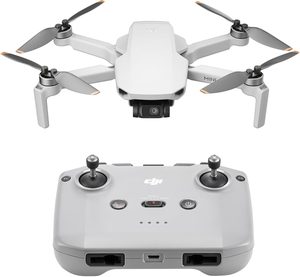
The Mini 4K is the cheapest way to get DJI's flight software, and that software is the reason to buy it. It shoots 4K on a proper 3-axis mechanical gimbal, weighs under 249 grams, holds position steadily in wind that unsettles cheaper drones, and returns home automatically on low battery or signal loss. Rated flight time is 31 minutes with 10 km transmission. At $269 it undercuts most of its direct competition while flying more confidently than any of it. What you give up is the newer sensor and obstacle sensing of the pricier Minis — this one will not avoid a tree for you, so it rewards a pilot who looks where they are going.
- 3-axis mechanical gimbal at $269 — rare at this price
- Under 249 g — no recreational registration required in the US
- DJI's flight software: the most assured position-holding in this group
- 31-minute rated flight time and 10 km transmission
- No obstacle sensing — it will not avoid anything for you
- Sold on Amazon by a third-party reseller, not DJI
2. Potensic Atom 2 — Best Step-Up
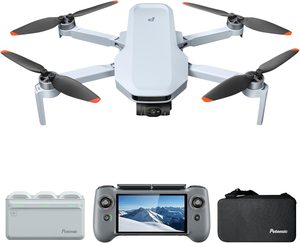
The Atom 2 is the drone to buy if you already suspect this will not be a passing interest. It records 4K on a 3-axis mechanical gimbal, shoots 8K stills, adds AI subject tracking and vertical capture that the Mini 4K lacks, and the Fly More Combo ships with enough batteries for 96 minutes across the set. It is also the only drone here sold directly by its manufacturer and shipped by Amazon, which means a stable price, ordinary warranty handling and stock that does not vanish. At $520 it costs nearly twice the Mini 4K, and the honest framing is that you are paying for features you will grow into rather than ones you need on week one.
- Sold by Potensic, shipped by Amazon — stable price and normal warranty
- AI subject tracking and vertical capture for social formats
- 96 minutes total flight across the Fly More Combo batteries
- Under 250 g with a 3-axis mechanical gimbal
- Nearly double the Mini 4K for capability a beginner may not use yet
- Smaller accessory ecosystem and community than DJI
3. Ruko F11PRO 2 — Longest Flight Time
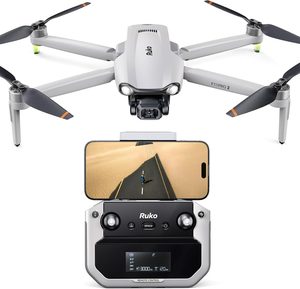
The F11PRO 2 competes on flying time and on gimbal quality rather than on brand. It ships with two batteries for a combined 70 minutes, carries a 3-axis mechanical stabiliser, and records 4K/30fps with GPS return-to-home and a beginner-friendly control layout. Like the Potensic, it is sold directly by its manufacturer on Amazon, so the buying experience is straightforward. It is heavier than the sub-250 gram drones here, which means FAA registration even for recreational flying — the trade for a larger airframe that handles wind more calmly than its price suggests.
- Two batteries included — 70 minutes combined flight time
- 3-axis mechanical gimbal at $300
- Sold and shipped by Ruko directly, with normal warranty support
- Larger airframe handles wind better than lighter drones
- Over 250 g — FAA registration required even recreationally
- Camera and software are a clear step behind DJI and Potensic
4. HoverAir X1 — Best for Filming Yourself
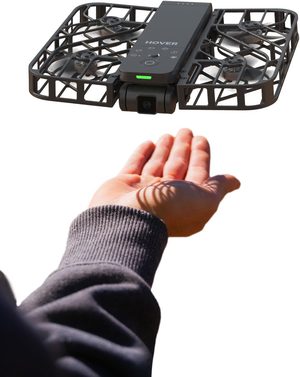
The X1 answers a different question from the rest of this list. There is no controller and no piloting: it launches from an open palm, flies a chosen path — orbit, follow, zoom out — and lands back in your hand. The enclosed frame makes it safe around people, which is precisely where a conventional drone is not. For someone whose actual goal is footage of themselves running, climbing or cycling, this removes every barrier that makes drones annoying. Judge it as a flying camera rather than a drone: there is no manual control, range is short, and the fixed automated paths are the whole product. At $269 it does that one job better than anything else here.
- Palm launch and landing — no controller, no piloting skill needed
- Enclosed propellers — safe to fly close to people
- Under 250 g — no recreational registration required in the US
- Genuinely the fastest setup-to-footage of any drone on this page
- No manual flying — you are limited to the automated paths
- Short range; unsuitable for landscape or exploration work
5. Holy Stone HS360S — Lowest Sensible Price
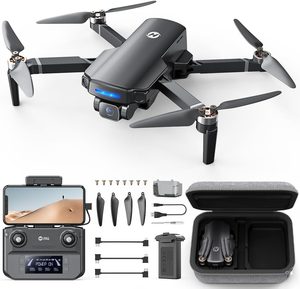
The HS360S marks the floor of the sensible market. At $180 it still includes the things that actually matter on a first drone — GPS with smart return-to-home, brushless motors that outlast the brushed motors in cheaper toys, follow-me tracking and a 10,000-foot control range — in a 249 gram folding airframe. It is sold by Holy Stone directly. The compromise is stabilisation: this is electronic rather than a mechanical gimbal, so footage is visibly less smooth than the drones above and degrades in wind. Buy it if the budget is firm or if you want to learn on something you will not mourn; step up to the Mini 4K if the footage matters.
- GPS with smart return-to-home at $180 — the key safety feature
- Brushless motors — significantly longer-lived than budget brushed motors
- 249 g folding airframe, no recreational registration required
- Sold directly by Holy Stone with normal warranty support
- Electronic stabilisation only — visibly less smooth than a gimbal
- Footage quality drops off noticeably in wind
What to Look for in a First Drone
GPS is the feature that stops you losing the drone
This is the single specification that separates a drone from a toy. GPS lets the aircraft hold position when you release the sticks, and it powers return-to-home when the battery runs low or the signal drops. Without it, a gust carries the drone away and there is no recovery. Never buy a first drone without it, whatever else the listing promises.
Mechanical gimbal versus electronic stabilisation
A 3-axis mechanical gimbal physically counter-rotates the camera against the drone's movement, producing smooth footage without touching image quality. Electronic stabilisation crops into the frame and corrects in software, costing resolution and struggling once there is wind. Three of the five drones here have a real gimbal; it is the clearest dividing line between a capable beginner drone and a cheap one.
The 250-gram line
In the US, a drone under 250 grams flown purely recreationally needs no FAA registration. Every drone here except the Ruko sits under that limit. It is worth understanding what the exemption does not cover: airspace rules are identical at every weight, and any commercial use — including monetised video — requires registration and a Part 107 certificate no matter how light the aircraft is.
Buy the second battery, not the better drone
A single battery gives 20 to 30 real-world minutes, and that is one short session. Beginners consistently get more value from a Fly More style bundle than from spending the same money moving up a model. Rated flight times also assume still air and steady cruise — plan for roughly three-quarters of the number on the box once you add wind, climbing and hovering while you frame a shot.
Our Verdict
The DJI Mini 4K is the right first drone for most people: a real mechanical gimbal, DJI's flight software and sub-250 gram weight for $269 is a combination nothing else here matches on value. If you already know you will still be flying next year, the Potensic Atom 2 is worth the extra and is sold far more cleanly than any DJI listing. Buyers who want maximum air time for the money should look at the Ruko F11PRO 2 and accept the registration. The HoverAir X1 is not really a competitor to the others — it is the best choice only if the footage is of you. And if $180 is the budget, the Holy Stone HS360S is the cheapest drone here we would still call a real one.