
Best FPV Drone 2026 — Top 5 Compared for Every Skill Level
As an Amazon Associate and member of other affiliate programs, we earn from qualifying purchases. How we test →
Last updated: September 3, 2026 • 5 FPV drones compared
- DJI Avata 2 — Best overall: cinematic FPV with the shortest learning curve (4.8/5)
- DJI Neo 2 — Best first FPV drone, no simulator needed (4.5/5)
- BetaFPV Cetus Pro — Best cheap way to find out if you like FPV (4.4/5)
FPV drones split into two worlds that barely overlap. On one side sit DJI's closed systems: buy one box, put on the goggles, fly the same afternoon, and get footage that is immediately usable. On the other sit traditional FPV kits from BetaFPV, EMAX and others — cheaper, repairable, endlessly modifiable, and genuinely difficult to fly until you have put in the hours.
Which world you belong in depends on one question: do you want the footage, or do you want the flying? Both are legitimate answers, and they lead to completely different purchases. This comparison covers both, with the traditional kits ranked by how forgiving they are to learn on rather than by top speed.
Quick Overview
| Drone | Type | Price | Best for | Score |
|---|---|---|---|---|
| DJI Avata 2 | Cinewhoop | $849 | Cinematic FPV Best Pick | ★★★★☆ 4.8 |
| DJI Neo 2 | Hybrid | $599 | Easiest entry Runner-up | ★★★★½ 4.5 |
| BetaFPV Cetus Pro | Whoop kit | $211 | First kit Best Value | ★★★★½ 4.4 |
| BetaFPV Aquila20 | RTF kit | $300 | Traditional FPV | ★★★★½ 4.3 |
| EMAX Tinyhawk 3 | RTF kit | $290 | Freestyle practice | ★★★★☆ 4.2 |
1. DJI Avata 2 — Best Overall
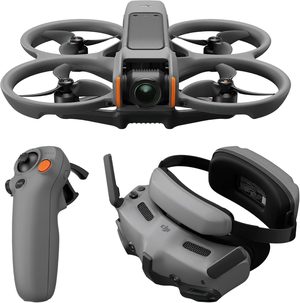
The Avata 2 is the drone that made cinematic FPV accessible to people who are not FPV pilots. It ships as one box — aircraft, Goggles 3 and the RC Motion 3 controller — and records 4K/60fps across a 155° field of view with built-in ducted propeller guards. The motion controller is the important part: tilt to steer, squeeze to accelerate, and the drone handles attitude itself, which means usable dive and chase footage on the first afternoon rather than after a month in a simulator. Manual acro mode is there when you want to progress into it. The prop guards make it safe to fly indoors and close to objects, which is the shot FPV exists for.
- Motion controller — flyable on day one, no simulator required
- 4K/60fps at 155° FOV with built-in propeller guards
- Everything in one box: drone, Goggles 3, controller
- Manual acro mode available as skill develops
- Closed system — no repairs or upgrades outside DJI parts
- Sold on Amazon only by third-party resellers, above DJI's own price
2. DJI Neo 2 — Easiest Entry
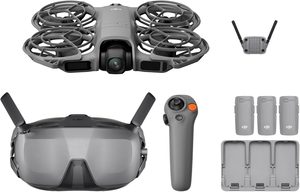
The Neo 2 sits between a self-flying camera and a true FPV drone, and that is exactly its appeal as a first purchase. The Motion Fly More Combo bundles Goggles N3 and the RC Motion 3 controller with three batteries, so the full FPV experience is there — but the drone will also take off from your palm and fly automated tracking shots with no goggles at all. That dual nature means it stays useful on days when you do not want to concentrate. It shoots 4K, and at $599 it is the cheapest route into DJI's FPV ecosystem. Range and image quality sit below the Avata 2, which is the trade for the price and the simplicity.
- Works as both an FPV drone and a hands-free tracking camera
- Goggles, motion controller and three batteries in the combo
- Cheapest entry into DJI's FPV system at $599
- Palm takeoff — no controller needed for automated shots
- Shorter range and weaker image quality than the Avata 2
- Third-party reseller only on Amazon, as with all DJI listings
3. BetaFPV Cetus Pro — Best First Kit
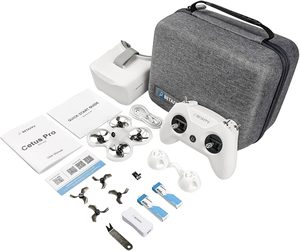
The Cetus Pro is the standard answer to "how do I find out whether I actually like FPV without spending real money". At $211 the kit includes the quad, the LiteRadio 2 SE transmitter and VR02 goggles, and it runs three flight modes so you can start in stabilised angle mode and step up to manual as confidence grows. Turtle mode flips it upright after a crash without you walking over to it — a small feature that matters enormously when learning indoors. It is a tiny indoor whoop, so the camera is for flying, not for footage, and outdoor use needs near-still air. As a training tool that survives beginner mistakes, nothing at this price does the job better.
- Complete kit at $211 — quad, transmitter and goggles included
- Three flight modes — progress from stabilised to full manual
- Turtle mode self-rights after a crash
- Durable enough for indoor learning; parts are cheap and available
- Analogue camera for piloting only — not a footage drone
- Too light for anything but calm outdoor conditions
4. BetaFPV Aquila20 — Best Traditional FPV
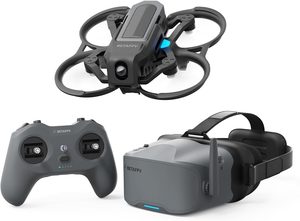
The Aquila20 is the step up from a training whoop into real FPV without moving to a DJI closed system. It is a 2S ready-to-fly kit with the LiteRadio 4 SE transmitter and VR04 goggles, and it adds DVR recording so you can review flights afterwards — the single most useful learning tool once you are past the basics. Three flight modes cover the same stabilised-to-manual progression as the Cetus Pro, but the extra power makes it genuinely usable outdoors rather than confined to a living room. This is the drone for someone who has decided FPV is for them and wants a platform they can repair, tune and eventually outgrow.
- DVR recording built in — review your own flights to improve
- 2S power system — genuinely flyable outdoors, unlike 1S whoops
- Complete RTF kit with LiteRadio 4 SE and VR04 goggles
- Fully repairable with standard, inexpensive FPV parts
- Analogue video — lower quality than any DJI digital system
- Assumes you will learn to tune and repair it yourself
5. EMAX Tinyhawk 3 — Best for Freestyle Practice
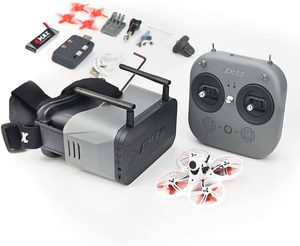
The Tinyhawk line has been the default freestyle trainer for years, and the third generation continues that. The RTF kit arrives with transmitter and goggles bound and ready, and the airframe is built to be crashed repeatedly and put back together — the frame and props are cheap and universally stocked. Compared with the Aquila20 it leans towards agility over stability, which makes it a better platform for learning flips, rolls and power loops and a worse one for calm cinematic lines. Choose it if the goal is to fly well rather than to film; choose the Aquila20 if you want a gentler progression.
- Built to crash — cheap, universally available spare parts
- Agile airframe well suited to learning freestyle manoeuvres
- RTF kit arrives bound and ready with goggles and transmitter
- Large community and years of tuning guides behind the platform
- Less stable than the Aquila20 — steeper initial learning curve
- Analogue video, and the camera is for flying rather than footage
What to Look for in an FPV Drone
Closed system or traditional kit
This is the decision everything else follows from. DJI's Avata 2 and Neo 2 are sealed systems: excellent digital video, minimal setup, and no meaningful repair path — a hard crash means a service quote. Traditional kits from BetaFPV and EMAX cost a third as much, use analogue video that looks noticeably worse, and are designed to be rebuilt on a kitchen table for the price of a takeaway. Neither is better in the abstract. If the output is the point, buy DJI. If the flying is the point, buy a kit.
Ready-to-fly means ready to fly, not ready to be good
An RTF kit includes the drone, a transmitter and goggles, bound and configured. What it does not include is the skill. In stabilised angle mode the drone self-levels when you release the sticks and is genuinely approachable. In manual mode it holds nothing, and the gap between those two modes is where every beginner underestimates the commitment. Budget a few hours in a simulator before the first manual flight — the software costs a few dollars and turns crashes into resets.
Ducted guards versus open props
Cinewhoops like the Avata 2 enclose their propellers, which lets them fly close to people, through doorways and around objects — the shots that make FPV worth doing. The ducts cost weight and flight time, and they cap top speed. Open-prop freestyle quads are faster and more efficient but genuinely dangerous near people. For a first drone, ducted is the sane choice.
Buying DJI in the US: check the seller
As with the rest of the DJI range, neither the Avata 2 nor the Neo 2 is sold on Amazon US by DJI itself. Both listings belong to independent resellers, which means prices above DJI's own MSRP, variable stock and warranty handled by the seller rather than the manufacturer. We link both routes above so you can compare before buying. The BetaFPV and EMAX kits do not have this problem.
Our Verdict
The DJI Avata 2 is the best FPV drone for most people, because it delivers the footage FPV is famous for without demanding the months of practice that footage normally costs. Anyone who wants the same idea for less, or who values a drone that also works hands-free, should take the DJI Neo 2. If you are not yet sure FPV is for you, spend $211 on the BetaFPV Cetus Pro and find out — it is the cheapest honest answer to that question. Pilots who already know they want the traditional route should choose between the BetaFPV Aquila20 for a gentler outdoor progression and the EMAX Tinyhawk 3 for freestyle practice.