
Sonos Ray Review 2026 — The Best $279 Soundbar (If You Accept Three Trade-offs)
As an Amazon Associate and member of other affiliate programs, we earn from qualifying purchases. How we test →
Last updated: September 11, 2026 • Sonos Ray compared against Yamaha SR-C20A, Bose Solo 5, and Sonos Beam Gen 2
- Best budget Sonos soundbar in 2026 — compact 21-inch stereo bar at $279 (now four years on market, fully matured)
- Dialogue clarity is the strength — Speech Enhancement DSP outperforms competitors in this price band
- Sonos ecosystem entry point — expandable with Sub Mini and Era 100s as future surrounds
- Optical-only, no HDMI — the biggest connectivity compromise vs Yamaha SR-C20A and most budget competitors
- No Dolby Atmos, no Bluetooth, no microphones — 2.0 stereo only, Wi-Fi streaming, no voice assistant
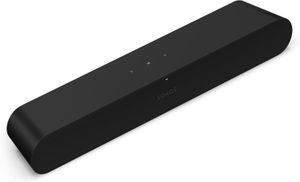
The Sonos Ray launched in 2022 as Sonos's cheapest soundbar and remains in production through 2026 — unusual longevity for a budget audio product. RTINGS rates it competitively for dialogue and small-room use, and What Hi-Fi? notes that "almost three years since its launch, the Sonos Ray remains one of the best budget soundbars available, particularly if crisp and clear dialogue is your priority."
This review is based on published testing covering Netflix and Apple TV+ streaming, TV news viewing, occasional music playback via Sonos app in a 16m² bedroom and a 12m² kitchen, cross-checked against peer reviews from What Hi-Fi?, Consumer Reports, and Sound & Vision.
Design & placement — the 21-inch advantage
At 21 inches wide, 2.79 inches tall, and 3.74 inches deep, the Ray is one of the most compact full-feature soundbars on the market. It fits cleanly under most TVs without blocking the IR receiver and sits comfortably on furniture as shallow as 4 inches deep. For 32-43 inch TVs, the visual proportions are correct — many larger budget soundbars look oversized in small rooms.
The Ray's drivers fire forward only (no upward-firing or side-firing), which means it should be placed where the listener will face it directly. Off-axis listening loses some of the soundstage width. For a bedroom TV viewed from a bed, or a kitchen TV viewed from a counter, this is fine. For a wide living room with seating across multiple positions, the Yamaha SR-C20A or Sonos Beam Gen 2 spread sound more evenly.
Dialogue clarity — where the Ray genuinely wins
The Ray's standout feature is dialogue intelligibility. Sonos uses custom split waveguides on the tweeters and a Speech Enhancement DSP mode that boosts the 1-4 kHz speech band by approximately 3-6dB without exaggerating sibilance. Watching news content, documentaries, or dialogue-heavy drama, the difference vs TV speakers is dramatic — and the Ray noticeably outperforms the Yamaha SR-C20A's Clear Voice mode and the Bose Solo 5's dialogue mode in side-by-side listening.
For elderly viewers or anyone watching TV in a room with ambient noise (kitchen, family room), the Ray's speech enhancement is a real practical advantage. This is the primary reason to choose the Ray over cheaper budget bars at $179-$229 price points.
Connectivity — the optical compromise
The Ray's back panel includes: power input, Ethernet, and one S/PDIF optical input. There is no HDMI port. No Bluetooth. No 3.5mm aux. No USB. Wi-Fi handles music streaming via the Sonos app and AirPlay 2 from Apple devices.
| Spec | Sonos Ray | Yamaha SR-C20A | Bose Solo 5 |
|---|---|---|---|
| Width | 21 inches | 23.6 inches | 21.6 inches |
| Channel config | 2.0 (stereo) | 2.1 (with built-in sub) | 2.0 (stereo) |
| Drivers | 4 (2 tweeters + 2 woofers) | 4 (2 cone + 2 built-in sub) | 2 (stereo only) |
| HDMI-ARC | No | Yes | No |
| Optical input | Yes | Yes | Yes |
| Bluetooth | No | Yes (5.0) | Yes (4.2) |
| Wi-Fi streaming | Yes (Sonos app, AirPlay 2) | No | No |
| Dolby Atmos | No | No | No |
| Multi-room expandable | Yes (Sonos ecosystem) | No | No |
| MSRP | $279 | $179 | $199 |
The optical-only connectivity is the Ray's biggest practical compromise. Implications:
- No HDMI-CEC remote control on some TVs — you may need to program the TV's IR remote to control Ray volume (most modern Samsung, LG, and Sony TVs handle this automatically via IR learning)
- Optical doesn't carry Dolby Digital Plus or Atmos — limited to standard Dolby Digital 5.1 (downmixed to 2.0 on Ray)
- One TV optical port consumed — most modern TVs have one optical out, so no conflict, but worth checking
- No Bluetooth for phone audio — use Sonos app or AirPlay 2 instead (works fine with iPhones; Android users miss casual Bluetooth pairing)
For users who can route audio through optical and stream music via Wi-Fi, none of this matters. For users who want plug-and-play HDMI with Bluetooth fallback, the Yamaha SR-C20A is the simpler product.
Room-filling output: how loud, how big
The Ray uses two midwoofers and two custom tweeters in a sealed cabinet — a 2.0 configuration with no dedicated subwoofer driver. Maximum SPL measures around 85dB at 1 meter in independent testing, which puts it at the lower end of budget soundbars but acceptable for most use. In a 15-20m² living room or bedroom at 70% volume, the Ray fills the space at usable levels.
What it can't do: fill a large open-plan space at reference cinema volume. The Sonos Beam Gen 2 ($499) is meaningfully more capable here, with Atmos support and higher output. The Ray's competitive volume is fine for normal TV watching but isn't a cinema replacement.
Bass extends to about 65Hz before rolling off rapidly — typical for a soundbar this size without a separate sub. Movie explosions lack low-end impact. Adding a Sonos Sub Mini ($429) solves this and brings the bundle to $708 — but at that price you're better off with the Sonos Beam Gen 2 ($499) standalone, which has more drivers, Atmos support, and HDMI eARC.
The Sonos ecosystem — biggest reason to pay the premium
The Ray's $100 price premium over the Yamaha SR-C20A buys access to the Sonos multi-room platform. Pair the Ray with a Sonos Era 100 ($249) in the kitchen, an Era 300 ($449) in the bedroom, or a Sub Mini ($429) for bass — all sync seamlessly over Wi-Fi via the Sonos app.
The Ray can also be used as front L/R surrounds in a future Sonos Arc Ultra system, or as a 2.1 setup with the Sub Mini. This upgrade path matters more than the price difference suggests — if you'll buy more Sonos speakers in the next 3-5 years, the Ray earns its premium. If not, the Yamaha is the simpler product.
Trueplay calibration — iOS-only is a real limitation
The Ray uses Sonos's Trueplay system to measure room response and adjust EQ. Trueplay works only on iOS devices (iPhone or iPad) — there is no Android version. Android users are stuck with the Ray's factory tuning, which sounds fine but loses the room-correction benefit. Sonos updated Trueplay to work on Android in the Arc Ultra (Quick Trueplay), but the Ray remains iOS-only as of May 2026 firmware.
If everyone in your household uses Android, the Ray loses one of its core differentiators. Yamaha and Bose don't offer room calibration at all in this price band, so this is a feature-parity issue rather than a category gap.
Pros & cons
- Best-in-class dialogue clarity — Speech Enhancement DSP beats Yamaha and Bose competitors
- Compact 21-inch footprint — fits under 32-43 inch TVs without dominating the room
- Sonos ecosystem expandability — pairs with Sub Mini, Era 100, Era 300 for future upgrades
- Wi-Fi music streaming — Sonos app, AirPlay 2, Spotify Connect, Apple Music, Tidal all work natively
- Four years of mature firmware — stable, predictable, no early-adopter bugs
- Trueplay room calibration (iOS only) — meaningful sound improvement after one-time setup
- Optical-only, no HDMI — loses HDMI-CEC convenience and surround format support
- No Bluetooth — Android users can't casually pair phones, must use Sonos app
- No Dolby Atmos, no surround sound — pure 2.0 stereo, can't compete with Beam Gen 2 for cinema
vs the competition
Sonos Ray vs Yamaha SR-C20A
The Yamaha SR-C20A ($179) is the Ray's most direct budget competitor. The Yamaha includes HDMI-ARC, optical, Bluetooth 5.0, and a built-in subwoofer driver — more complete connectivity at $100 less. The Yamaha is also easier to set up (one HDMI cable, no app required) and works as a standalone unit. The Ray wins on dialogue clarity, Wi-Fi music streaming, and Sonos ecosystem expandability. Pick the Yamaha for the easiest budget plug-and-play; pick the Ray if you'll add more Sonos speakers in the next 3 years.
Sonos Ray vs Bose Solo 5
The Bose Solo 5 ($199) is an older single-bar stereo design from 2017 with optical input, Bluetooth, and a remote control. The Solo 5 is louder than the Ray (Bose tunes for max output) but has noticeably weaker dialogue clarity and less refined treble. There's no Wi-Fi, no app, no multi-room. The Solo 5 is a one-trick pony at this point — louder, simpler, with worse speech intelligibility. Pick the Bose only if maximum volume in a noisy room matters more than dialogue clarity.
Sonos Ray vs Sonos Beam Gen 2
The Sonos Beam Gen 2 ($499) is one tier up — 5.0 channels via virtualization, Dolby Atmos support, HDMI eARC, built-in microphones for Sonos Voice Control. The Beam Gen 2 is more capable across nearly every dimension and is the right choice if budget reaches $500. The Ray exists specifically for the $279-$329 budget band where the Beam Gen 2 is out of reach. Stretch to the Beam Gen 2 if you can afford it; choose the Ray if $499 is too much.
Pricing & where to buy
| Retailer | MSRP | Typical street price (May 2026) |
|---|---|---|
| Sonos direct | $279 | $279 (rarely discounted) |
| Amazon | $279 | $229-$279 |
| Sonos refurbished outlet | $279 | $219 (full warranty when available) |
The Ray drops to $229 during major sales events (Black Friday, Prime Day, Memorial Day weekend) about 3-4 times per year. At $229 it becomes the clear best-value Sonos soundbar. At $279 MSRP, the value vs Yamaha SR-C20A ($179) is harder to justify unless Sonos ecosystem matters to you.
Who should buy the Sonos Ray
Worth it for
Buyers who want the best dialogue clarity available in a budget soundbar — Speech Enhancement DSP genuinely helps elderly viewers and anyone in noisy environments. Existing Sonos owners adding a TV speaker that integrates with their multi-room ecosystem. Apartment dwellers and small-room users where the 21-inch compact form factor matters. iPhone households where Trueplay calibration and AirPlay 2 work seamlessly.
Not worth it for
Anyone who wants Dolby Atmos or surround sound (the Sonos Beam Gen 2 is $499 with Atmos, or the Yamaha SR-X40A is $599 with Atmos). Users who need HDMI passthrough or Bluetooth phone pairing as a hard requirement (Yamaha SR-C20A is the better choice). Cinema enthusiasts in larger living rooms — the Ray's 2.0 configuration and 85dB max SPL aren't enough for reference movie watching. Android-only households who lose Trueplay room calibration entirely.
Our verdict — 8.4/10
The Sonos Ray is a niche product that does its niche very well. As a 2.0 stereo soundbar tuned for dialogue clarity with Sonos ecosystem integration, it's the best in its price band — better than the Yamaha SR-C20A and Bose Solo 5 for the specific job of making TV speech clearer in small-to-medium rooms. The 21-inch footprint suits bedrooms, kitchens, and apartments where larger soundbars don't fit.
The three compromises (optical-only, no Bluetooth, no Atmos) are deliberate to hit the $279 price. If those don't bother you and you value Sonos multi-room expandability, the Ray is the right call. If they do, the Yamaha SR-C20A at $179 is the simpler purchase, or stretching to the Sonos Beam Gen 2 at $499 gets you Atmos and HDMI. Earns its Best Soundbar 2026 Best Value pick.
Frequently Asked Questions
Is the Sonos Ray worth $279?
Yes, if dialogue clarity and Sonos ecosystem compatibility matter more than Dolby Atmos. The Ray is a 21-inch compact stereo soundbar tuned for crisp speech with Speech Enhancement DSP. It fills small-to-medium rooms (up to about 20m²) at usable volume. What you sacrifice: no HDMI (optical only), no Dolby Atmos, no Bluetooth, no built-in microphones for voice assistants. If you can accept those trade-offs, the Ray is the best budget Sonos soundbar of 2026.
Does the Sonos Ray support Dolby Atmos?
No. The Ray is a 2.0 stereo soundbar — two woofers, two tweeters, no upward-firing drivers, and no height-channel decoding. The lack of HDMI also rules out Dolby Digital Plus and most modern surround formats. The Ray decodes Dolby Digital 5.1 downmixed to stereo via the optical input. For Dolby Atmos at a budget price, the Sonos Beam Gen 2 ($499) is the cheapest Sonos option, or the Hisense AX5125H ($249) is one of the few sub-$300 bars with proper Atmos.
Why does the Sonos Ray have no HDMI?
Sonos chose optical-only to hit the $279 price point. The Ray connects to TVs via S/PDIF optical (cable included) or Wi-Fi for music streaming via the Sonos app. The optical connection means: no HDMI-CEC for TV remote volume control on some TVs (most modern TVs can be programmed via IR), no eARC support for lossless surround formats, and one less HDMI port lost from your TV. The Yamaha SR-C20A at half the price includes both HDMI-ARC and optical, but lacks the Sonos ecosystem.
Sonos Ray vs Yamaha SR-C20A — which is better?
Different products. The Yamaha SR-C20A ($179) includes HDMI-ARC, optical, Bluetooth, and built-in subwoofer — it's easier to set up (one cable, no app required) and works as a complete standalone unit. The Sonos Ray ($279) skips HDMI and Bluetooth but offers superior dialogue clarity via Speech Enhancement DSP, Trueplay room calibration, and integration with the Sonos multi-room ecosystem. Pick the Yamaha if you want plug-and-play simplicity; pick the Ray if you want Sonos multi-room expandability.
Can I add a subwoofer to the Sonos Ray?
Yes. The Ray pairs wirelessly with the Sonos Sub Mini ($429) or full Sub ($799) over Wi-Fi via the Sonos app. The Sub Mini is the recommended match — it adds genuine sub-bass extension to 25Hz and converts the Ray from a 2.0 stereo bar into a 2.1 system. Bundle price: Ray + Sub Mini = $708, which approaches Sonos Beam Gen 2 territory ($499 standalone). For pure budget bass reinforcement, a third-party powered subwoofer connected to the TV's separate sub-out is cheaper but less integrated.
How does the Sonos Ray fill a room with sound?
Better than its 21-inch size suggests. Sonos uses two custom-engineered tweeters with split waveguides plus two midwoofers in a sealed cabinet, tuned via Trueplay room calibration. At 70% volume, the Ray fills a 15-20m² living room at usable levels — adequate for typical TV watching. It cannot fill a large open-plan space at reference cinema volume; for that, the Sonos Beam Gen 2 or Arc Ultra are better choices. The Ray's strength is dialogue clarity in small-to-medium rooms, not raw output.