
Best Memory Card in 2026: SD, CFexpress, and MicroSD Compared
As an Amazon Associate and member of other affiliate programs, we earn from qualifying purchases. How we test →
Last updated: September 5, 2026 • 5 cards compared
- Sony SF-G Tough — Best durability (4.8/5)
- Lexar Professional 2000x — Best UHS-II value (4.7/5)
- Samsung Pro Plus — Best microSD (4.5/5)
Memory cards are the one component of your camera system where a failure means lost irreplaceable images. Speed matters for burst shooting and video. Durability matters in field conditions. We compare five cards across read/write speeds, build quality, compatibility, and value — covering SD, CFexpress, and microSD formats.
Quick Comparison
| Card | Best for | Score |
|---|---|---|
| Sony SF-G Tough | Best durability Best Pick | ★★★★☆ 4.8 |
| Lexar Professional 2000x | Best UHS-II value Runner-up | ★★★★½ 4.7 |
| Samsung Pro Plus | Best microSD | ★★★★½ 4.5 |
| ProGrade CFexpress Type B | Best CFexpress | ★★★★½ 4.7 |
| SanDisk Extreme Pro SDXC | Best value UHS-II Best Budget | ★★★★½ 4.4 |
Memory Card Standards Explained
SD UHS-I and UHS-II
SD UHS-I is the most common SD standard, supported by virtually every camera with an SD slot. Maximum theoretical speed is 104 MB/s. This is sufficient for JPEG burst shooting, 4K H.264 video, and RAW single-shot capture. SD UHS-II doubles the available bandwidth to 312 MB/s theoretical maximum — required for high-frame-rate RAW burst shooting in cameras like the Sony A7R V, Canon EOS R3, and Nikon Z9. Your camera must support UHS-II to benefit from the extra speed.
CFexpress Type B
CFexpress 2.0 uses PCIe Gen 3.0 x2 and provides speeds up to 1700 MB/s read — required for 8K RAW video and 20fps+ RAW burst. CFexpress 4.0 is the newer standard, using PCIe Gen 4.0 x2 for read speeds up to 3500 MB/s and write speeds over 3000 MB/s. CFexpress 4.0 cards are backwards-compatible with CFexpress 2.0 slots. Cameras with CFexpress slots include Nikon Z9, Canon EOS R5/R5 II, Sony A1/A9 III, and OM System OM-1 II.
MicroSD
MicroSD cards are used in action cameras (GoPro, DJI Osmo), drones, smartphones, and some mirrorless cameras. The maximum speed is limited by the UHS-I or UHS-II bus of the device.
1. Sony SF-G Tough — Best for Harsh Conditions
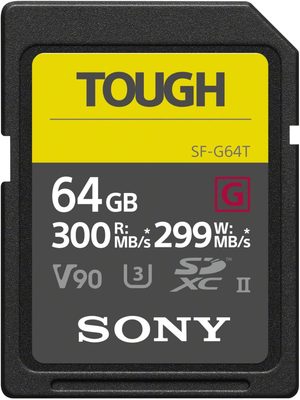
The Sony TOUGH SF-G series is the most durable SD card in production. Its one-piece moulded body has no write-protect switch — the plastic tab that breaks on standard SD cards is eliminated entirely. The card is rated for 18kgf bending force, 5m drop resistance, and IPX8 waterproofing (submerged to 5m for 72 hours). For photographers working in rain, dust, sandy environments, or extreme cold, this durability specification matters fundamentally. The UHS-II bus enables 277 MB/s read and 150 MB/s write speeds — fast enough for continuous RAW burst in most professional mirrorless systems. Sony's 5-year limited warranty and data recovery service provide additional assurance for professional use.
- 18kgf bend resistance — virtually unbreakable
- No write-protect switch — eliminates common failure point
- IPX8 waterproof to 5m for 72 hours
- UHS-II speeds: 277 MB/s read, 150 MB/s write
- 5-year warranty with Sony data recovery service
- Most expensive SD card on this list (~€80 for 128GB)
- Write speed (150 MB/s) lower than Lexar 2000x
- No write-protect switch (workflow consideration)
2. Lexar Professional 2000x — Best UHS-II Value
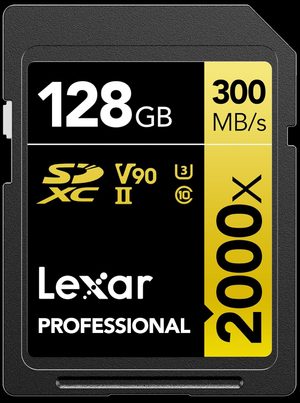
The Lexar Professional 2000x delivers the fastest UHS-II write speeds of any SD card at the mid-range price point. The 300 MB/s read and 260 MB/s write speeds make it the fastest UHS-II SD card in real-world tests, supporting the longest continuous RAW burst sequences in cameras like the Canon EOS R5, Nikon Z6 III, and Sony A9 III. For sports and wildlife photographers shooting 20+ fps bursts, write speed is the critical specification — a card that cannot keep up with the buffer will cause the camera to slow down or stop mid-burst. At €55 for 128GB, the Lexar 2000x is significantly more affordable than the Sony TOUGH while providing faster write performance. Lexar provides a lifetime limited warranty.
- Fastest write speed (260 MB/s) of any UHS-II SD card in its price range
- Clears camera buffer fastest during RAW burst
- More affordable than Sony TOUGH (~€55 for 128GB)
- Lifetime limited warranty
- Standard SD build — less durable than Sony TOUGH
- Write-protect switch present (can break)
3. ProGrade CFexpress Type B — Best CFexpress Card
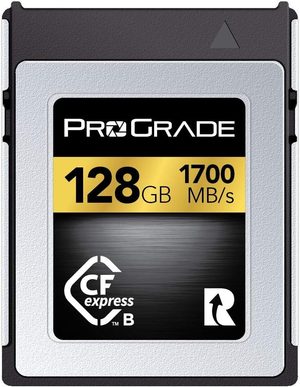
The ProGrade CFexpress Type B is a leading recommendation for high-speed CFexpress B cards. Conforming to CFexpress 4.0 (PCIe Gen 4.0 x2), it delivers up to 3200 MB/s read and 3240 MB/s write speeds — nearly double the previous generation's performance. For cameras with CFexpress B slots (Nikon Z9, Canon EOS R5 II, Sony A9 III), these speeds enable unlimited buffer depth at sustained burst rates, 8K RAW video without throttling, and dramatically faster offload to a Gen 4 card reader at the editing workstation. ProGrade's POWER series is built to professional durability standards — rated to withstand vibration, shock, and temperature extremes. CFexpress 4.0 cards are backwards compatible: they work in CFexpress 2.0 camera slots at 2.0 speeds.
- CFexpress 4.0 — up to 3200/3240 MB/s, fastest consumer card available
- Enables unlimited burst depth and 8K RAW without throttling
- Backwards compatible with CFexpress 2.0 camera slots
- Professional shock, vibration, and temperature durability ratings
- CFexpress B slot required — not all cameras support this format
- Full 4.0 speed requires a PCIe Gen 4 card reader
- Expensive per gigabyte compared to SD alternatives (~€180 for 256GB)
4. Samsung Pro Plus microSD — Best MicroSD Card
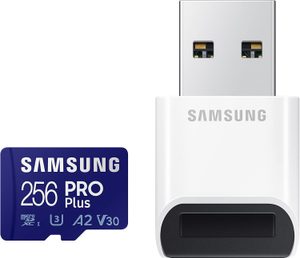
The Samsung PRO Plus microSD is the performance leader in the microSD category. At 180 MB/s read and 130 MB/s write, it outperforms most competitors in the same format. For GoPro action cameras, DJI drones (Mavic and Mini series), and action cameras that accept microSD, the PRO Plus enables 4K 60fps recording without dropped frames. Samsung's IP68 waterproofing and magnet-proof claims add resilience for action camera use. At €25 for 128GB, it is exceptionally affordable for the performance. Samsung manufactures its own NAND flash — a quality control advantage over brands that source chips from third parties. The PRO Plus includes an SD card adapter for use in standard SD slots for transfer and camera use.
- Fastest microSD available (180 MB/s read)
- Samsung first-party NAND flash manufacturing
- Affordable at ~€25 for 128GB
- SD adapter included
- microSD format limited to action cameras, drones, phones
- Write speed (130 MB/s) limits some 4K applications
5. SanDisk Extreme Pro SDXC — Best Value UHS-II
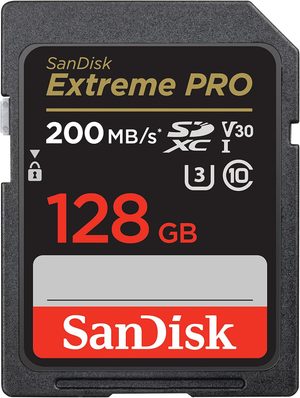
The SanDisk Extreme PRO V60 is the 2025/2026 update to the long-standing Extreme PRO series, now featuring UHS-II speeds with 280 MB/s read and 100 MB/s write. The V60 video speed class certification guarantees a minimum 60 MB/s sustained write speed — sufficient for continuous burst RAW shooting and 4K video in cameras that support UHS-II. For photographers upgrading from UHS-I cameras to a newer UHS-II mirrorless body, the Extreme PRO V60 is the natural next step. At ~€45 for 128GB, it represents excellent value in the UHS-II tier — substantially more affordable than the Sony TOUGH SF-G while delivering genuine UHS-II performance. Temperature-proof from -25°C to 85°C covers most outdoor photography conditions. SanDisk's established reliability and wide availability make it a safe default choice.
- UHS-II speeds (280 MB/s read) at an accessible price (~€45)
- V60 video class — guaranteed 60 MB/s sustained write for burst shooting
- Proven SanDisk reliability and wide availability
- Temperature-proof from -25°C to 85°C
- Write speed (100 MB/s) lower than Lexar 2000x for burst-heavy use
- Standard SD build — less durable than Sony TOUGH
How to Choose a Memory Card
Match card format to your camera
Buying the wrong format is the most expensive mistake. Check your camera's specifications before purchasing. A UHS-II card works in a UHS-I slot but only at UHS-I speeds — you pay the premium for no benefit. A CFexpress card is incompatible with SD slots entirely.
Speed class requirements by use case
For casual shooting and 4K H.264 video, any UHS-I card suffices. For continuous RAW burst at 10fps+, you need UHS-II or CFexpress. For 8K RAW or 20fps+ RAW burst, CFexpress B is required. Match the card speed to your actual shooting needs — paying for speed you cannot use adds no value.
Card count strategy
Two 64GB cards provide more redundancy than one 128GB. If a 128GB card fails mid-shoot, you lose everything. With two 64GB cards, fill one before using the second — you always have a backup of the first card's content. For professional work, shoot to dual card slots simultaneously when your camera supports it.
Our Verdict
Best for harsh conditions: Sony SF-G Tough — most durable SD card ever made. Best UHS-II value: Lexar Professional 2000x — fastest write speed for burst shooting. Best CFexpress: ProGrade CFexpress B — up to 3200 MB/s for cameras with CFexpress B slots. Best microSD: Samsung Pro Plus — fastest microSD for action cameras and drones. Best value UHS-II: SanDisk Extreme Pro V60 — 280 MB/s read with V60 video class certification.
FAQ
How do I know which memory card format my camera uses?
Check your camera's specifications in the manual or manufacturer's website. Look for the card slot section — it will list SD/UHS-I, SD/UHS-II, or CFexpress Type B/A. Many professional cameras have dual card slots, sometimes with different formats for each slot.
Should I use one large card or multiple smaller cards?
Multiple smaller cards distribute risk: if one fails, you only lose part of your shoot rather than everything. Many photographers use two 64GB cards rather than one 128GB. The disadvantage of multiple cards is the inconvenience of swapping during a shoot.
How do I back up memory cards in the field?
The fastest reliable solution is a portable SSD with a built-in card reader (Western Digital My Passport Wireless or similar). Copy cards at the end of each day. For critical professional shoots, use a camera with dual card slots and write to both cards simultaneously as in-camera backup.