
Best ND Filter in 2026: Fixed and Variable Options for Photo and Video
As an Amazon Associate and member of other affiliate programs, we earn from qualifying purchases. How we test →
Last updated: September 5, 2026 • 7 filters compared
- B+W 77mm ND 3.0 — Best fixed ND (4.9/5)
- NiSi 100mm V7 System — Best landscape system (4.7/5)
- K&F Concept Variable ND — Best variable value (4.3/5)
ND (Neutral Density) filters reduce light reaching the sensor without affecting colour, enabling longer exposures in bright daylight, faster apertures in video, and silky water effects in landscape photography. We compare seven filters across optical quality, colour accuracy, and ease of use.
Quick Comparison
| Filter | Best for | Score |
|---|---|---|
| B+W 77mm ND 3.0 | Best fixed ND Best Pick | ★★★★☆ 4.9 |
| NiSi 100mm V7 System | Best landscape system Runner-up | ★★★★½ 4.7 |
| K&F Concept Variable ND | Best variable value Best Budget | ★★★★½ 4.3 |
| Breakthrough Photography X4 | Best premium variable | ★★★★½ 4.7 |
| Tiffen Variable ND | Best budget variable | ★★★★☆ 4.2 |
| NiSi True Color ND-Vario | Best 1–5 stop variable | ★★★★½ 4.6 |
| Haida PROII CPL+VND | Best 2-in-1 filter | ★★★★½ 4.4 |
Understanding ND Filters
Fixed vs variable ND
Fixed ND filters block a specific number of stops of light. ND4 = 2 stops. ND16 = 4 stops. ND64 = 6 stops. ND1000 = 10 stops. For predictable lighting conditions where you always shoot at the same time of day, fixed NDs are the cleanest optical solution. Variable ND filters adjust from approximately 2 stops to 8–10 stops by rotating the front ring. This makes them extraordinarily convenient for run-and-gun video work where lighting changes continuously. The optical compromise is that variable NDs use two polarising filters — as they approach maximum density, an X-pattern cross appears across the image.
Colour cast and optical quality
Colour cast is the single most important quality indicator for ND filters. Cheap ND filters introduce a blue, green, or magenta cast visible in RAW images and requiring correction in post-production. Premium filters (B+W, NiSi, Breakthrough Photography) maintain colour neutrality — the scene looks the same with or without the filter, just darker. When comparing filters, photograph a white surface with and without the filter and compare the colour temperature in Lightroom.
Filter size systems
Screw-on filters thread directly onto the lens and must match the lens filter thread diameter (49mm, 58mm, 67mm, 77mm, 82mm are the most common). Square or rectangular filter systems (NiSi, Lee, Cokin) use an adapter ring on the lens and a holder that accepts standard-size filter glass — one set of filters works across all your lenses with different adapter rings. Square systems are more expensive but more versatile for photographers with multiple lens diameters.
1. B+W 77mm ND 3.0 — Best Fixed ND Filter
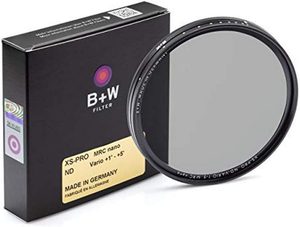
B+W (Schwarzwälder Feinoptik) is the German optical company owned by Schneider Kreuznach that sets the standard for screw-on photographic filters. The B+W ND 3.0 (10-stop) filter uses MRC Nano coating (Multi-Resistant Coating) that repels water, grease, and dust — reducing the need for cleaning in outdoor conditions. The filter glass is produced to B+W's optical standards and tested for colour neutrality to within measurement tolerances invisible to the eye. A 10-stop filter turns a 1/100s exposure into 10 seconds in the same light, enabling motion blur in waterfalls, cloud streaks across skies, and glassware smoothing of sea surfaces in midday light. At approximately €90 for the 77mm version, B+W is the definitive fixed ND recommendation. Step-up rings allow using a 77mm filter on smaller lens diameters.
- Best-in-class colour neutrality — no measurable colour cast
- MRC Nano coating repels water, grease, dust
- German optical quality from Schneider Kreuznach
- 10-stop density enables dramatic long-exposure effects
- Fixed density — one filter for one specific exposure scenario
- Need multiple filters for different stop requirements
- Size-specific — one purchase per lens diameter (~€90)
2. NiSi 100mm V7 System — Best Landscape System
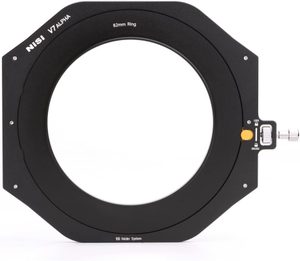
NiSi's 100mm square filter system is the dominant choice for serious landscape photographers. The 100mm format uses a filter holder that attaches to the lens via adapter rings, allowing one set of filters to work across all lenses. This is the fundamental advantage over screw-on filters: buy the NiSi ND kit once and it works on every lens in your kit by changing only the adapter ring. The NiSi 100mm ND kit typically includes a 3-stop (ND8) and a 10-stop (ND1000) filter plus a circular polariser, covering the most common landscape filter combinations. The optical quality matches B+W at the fixed ND level — colour neutrality is excellent, coatings are hydrophobic, and the glass transmits light cleanly. Graduated ND filters (which darken only part of the image) are available in the same 100mm system for exposure balancing between sky and foreground. At €300 for the starter kit, it is a significant investment — but more cost-effective than buying screw-on filters in every lens diameter.
- One system, all lenses — adapter rings for any diameter
- Graduated ND compatibility for sky/foreground balance
- Excellent optical quality matching screw-on premiums
- Expandable system — add filters without replacing others
- High upfront cost for the complete kit (~€300)
- Larger and heavier than screw-on filters
- Holder and adapter ring required for each new lens
3. K&F Concept Variable ND — Best Variable Value
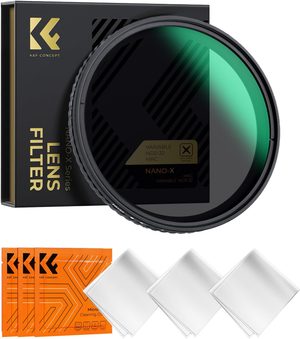
K&F Concept has built a strong reputation for affordable but capable camera accessories, and their Variable ND filter range is one of their best products. At €45 for a 77mm variable ND covering 2–32 stops, it offers remarkable flexibility at a budget price. The filter includes graduated markings on the rotating ring, making it straightforward to set specific stop values. Colour neutrality is good but not at B+W or Breakthrough Photography level — there is a subtle warm cast at certain densities. The X pattern artefact appears at maximum density settings, which is manageable by avoiding the extreme ends of the rotation range. For video work where quick density adjustment is required and slight colour correction in post-production is acceptable, the K&F Variable ND is an excellent value choice.
- Variable adjustment from 2–32 stops in one filter
- Excellent value at ~€45
- Graduated density markings on ring
- Good build quality for the price
- Subtle warm colour cast at some settings
- X artefact at maximum density setting
- Optical quality below B+W and Breakthrough Photography
4. Breakthrough Photography X4 — Best Premium Variable
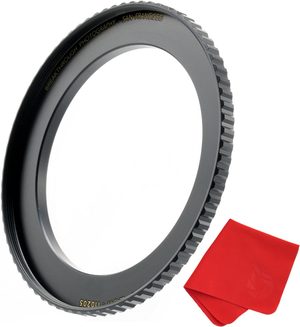
The Breakthrough Photography X4 variable ND is the reference standard for variable ND filters used by professional video and hybrid photographers. Its optical engineering minimises the X artefact to the point where it only becomes problematic at extreme density settings, unlike budget variable NDs where it appears within the normal shooting range. Colour neutrality is comparable to B+W fixed NDs — measurably neutral across the full density range. The X4 is available in a nano coating version (X4 Nano) that adds hydrophobic and oleophobic properties to the optical glass. The range is 1.5–10 stops — slightly less than budget variable NDs at the maximum end, but the avoidance of the X artefact throughout this range makes the usable range effectively complete. For cinematographers and video photographers who shoot run-and-gun in variable light, the X4 is the professional choice.
- X artefact minimised throughout usable range
- Colour neutrality matching premium fixed NDs
- Professional video use: adjust density while rolling
- Nano coating version available
- Expensive at ~€130
- Range limited to 1.5–10 stops vs wider budget options
- US-based brand — shipping times to Europe can be longer
5. Tiffen Variable ND — Best Budget Variable
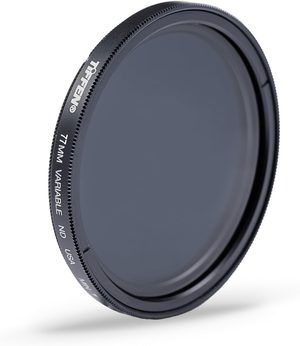
Tiffen is an American filter manufacturer with decades of history in cinema and photographic filtration. Their Variable ND filter occupies the mid-range between the K&F budget option and the Breakthrough Photography premium. At around €60, the Tiffen Variable ND offers 2–8 stops of adjustment with better colour neutrality than the K&F and a more refined rotation feel. The X artefact is present at maximum density, as with all variable NDs, but is manageable within the 2–6 stop range that covers most use cases. Tiffen's long history with film and video production ensures the optical quality is reliable and consistent. For photographers or videographers who want reliable variable ND capability without the premium Breakthrough Photography pricing, the Tiffen is a well-balanced mid-range option.
- Tiffen's established optical quality and reputation
- Better colour neutrality than K&F at similar price
- Smooth rotation mechanism
- Good balance between cost and performance (~€60)
- X artefact at maximum density
- 2–8 stop range narrower than some alternatives
- Mid-range pricing doesn't reach Breakthrough Photography quality
6. NiSi True Color ND-Vario — Best 1–5 Stop Variable
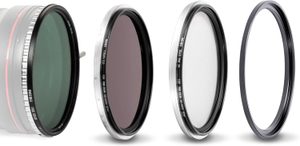
The NiSi True Color ND-Vario Pro Nano is the 2026 benchmark for variable ND filters in the 1–5 stop range. NiSi uses their True Color technology — a proprietary multi-coating that maintains colour accuracy across the full variable range. The result is measurably neutral colour at every density setting, eliminating the colour shift that plagues most variable NDs at intermediate densities. The Pro Nano version adds a nano-coating for water and grease repellency. Build quality is top-notch: solid rotation with clear stop markings, aluminium construction, and a frame diameter that won't vignette even on wide-angle lenses. For photographers and videographers who need a variable ND with genuine colour accuracy throughout the range, this is the 2026 recommendation for the 1–5 stop working range.
- True Color technology — accurate colour throughout the range
- Top-notch build quality and field-proven durability
- Pro Nano coating for hydrophobic protection
- No X artefact within the 1–5 stop working range
- Only 1–5 stops — not suitable for strong ND requirements
- Higher price than budget variable options (~€120)
- Available in fewer filter thread sizes than B+W or Tiffen
7. Haida PROII CPL+VND — Best 2-in-1 Polariser + Variable ND
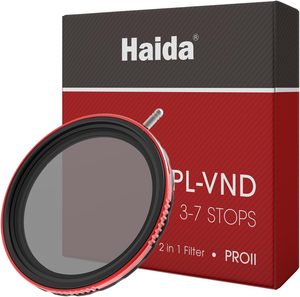
The Haida PROII CPL-VND combines a circular polariser (CPL) and variable ND filter in a single screw-on unit — a genuine space-saver for video and travel photographers who would otherwise carry both filters separately. The filter is constructed from K9 optical glass with 16 layers of multi-coating and an aluminium alloy frame. A protruding metal pin adjusts ND strength independently from the CPL rotation. The optical quality is impressive for a 2-in-1 design — minimal colour cast, acceptable X artefact behaviour within the usable 2–7 stop range, and effective polarisation. For landscape and travel photographers who need compact kit, combining these two filters eliminates one item from the bag entirely. At ~€100, the value proposition is strong for a dual-function filter.
- Combines CPL + variable ND — two filters in one
- 16-layer multi-coating on K9 optical glass
- Independent ND and CPL adjustment via metal pin
- Excellent for compact travel setups (~€100)
- Thicker than standard filters — vignetting risk on ultra-wides
- X artefact appears above 7 stops
- Not a replacement for a dedicated high-quality CPL
How to Choose an ND Filter
Fixed or variable?
For video work with variable lighting, choose variable ND — it is the only practical way to maintain correct exposure as you change locations. For landscape photography at fixed times of day, fixed NDs provide cleaner optical quality with no X artefact or colour compromise. Many serious photographers carry both: a fixed 10-stop for long landscape exposures and a variable for video and run-and-gun work.
What stop count do you need?
ND64 (6 stops) is the entry point for daylight landscape work. ND1000 (10 stops) enables the most dramatic motion blur effects — 10-second exposures in midday sun. For portrait photography with wide apertures in daylight, 3–5 stops is typically sufficient. For video observing the 180-degree shutter rule, 2–8 stops covers most outdoor scenarios.
Screw-on or square system?
If you have one or two lenses of the same filter thread diameter, screw-on filters are more cost-effective. If you have multiple lenses with different diameters, or want graduated ND capability for skies, a square system with adapter rings is more economical across the full kit. Step-up rings (€3–8) allow using one larger screw-on filter across multiple smaller lens diameters.
Our Verdict
Best fixed ND: B+W 77mm ND 3.0 — measurably colour-neutral, MRC Nano coating, German optical quality. Best landscape system: NiSi 100mm V7 — one set of filters for all lenses, including graduated ND capability. Best variable value: K&F Concept Variable ND — most flexibility per euro for video shooters on a budget. Best premium variable: Breakthrough Photography X4 — minimal X artefact and neutral colour for professional video. Best budget variable: Tiffen Variable ND — established optical quality at a mid-range price. Best 1–5 stop variable: NiSi True Color ND-Vario Pro Nano — True Color technology for colour-critical work. Best 2-in-1: Haida PROII CPL+VND — combines polariser and variable ND in one filter for compact travel kits.
FAQ
Do I need a specific ND filter for video?
Yes, variable ND filters are significantly more useful for video than fixed NDs. Video requires maintaining the 180-degree shutter rule (shutter speed = 2× frame rate) while adjusting aperture for depth of field. A variable ND filter lets you change density in real time to maintain correct exposure as you move between different lighting conditions — impossible with a fixed ND.
Can I use a 77mm filter on a 67mm lens?
Yes, with a 67–77mm step-up ring (approximately €5). Step-up rings allow using larger filters on smaller lens diameters. The only consideration is slight vignetting on ultra-wide lenses at their widest focal length — test before committing. Using a larger filter on a smaller lens is standard practice to maximise the usability of premium filter purchases.
What ND strength do I need for waterfalls?
For silky waterfall blur in bright daylight, an ND1000 (10 stops) is the standard. At ISO 100, f/11, and ND1000, you can achieve 10–30 second exposures in midday sun. In overcast conditions or at golden hour, an ND64 (6 stops) or ND256 (8 stops) may be sufficient. Carry at minimum an ND64 and ND1000 to cover the full range of outdoor lighting conditions.