
Best Camera Bag in 2026: Backpacks, Shoulder Bags, and Cases Compared
As an Amazon Associate and member of other affiliate programs, we earn from qualifying purchases. How we test →
Last updated: September 20, 2026 • 5 bags compared
- Lowepro ProTactic 450 AW II — Best protection (4.8/5)
- Peak Design Everyday Backpack 20L — Best design (4.7/5)
- Wandrd Prvke V4 21L — Best all-round (4.6/5)
A camera bag protects thousands of euros of equipment while being comfortable enough to carry all day. The right choice depends on whether you are hiking, commuting, or travelling — and how much gear you need to carry. We compare five bags across protection, access speed, comfort, and versatility.
Quick Comparison
| Bag | Best for | Score |
|---|---|---|
| Lowepro ProTactic 450 AW II | Best protection Best Pick | ★★★★☆ 4.8 |
| Peak Design Everyday Backpack 20L | Best design Runner-up | ★★★★½ 4.7 |
| Wandrd Prvke V4 21L | Best all-round | ★★★★½ 4.6 |
| Tenba DNA 15 | Best shoulder bag | ★★★★½ 4.4 |
| Shimoda Explore 40 | Best hiking Best Budget | ★★★★½ 4.5 |
What to Look for in a Camera Bag
Backpacks vs shoulder bags
Backpacks are the most comfortable for all-day carrying of heavy loads. They distribute weight across both shoulders. The disadvantage is access — reaching your camera typically requires putting the bag down and opening the top or back panel. For hiking and travel photography where you walk long distances, backpacks are the correct choice.
Shoulder bags allow faster camera access — swing the bag to the front and reach the camera without putting the bag down. For street photography, events, and documentary work where you need to react quickly, shoulder bags provide an access speed advantage. The disadvantage is weight distribution — a heavy shoulder bag over long distances causes shoulder and back fatigue.
Divider quality
Divider system quality determines how well your equipment is protected and how efficiently you can organise it. Cheap bags have fixed foam dividers that are too thick and waste space. Quality bags (Lowepro, Peak Design) use adjustable soft dividers that protect equipment while allowing custom configurations for any combination of bodies, lenses, and accessories.
Weather resistance
DWR (Durable Water Repellent) coating on the exterior fabric repels light rain and morning dew. Rain covers (included with some bags or sold separately) provide protection in heavier rain. For outdoor photography in variable weather, a bag with either built-in rain cover or good DWR coating is essential.
1. Lowepro ProTactic 450 AW II — Best Protection

The Lowepro ProTactic 450 AW II is Lowepro's flagship professional camera backpack. Its four-access-point design allows reaching the camera compartment from the back, top, or either side — without putting the bag down on some access types. The back panel opens to reveal the full camera compartment independently of the laptop sleeve above. This is Lowepro's SafetyHarbor system — the main compartment access stays against your body while shooting, preventing pickpocketing in urban environments. Protection is exceptional with a rigid top section protecting lenses even if the bag is dropped. The all-weather cover stores in a dedicated pocket and deploys in seconds. The ProTactic's load capacity covers two professional bodies, multiple lenses up to 500mm, a 15-inch laptop, and accessories.
- Four access points including side access without bag removal
- SafetyHarbor keeps compartment against body for security
- Rigid construction protects equipment from drops
- All-weather cover included
- 45L capacity — fits two bodies, multiple lenses, 15" laptop
- 1.8kg empty — heavier than competitors
- Large and bulky — unsuitable for lightweight travel
- $290–320 upfront cost
2. Peak Design Everyday Backpack 20L — Best Design
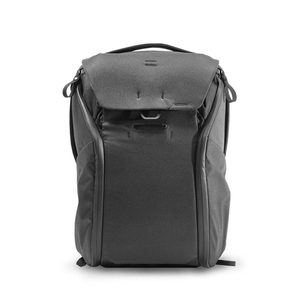
The Peak Design Everyday Backpack 20L is the camera bag that photographers who care about aesthetics buy. It looks like a premium everyday bag, not a camera bag — an important distinction for street photographers and travel photographers who prefer discretion over announcing their expensive equipment. The weatherproof recycled ripstop shell is both waterproof and lightweight. The FlexFold dividers are the best divider system in any camera bag — triangular padded flaps that fold and configure in seconds to any combination of body, lenses, and accessories. The MagLatch top closure secures with one hand and opens with one thumb. Side zip access opens the full camera section without removing the bag from your back when wearing it slung forward.
- FlexFold dividers — best configurable divider system available
- Discrete design — does not look like a camera bag
- MagLatch one-hand top closure
- Weatherproof recycled ripstop shell
- Side zip camera access without removing bag
- Expensive at $270–290
- 20L capacity limits gear to mirrorless system
- Peak Design accessories ecosystem adds cost
3. Wandrd Prvke V4 21L — Best All-Round Camera Backpack
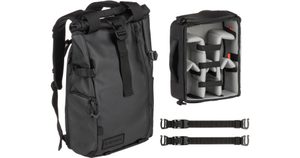
The Wandrd Prvke has been refined for 2025/2026 (V4) and has emerged as one of the most praised all-round camera backpacks available. The V4 update brought zippered access to the rolltop, a larger side-access opening with U-pull zippers, and improved internal organisation. It combines the aesthetic appeal of an everyday backpack with a fully functional camera compartment — similar to Peak Design but at a slightly lower price point. The rolltop design expands capacity when needed and compresses for light-travel days. The camera compartment is accessed via a back panel that opens fully, with adjustable padded dividers accommodating a mirrorless body, multiple lenses, and accessories. The weatherproof waxed canvas exterior is durable and distinctive.
- V4 update: zippered rolltop access and improved U-pull side opening
- Expandable rolltop — adapts capacity to daily needs
- Premium weatherproof waxed canvas exterior
- Adjustable padded dividers for full mirrorless system
- Expensive at $310–340
- Rolltop can be slower to access than zip-top bags
- Smaller laptop sleeve — limited to 13–14 inch models
4. Tenba DNA 15 — Best Shoulder Bag
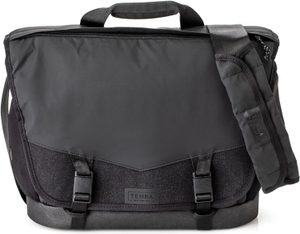
The Tenba DNA 15 is a refined camera and laptop shoulder bag built for urban photographers and professionals who move between office and field. Its 15-inch laptop sleeve sits in a separate compartment from the padded camera section, allowing both to be accessed independently. The exterior is constructed from recycled sail cloth — exceptionally durable, water-repellent, and lightweight. The camera compartment holds a mirrorless or DSLR body with 2–3 lenses using adjustable padded dividers. At a shoulder-bag price point, the DNA 15 offers genuine professional quality without the bulk of a backpack, making it the right choice for documentary photographers, event shooters, and commuters who need fast access and a professional appearance.
- Recycled sail cloth exterior — durable and water-repellent
- Separate laptop and camera compartments
- Fast swing-forward access for street and event shooting
- Professional appearance suitable for corporate settings
- Shoulder bag — weight imbalance over long distances
- Smaller capacity than backpack options
- Not ideal for hiking or heavy gear loads
5. Shimoda Explore 40 — Best Outdoor Hiking Bag

The Shimoda Explore 40 is built for photographers who hike with heavy camera systems. Its modular design separates the camera protection (handled by removable inner Core Units — two small ones are included in the Starter Kit linked here) from the bag's hiking harness and frame sheet system. This allows using the bag as a pure 40L hiking pack without the camera unit for approach hikes, then inserting the Core Unit at the shooting location. The back panel access reveals the Core Unit — your entire organised camera system — which can be lifted out and accessed or swapped for a different Core Unit. The shoulder straps are wide and padded for multi-hour carrying, and a hip belt is included, transferring pack weight to the hips for long hikes. No other bag on this list is designed for serious mountain or outdoor photography use with equivalent carrying comfort.
- Modular Core Unit — swap camera configurations
- Hiking-grade harness with hip belt for long carries
- Frame sheet distributes heavy loads correctly
- 40L capacity for full-day wilderness shoots
- Core Unit sizing is a decision in itself — the two small units suit mirrorless, not big telephotos
- Overkill for urban or travel photography
- Bulky for commuting use
How to Choose the Right Camera Bag
Match bag type to your workflow
The single biggest mistake is buying a bag for maximum capacity when your actual need is fast access. Understanding your workflow first prevents buying the wrong type. Hiking and travel photographers need backpacks. Street and event photographers benefit from shoulder bags. Photographers who combine both can consider hybrid designs like the Wandrd Prvke.
Consider future gear
Buy a bag that accommodates one step up in your gear. A mirrorless shooter using a body and two lenses today may add a third lens or a second body. Bags with adjustable dividers accommodate this growth; fixed-insert bags do not.
Weight vs protection trade-off
Heavier bags provide more structure and protection. Lighter bags are more comfortable on long carries. For day hikes with $5,000+ of equipment, the Shimoda's extra weight is justified. For commuting with a single body and two lenses, the Peak Design or Wandrd is a better daily carry.
Our Verdict
Best protection: Lowepro ProTactic 450 AW II — four access points, SafetyHarbor, all-weather cover. Best design: Peak Design Everyday Backpack 20L — FlexFold dividers and discrete aesthetics. Best all-round: Wandrd Prvke V4 — refined for 2026 with improved access and premium weatherproof construction. Best shoulder bag: Tenba DNA 15 — sail cloth, separate laptop compartment. Best hiking: Shimoda Explore 40 — the only hiking-grade modular camera backpack.
FAQ
Can camera bags be carried as cabin luggage?
Most camera backpacks sized 20–30L fit in overhead bins on major carriers. Always check the specific dimensions against your airline's cabin baggage policy — they vary significantly. The Peak Design Everyday 20L and Wandrd Prvke 21L both fit as cabin bags on most airlines.
Should I buy a bag with or without padding for lenses?
Always with padding — specifically adjustable padded dividers, not fixed foam. Adjustable dividers allow reorganising for different gear configurations. Bags with only fixed foam inserts become obsolete when you change equipment.
Is a rain cover worth having?
Yes. Even if you shoot primarily in dry weather, unexpected rain is the normal condition for outdoor photography. A rain cover adds negligible weight, stores in a small pocket, and takes 10 seconds to deploy. Bags that include rain covers (Lowepro ProTactic, Shimoda) give you one fewer thing to buy separately.