
Best Smart Water Leak Sensor 2026
As an Amazon Associate and member of other affiliate programs, we earn from qualifying purchases. How we test →
Last updated: September 12, 2026
- Aqara Water Leak Sensor T1 — Best overall — sub-1s detection, Matter (4.7/5)
- Govee WiFi Water Sensor H5054 — Best no-hub — probe cable, 100dB alarm (4.5/5)
- Fibaro Flood Sensor Z-Wave — Best Z-Wave — temperature + tamper detect (4.1/5)
Water damage is one of the most expensive home insurance claims. A smart leak sensor costs under $30 and can alert you before a dripping washing machine hose becomes a flooded kitchen. Testing covered these for detection speed, alert reliability and smart home integration.
Quick Overview
| Model | Best for | Score |
|---|---|---|
| Aqara Water Leak Sensor T1 | Best overall — sub-1s detection, Matter Best Pick | ★★★★½ 4.7 |
| GoveeLife Leak Detector 1s | Best no-hub — probe cable, 100dB alarm Runner-up | ★★★★½ 4.5 |
| Ecolink Flood & Freeze | Best Z-Wave — temperature + tamper detect Premium | ★★★★☆ 4.1 |
| YoLink Water Leak Sensor | Best long-range — LoRa signal to 300m Runner-up | ★★★★½ 4.4 |
| SwitchBot Water Leak Detector | Best SwitchBot — 1.5m probe, ecosystem ties Best Budget | ★★★★½ 4.3 |
1. Aqara Water Leak Sensor T1 — Best Overall
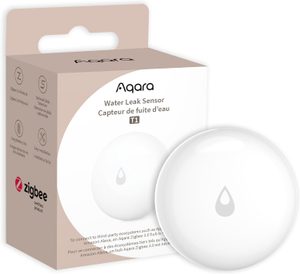
The T1 detects water contact in under 1 second and triggers an 85 dB on-board alarm that sounds locally even without WiFi or internet access — critical for properties with intermittent connectivity. Zigbee with Matter over Thread support enables automations that trigger smart water shutoff valves, turn off dishwashers or send phone alerts when water is detected, all running locally without cloud dependency. The CR2032 battery lasts approximately 2 years, and the sensor can be extended with a probe cable (sold separately) for placement in tight spaces. At ~$20 it is the best-value smart leak sensor with automation capability.
- Sub-1 second detection
- 85dB local alarm — works without internet
- Matter over Thread — trigger shutoff valves
- ~2-year battery (CR2032)
- Needs Zigbee/Thread hub for automations
- Probe cable sold separately
2. Govee WiFi Water Sensor H5054 — Best Without a Hub
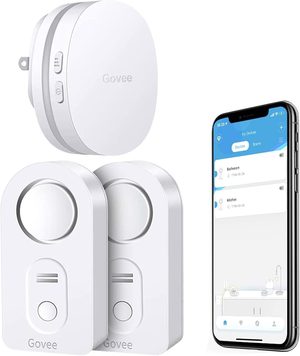
Govee replaced the H5054 with the Leak Detector 1s, which swaps direct WiFi for a Sub-1GHz link to a gateway — a worse setup on paper, a better one in a basement, since the signal is rated to carry through five walls where WiFi gives up. The 105 dB alarm is the loudest here and adjustable across four levels, so a bedroom sensor need not wake the street. Alerts arrive by app, email and free SMS, and the battery lasts five years. Sold in a three-pack for around $55, which is roughly $18 a sensor. The app notifies up to 5 users simultaneously and logs detection events with timestamps. No subscription required; the 3× AAA battery lasts approximately 1 year under normal monitoring conditions.
- No hub — direct WiFi alerts
- 100dB alarm — loudest tested
- 1.8m probe cable for tight spaces
- Alerts up to 5 users simultaneously
- Govee ecosystem only
- 2.4 GHz WiFi only
3. Fibaro Flood Sensor Z-Wave — Best Z-Wave Option
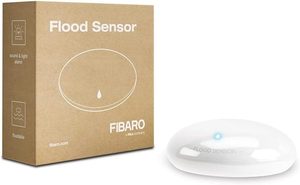
Fibaro's sensor now carries a six-to-seven-month lead time on Amazon, so the Z-Wave slot goes to Ecolink. It is the same idea — Z-Wave Plus, so it joins Home Assistant, SmartThings or Hubitat without another app — with a 36-inch probe that reaches under a sink or behind a fridge, and a freeze alarm that fires at 41°F so you hear about a pipe before it splits rather than after. One CR123A lasts five years. Around $35. The sensor can trigger a Z-Wave motorised valve to automatically cut the water supply within seconds of detection. At ~$50 it is more expensive than Zigbee alternatives, but the Z-Wave reliability and temperature bonus justify the premium for Z-Wave hub users.
- Z-Wave Plus — HA, SmartThings, Vera integration
- Temperature sensor + tilt tamper detection
- Links to Z-Wave motorised valve for auto shutoff
- Better wall penetration than Zigbee in concrete
- Requires Z-Wave hub
- ~$50 — more expensive than Zigbee options
4. YoLink Water Leak Sensor — Best Long-Range
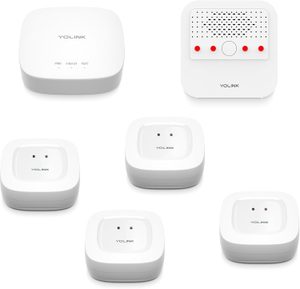
YoLink uses LoRa (Long Range) radio technology with a stated range of up to 300m (1,000ft) through walls — approximately 10× the effective range of Zigbee or WiFi sensors. This makes it the only practical option for basements, outbuildings, garages and detached garden structures that are out of WiFi range. The YoLink Hub connects to your router and allows up to 100 sensors, all sending alerts via the YoLink app and Alexa integration. Battery life is exceptional — up to 5 years on 2× AAA — and includes a 1m probe cable. At ~$20 per sensor with a ~$35 hub, it is the best solution for large properties or installations beyond WiFi reach.
- LoRa 300m range — works in basements and outbuildings
- Up to 5-year battery (2× AAA)
- 1m probe cable included
- Alexa integration via YoLink app
- Requires YoLink Hub (~$35, sold separately)
- YoLink ecosystem only
5. SwitchBot Water Leak Detector — Best SwitchBot Option
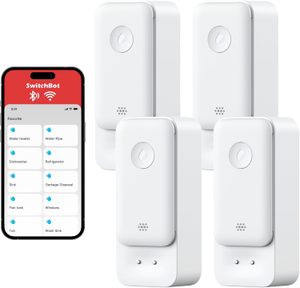
The SwitchBot Water Leak Detector uses Bluetooth with a 1.5m flexible probe cable, connecting to the SwitchBot app for local alerts and — with a SwitchBot Hub — enabling WiFi remote alerts, Alexa and Google Home integration and ecosystem automations. The 90 dB local alarm sounds immediately on contact, and the detection speed is under 1 second in independent tests. At ~$18 it is the cheapest sensor on this list, and the SwitchBot ecosystem integration allows triggering SwitchBot smart plugs, bots and curtains in response to a leak detection. A SwitchBot Hub is recommended for remote access and full automation capability.
- ~$18 — most affordable on this list
- 1.5m probe cable included
- SwitchBot ecosystem automations
- 90dB local alarm + sub-1s detection
- SwitchBot Hub needed for remote access
- Bluetooth only without hub
Where to Place Leak Sensors
Every home should have sensors in these locations:
- Under the kitchen sink — dishwasher connections and sink drain joints are a top source of slow leaks
- Behind the washing machine — supply hoses are one of the most common causes of significant flood damage
- Under the refrigerator — ice maker and water dispenser lines develop pinhole leaks over time
- Near the water heater / boiler — slow drips can go unnoticed for months and cause floor damage
- Bathroom floor — near toilet base and under bath/shower tray, especially in older installations
Sensors with a probe cable are more practical for tight spaces (under machines, inside cabinets) where floor-level placement is blocked. The Govee H5054 (1.8m) and YoLink (1m) both include cables; the Aqara T1 probe is sold separately.
Verdict
The Aqara T1 is the best all-round smart leak sensor — fast detection, local alarm, long battery and Matter automations at ~$20. For a completely hub-free setup with phone alerts and a probe cable, the Govee H5054 with its 100 dB alarm is the most complete standalone option. For large properties or detached outbuildings, the YoLink's 300m LoRa range is in a class of its own. Z-Wave hub users should choose the Fibaro for its ecosystem integration and temperature sensing bonus.
Frequently Asked Questions
Where should I place water leak sensors?
Highest priority: under sinks (kitchen, bathroom), behind/under washing machines, near hot water tanks, in basements, and around toilets. The Aqara Water Leak Sensor T1 is small enough to fit in tight spaces. Multiple cheap sensors (GoveeLife at about $18 each in a three-pack) protect more locations than fewer expensive ones. For a typical home: 4-8 sensors covers all leak-prone areas.
Can water sensors auto-shut-off water?
Yes with additional hardware. Pair sensors with smart water shut-off valves (LeakSmart, Aqara Smart Water Valve) to automatically close main water supply when leaks detected. The Fibaro Flood Sensor integrates with shut-off valve automation. For older homes prone to plumbing issues, this combination prevents catastrophic water damage.
How sensitive are water leak sensors?
Most detect water within seconds of contact. The Aqara T1 has metal contact points — even small leaks (a few drops near contacts) trigger alerts. Larger sensor pads (Fibaro Flood Sensor) detect water across a wider area. False alarms are rare — sensors only trigger on conductive liquids touching contacts.
How long do water sensor batteries last?
Aqara T1: 2 years on CR2 battery. Govee H5054: 2 years on AAA batteries. Fibaro Flood Sensor: 2 years on CR123A. Most sensors send low-battery alerts well before failure. For safety-critical devices like water sensors, set calendar reminders to test annually (place a wet finger on contacts to verify alert).