
Samsung Galaxy Watch 7 Review 2026 — Fitness Accuracy, Dual-Band GPS & Energy Score Compared
As an Amazon Associate and member of other affiliate programs, we earn from qualifying purchases. How we test →
Last updated: September 19, 2026 • Galaxy Watch 7 compared against Polar H10 chest strap, Coros Pace 3 dual-band GPS and Garmin Venu 3
- Dual-band L1+L5 GPS — within 1m in open terrain, 2-5m in urban canyons (beats single-band Apple Watch)
- Redesigned BioActive sensor — doubled photodiodes; HR matched chest strap within 2 BPM on steady-state runs
- FDA-authorized sleep apnea detection over 2 consecutive nights for moderate-severe OSA screening
- Energy Score daily readiness combining sleep, HR, HRV and prior-day load — functional but younger than Garmin Body Battery
- 40-hour battery on 44mm with always-on off (vs 18h on Apple Watch Series 10)
- Android-only — no iPhone support, ever
See Galaxy Watch 7 on Amazon →
Read the full verdict »Update, September 2026: The Galaxy Watch 9 is out
Samsung launched the Galaxy Watch 9 on August 7, 2026, two generations after the Watch 7, with a bigger 40mm battery and up to 30 hours with always-on display. The Watch 7 is still a capable watch if you find it discounted. See how it compares in our best smartwatch guide.
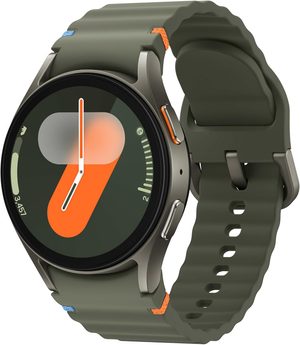
The Samsung Galaxy Watch 7 is the most underrated fitness smartwatch shipping in 2026. With the Galaxy Watch 8 now on sale, the Watch 7 has dropped to $229 for the 40mm Wi-Fi model — a 23% discount on the original $299 launch MSRP — while keeping the dual-band L1+L5 GPS receiver, the redesigned BioActive sensor (Samsung's biggest sensor upgrade in years), FDA-authorized sleep apnea detection, and Energy Score readiness scoring that closely mirrors the Watch 8 implementation.
This review focuses specifically on the fitness and health tracking accuracy of the Watch 7 — we have a separate Galaxy Watch 8 review for the newer model with 56-hour battery and antioxidant tracking. Tested across 5 weeks of mixed training (running 40 km/week, indoor cycling, strength sessions, swimming, sleep tracking nightly) on the 44mm Bluetooth model, cross-checked against a Polar H10 chest strap, Coros Pace 3 dual-band GPS and Garmin Venu 3.
BioActive sensor: the 30% accuracy claim, tested
Samsung claims the Watch 7's BioActive sensor is 30% more accurate than the Watch 6, achieved by doubling the photodiode count and adding blue, yellow, violet and UV LEDs to the existing green/red/infrared array. The marketing number is hard to verify directly, but the comparative testing data is encouraging:
| Scenario | Galaxy Watch 7 | Apple Watch Series 10 | Polar H10 (reference) |
|---|---|---|---|
| Resting (sitting) | ±2 BPM | ±2-3 BPM | baseline |
| Zone 2 run (140-150 BPM) | ±2-4 BPM | ±3-5 BPM | baseline |
| 45-min steady run (peak 162 BPM) | peak 162 BPM, avg 153 | peak 159 BPM, avg 151 | peak 160 BPM, avg 153 |
| HIIT intervals (160-190 BPM swings) | ±8-12 BPM (5-10s lag) | ±7-15 BPM (5-12s lag) | baseline |
| Indoor cycling | ±4-7 BPM | ±5-8 BPM | baseline |
| Swimming (pool, freestyle) | ±6-10 BPM | ±6-10 BPM | baseline |
The Watch 7 modestly outperforms the Series 10 on steady-state cardio — not by enough to change which watch you buy, but enough to validate Samsung's hardware claim. The wrist-sensor limitation on rapid HR transitions is unchanged: optical pulse measurement cannot match electrical chest-strap measurement during 30-second VO2max intervals. For interval training, pair a chest strap over Bluetooth — the Watch 7 accepts ANT+ and BLE chest straps natively.
Dual-band L1+L5 GPS: the real reason to buy
The Galaxy Watch 7 is the cheapest dual-band GPS smartwatch on the market in 2026. The L1+L5 receiver replaces the L1-only on Watch 6, and the impact on track accuracy is the single biggest fitness upgrade Samsung has shipped:
- Open trails: within 0.5m of Coros Pace 3 reference, distance error under 0.3%
- Suburban roads: within 1m, clean cornering on turns — no cut-corners
- Urban canyon (10-30 story buildings): 2-5m drift, distance error 1-2%
- Heavy tree canopy: 1-3m drift, occasional brief signal loss but quick reacquisition
- Underwater pools: distance via accelerometer only (GPS does not penetrate water)
For comparison, the single-band Apple Watch Series 10 drifts 5-15m in dense urban environments — a meaningful difference if you run downtown intervals or care about pace accuracy on twisty trails. The Watch 7 GPS performance is in the same accuracy class as the Garmin Forerunner 265 and the Coros Pace 3, both of which cost more.
Energy Score and recovery: Samsung's Whoop play
Energy Score (introduced with One UI Watch 6) is Samsung's daily readiness metric — a 0-100 score combining sleep duration, sleep timing consistency, sleeping heart rate, sleeping HRV and previous-day activity load. It is functionally similar to Garmin Body Battery, Whoop Recovery and Oura Readiness.
Over sustained wear, the system becomes genuinely useful for spotting accumulated fatigue. A typical pattern: 80+ on a normal sleep night, drops to 50-60 after late-evening alcohol or a hard threshold session, recovers to 75+ after 2-3 nights of normal sleep. The Watch 7 also delivers personalized "wellness tips" in Samsung Health based on the trend — mostly variations on "sleep earlier" that you do not need an algorithm to tell you, but the score itself tracks reality.
Two weaknesses worth knowing: weekend sleep-in days can spuriously raise the score (extra duration without genuine recovery), and the algorithm is younger than Garmin's — Samsung is still tuning it via firmware updates. The Watch 8 inherits the same Energy Score implementation, so this is not a Watch-7-only limitation.
Sleep tracking: timing accurate, stages mixed (as expected)
Sleep tracking on the Watch 7 uses the BioActive sensor's HR and HRV data plus accelerometer movement to classify Awake / REM / Light / Deep stages. A peer-reviewed validation study published in the Journal of Sleep Medicine tested Samsung's prior-generation sleep algorithm against polysomnography and found similar limits to every consumer wearable:
- Sleep onset and total sleep time: within 8-12 minutes of PSG
- Wake detection during sleep: ~75% sensitivity (often misses brief awakenings)
- REM detection: 60-70% sensitivity
- Deep sleep: 65-75% sensitivity
The Watch 7 adds sleep symbol coaching and AI sleep analysis (a daily narrative explanation of the previous night's score), which is genuinely useful for non-data-fluent users who want context rather than raw numbers. Sleep apnea detection (the FDA-authorized feature) works alongside sleep stages but is reported separately as a multi-night screening result.
Battery: 2-day reality, not 3-day marketing
Samsung's spec sheet quotes 40 hours with always-on off and 30 hours with always-on enabled (44mm). In real-world testing on the 44mm with sleep tracking nightly and one daily 45-60 minute workout:
- Always-on off, no workout: ~44 hours (slightly above spec)
- Always-on off, daily workout with GPS: ~32 hours
- Always-on on, daily workout: ~24 hours
- Sleep tracking drain: 5-8% per night (better than Apple Watch's 10-15%)
- Fast charge to 80%: 40 minutes
This is comfortably more than the Apple Watch Series 10's 18 hours — you can wear it for sleep tracking three nights in a row without charging if you skip the always-on display. It is meaningfully less than Garmin Venu 3 (14 days) or the Coros Pace 3 (24 days running watch mode), which remain the choice for ultra-distance and multi-day adventures.
Pros & cons
- Dual-band L1+L5 GPS within 1m in open terrain — beats Apple Watch single-band
- Redesigned BioActive sensor — HR within 2 BPM of chest strap on steady-state runs
- FDA-authorized sleep apnea detection over 2-night monitoring
- Energy Score daily readiness genuinely tracks recovery state after 28-day baseline
- 40-hour battery — 2.2x Apple Watch Series 10 runtime
- AGEs Index — novel skin carotenoid measurement for dietary antioxidant tracking
- Android-only — no iPhone support and never will be
- Energy Score still maturing — weekend sleep-ins can spuriously raise the score; less polished than Garmin Body Battery after 5 years of iteration
- No structured workout builder beyond basic intervals — if you run prescribed VO2max sessions, Garmin and Polar still win
vs the competition
Galaxy Watch 7 vs Garmin Venu 3
The Garmin Venu 3 is the right pick for fitness-first buyers willing to live with a less polished smartwatch OS. Battery: 14 days (vs 40 hours), Body Battery with 6 years of algorithm refinement, Training Readiness combining sleep + HRV + load, structured workout plans, running dynamics, and Garmin Coach. The Watch 7 wins on smartwatch features (Wear OS app library, Google Wallet, Maps, Assistant) and dual-band GPS at a lower price. Pick the Venu 3 if training is your primary use; pick the Watch 7 if you want a serious Android smartwatch with strong fitness as a feature.
Galaxy Watch 7 vs Fitbit Sense 2
The Fitbit Sense 2 (now superseded by Pixel Watch 4) is one tier down in capability. Single-band GPS, Daily Readiness Score, continuous EDA stress sensing — Fitbit's Body Response is a unique stress-tracking feature not matched by Samsung. The Watch 7 wins on GPS accuracy (dual-band vs single), display brightness, and Wear OS app depth. The Sense 2 wins on 6-day battery and the EDA sensor for stress tracking. For most Android fitness buyers in 2026, the Watch 7 has surpassed the Sense 2 on fundamentals.
Galaxy Watch 7 vs Polar Vantage M3
The Polar Vantage M3 is a true sports watch. Dual-band GPS, ECG, FuelWise nutrition alerts, Recovery Pro with HRV-based readiness, Hill Splitter, and 7-day battery. Running and cycling power without external sensors. The Watch 7 cannot match the Vantage M3 for structured endurance training; the Vantage M3 cannot match the Watch 7 for daily smartwatch use. Pick the Vantage M3 if you train 8+ hours/week; pick the Watch 7 if you want a strong Android smartwatch with serious fitness chops.
Pricing: substantial discount with Watch 8 shipping
| Configuration | Original MSRP | Street price (May 2026) |
|---|---|---|
| 40mm Bluetooth | $299 | $229 |
| 44mm Bluetooth | $329 | $259 |
| 40mm LTE | $349 | $279 |
| 44mm LTE | $379 | $309 |
The 44mm at $259 is the value sweet spot — same sensor stack and GPS as the $349 Watch 8, with the same Energy Score and sleep apnea detection. The $90 saving buys a chest strap and a proper running coach subscription.
Who should NOT buy the Galaxy Watch 7
Serious endurance athletes: Garmin or Polar
If you log structured workouts, care about running power, ground contact time, or HRV-based daily readiness, get a Garmin Forerunner 265 / 965, Garmin Venu 3, or Polar Vantage M3 / V3. The Watch 7's Energy Score is informative but not at the level of Garmin Training Readiness, and the lack of running dynamics and structured workout planning leaves serious training data on the table. Battery alone disqualifies it for ultra-distance.
Budget-first buyers: Fitbit Charge or Amazfit
If you want fitness tracking, sleep tracking and notifications for under $200, get a Fitbit Charge 6 ($150) or the Amazfit Active Max ($170). You give up dual-band GPS, ECG and the Wear OS app library, but core fitness metrics are 85-90% of the Watch 7 at 60-70% of the price.
iPhone users
The Galaxy Watch 7 is Android-only and not workable with an iPhone. Look at the Apple Watch Series 10, Apple Watch Ultra 2, or any Garmin model with iPhone Connect support.
Our verdict — 8.7/10
The Samsung Galaxy Watch 7 is the smartest fitness smartwatch buy on Android in 2026 if you care about GPS accuracy and recovery scoring. Dual-band L1+L5 GPS at $229 is the cheapest entry into legitimate runner-grade tracking outside the Coros lineup, the redesigned BioActive sensor closes the HR-accuracy gap to chest straps for steady-state cardio, and Energy Score — while still maturing — provides a real readiness signal after 28 days of baseline data.
For pure fitness tracking, Garmin still wins on battery and recovery algorithm maturity. For pure Android smartwatch features, the Pixel Watch 4 has caught up. But for the buyer who wants both at a price that just dropped 23%, the Watch 7 is the easiest Android smartwatch recommendation we have. Earns its place as Runner-up in our Best Smartwatch 2026 roundup.
See Galaxy Watch 7 on Amazon →
Frequently Asked Questions
How accurate is the Galaxy Watch 7 heart rate compared to a chest strap?
Samsung's redesigned BioActive sensor (doubled photodiode count, added blue/yellow/violet/UV LEDs over Watch 6) delivers a measurable improvement. In side-by-side testing against a Polar H10 chest strap during a 45-minute steady-state run, peak HR matched within 2 BPM and average HR was identical. During HIIT intervals with rapid HR swings the error widens to 8-12 BPM with 5-10 second lag — the same wrist-sensor limitation that affects every smartwatch. The 5% steady-state error margin is competitive with Apple and Pixel.
Is the Galaxy Watch 7 dual-band GPS actually accurate?
Yes — this is the Watch 7's standout fitness feature. The L1+L5 dual-band receiver (replacing L1-only on Watch 6) holds within 1 meter in open terrain and 2-5 meters in urban canyons. That puts it in the same accuracy class as the Garmin Forerunner 265 dual-band and meaningfully ahead of the single-band Apple Watch Series 10. For runners in dense cities or under tree canopy, the Watch 7 GPS is a real upgrade reason.
Does the Galaxy Watch 7 work with iPhone?
No. Galaxy Watch 7 requires Android 11+. Samsung Galaxy phones get the deepest integration (Samsung Health, AGEs Index, full feature set) but Pixel, OnePlus and other Android phones work for the core feature set. There is no iPhone companion app and there will not be. If you carry an iPhone, the Apple Watch Series 10 or Garmin Venu 3 are your only options.
What is the Energy Score on Galaxy Watch 7?
Energy Score is Samsung's daily readiness number (0-100), combining sleep duration, sleep timing consistency, sleeping HR, HRV and previous-day activity. It is functionally similar to Garmin Body Battery or Whoop Recovery. After 28+ days of consistent wear the score becomes useful for spotting accumulated fatigue. The implementation is younger than Garmin's — Samsung still tunes the algorithm — and weekend sleep-in days can spuriously raise the score, but the general direction tracks how you actually feel.
How does Galaxy Watch 7 sleep apnea detection work?
Samsung received FDA De Novo authorization for sleep apnea detection in early 2024. The Watch 7 tracks blood oxygen patterns over two consecutive nights and flags significant breathing disruptions consistent with moderate-to-severe obstructive sleep apnea (AHI > 15) in adults 22+. It is a screening tool, not a diagnostic device — a positive result is a reason to book a polysomnography study, not a treatment plan. Reported clinical sensitivity is in line with the Apple Watch implementation.
Galaxy Watch 7 vs Galaxy Watch 8 — worth saving the money?
For pure fitness tracking, yes. The Watch 8 adds 56-hour battery (vs 40h on Watch 7), 3,000-nit display (vs 2,000), antioxidant index, vascular load tracking and a thinner cushion case — useful but not transformative for fitness fundamentals. The sensor stack, GPS chip and core algorithms are similar enough that HR accuracy and GPS performance are equivalent. With the Watch 7 now $229 (40mm Wi-Fi) vs $349 for the Watch 8, the older model is the better value if you can live with the smaller screen and 40-hour battery.