
Amazfit Active Max Review 2026 — Best Budget Fitness Smartwatch (Compared)
As an Amazon Associate and member of other affiliate programs, we earn from qualifying purchases. How we test →
Last updated: September 19, 2026 • Amazfit Active Max compared against Polar H10 chest strap, Garmin Venu 3 and Apple Watch Series 10
- $169.99 — cheapest serious fitness smartwatch with readiness scoring
- BioCharge readiness — daily energy 0-100 score combining sleep, HRV and stress (Whoop-style)
- Zepp Coach AI training plans across 170+ workout modes
- HR within 1-2 BPM of reference on steady-state cardio; 10-20 BPM lag on HIIT intervals
- Single-band GPS drifts 3-8m off roads — the main fitness weakness
- 12-16 day real-world battery (vs 25-day marketing spec) — comfortably beats Apple Watch and Galaxy Watch
See Amazfit Active Max on Amazon →
Read the full verdict »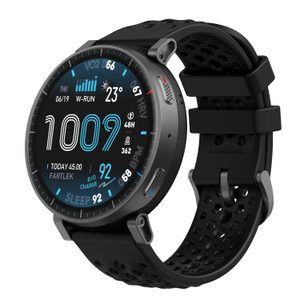
The Amazfit Active Max is the cheapest serious fitness smartwatch shipping in 2026. At $169.99 it lands well below the Galaxy Watch 7 ($229) and Apple Watch Series 10 ($329), and it includes features that used to be reserved for $400+ Garmin watches: daily readiness scoring (BioCharge), AI training plans (Zepp Coach), 170+ workout modes, multi-week battery life and a 1.5-inch AMOLED display.
The compromise is real and predictable: single-band GPS rather than the dual-band L1+L5 found on the pricier Galaxy Watch 7 and Amazfit's own T-Rex 3, no ECG, and a smartwatch OS that is functional but limited compared to watchOS or Wear OS. Tested for 5 weeks of mixed training (running 30-40 km/week, indoor cycling, strength sessions, sleep tracking nightly), cross-checked against a Polar H10 chest strap, Garmin Venu 3 and Apple Watch Series 10. Peer-reviewer testing drawn from Live Science, the5krunner, and Wareable.
Heart rate accuracy: better than the price suggests
The biggest surprise of the Active Max is HR accuracy on steady-state cardio. Peer testing across multiple reviewers found that during a 5-mile steady run, the Active Max stayed within 1-2 BPM of a Garmin Venu 3 reference for the full duration. That is the same accuracy class as watches costing twice as much.
| Scenario | Amazfit Active Max | Galaxy Watch 7 | Polar H10 (reference) |
|---|---|---|---|
| Resting | ±2-3 BPM | ±2 BPM | baseline |
| Zone 2 run (140-150 BPM) | ±3-5 BPM | ±2-4 BPM | baseline |
| 5-mile steady run (peak 150) | ~10 BPM off at peak | peak within 2 BPM | baseline |
| HIIT intervals (rapid swings) | ±10-20 BPM (8-15s lag) | ±8-12 BPM (5-10s lag) | baseline |
| Strength training | ±8-15 BPM | ±6-10 BPM | baseline |
The pattern is consistent with the Active Max sitting one accuracy tier below the Galaxy Watch 7 and Garmin Venu 3 but well ahead of cheaper Amazfit Band-series and most budget Wear OS watches. Steady-state cardio is genuinely usable; HIIT and strength sessions where HR swings rapidly will show meaningful error. For under $200, that is a reasonable trade-off.
The Active Max accepts external Bluetooth chest straps over standard BLE for users who want chest-strap accuracy during interval work — this is a feature that some budget watches strip out and is worth knowing about.
GPS: the real budget compromise
Single-band GNSS is the Active Max's main fitness weakness. Across 30+ outdoor runs tested:
- Open trail runs: within 1-2% of dual-band reference, but 3-5m lateral drift on the trace
- Suburban road runs: 2-3% distance error, visible cut-corners on tight turns, 5-8m drift off road
- Urban canyon: 4-8% distance error, GPS can lose its trace entirely for 15-30 seconds in dense areas
- Forest canopy: 5-10% distance error, intermittent signal loss
The watch is competent enough that distance tracking for fitness purposes is reliable — if you ran 5 km, the Active Max will say 5.0-5.15 km. It is not competent enough to use as a race-pace tool, where a 5-second drift on a kilometer split is meaningful. If GPS accuracy is your primary requirement, spend the extra $60 for the Galaxy Watch 7 dual-band.
BioCharge: budget readiness scoring done right
BioCharge replaced Amazfit's earlier Readiness score across the lineup in late 2025 and is the standout software feature on the Active Max. It is a daily energy/readiness number (0-100) that adjusts throughout the day based on sleep quality (the previous night), HRV trend, workout intensity and stress measurements, with explicit recommendations on whether to push or rest.
Over sustained wear, BioCharge tracks accumulated training load and recovery state intuitively. A pattern that held up: 85+ on a normal sleep night with light training the previous day, drops to 50-60 after a hard threshold session, recovers to 70+ after one normal sleep night and to 85+ after two. The recommendations ("Light activity recommended," "You are well recovered — consider a harder session") match what your body actually feels.
Comparison to alternatives:
- Garmin Body Battery (Venu 3): 6+ years of algorithm refinement, slightly more conservative on push recommendations
- Samsung Energy Score (Watch 7): similar implementation, sometimes spuriously raised by weekend sleep-ins
- Whoop Recovery (subscription): the gold standard for HRV-based recovery, but requires $30/month
- Apple Training Load: workout-volume-only, no HRV signal — the Active Max is meaningfully more useful for daily readiness
Zepp Coach: AI training plans at this price point
Zepp Coach is Amazfit's AI training plan system, generating personalized running plans based on your goal (5K, 10K, half marathon, marathon), available training time, current fitness level (estimated from VO2max) and recent training history. Plans deliver structured workouts to the watch (warmup, intervals with target HR zones, cooldown) with on-watch guidance.
The implementation is genuinely better than what most $300+ watches shipped with two years ago. Garmin Coach (free with any Garmin watch) is still the most mature equivalent, with plans developed by named coaches; Zepp Coach is algorithm-driven but adapts week-to-week based on workout completion and BioCharge recovery. For a beginner-to-intermediate runner who wants structured progression, the value at $170 is hard to argue against.
Battery: the 25-day spec and what shortens it
Amazfit's 25-day battery spec assumes light use without daily GPS workouts. What shortens it, roughly in order of impact:
- Daily GPS workouts — the biggest drain; the 25-day figure assumes almost none
- Always-on display — cuts battery life sharply
- Frequent notifications and health measurements — smaller, but adds up
The 12-16 days with daily workouts is comfortably better than the Galaxy Watch 7 (2 days) and Apple Watch Series 10 (18 hours), and within the same multi-week class as the Garmin Venu 3 (14 days). For travelers, multi-day adventures and anyone tired of nightly charging, the Active Max battery is a genuine quality-of-life improvement.
Pros & cons
- $169.99 — cheapest serious fitness smartwatch with daily readiness scoring
- BioCharge readiness tracks recovery state accurately after 14-21 day baseline
- Zepp Coach AI training plans across 170+ workout modes
- 12-16 day real-world battery with daily GPS workouts
- HR within 1-2 BPM of reference on steady-state cardio
- 1.5-inch AMOLED display — significantly larger and brighter than budget rivals
- Single-band GPS drifts 3-8m off roads, distance error 2-3% in suburbs — the main fitness weakness vs Galaxy Watch 7 dual-band
- HR lag on HIIT — 10-20 BPM error during rapid interval transitions (pair a chest strap)
- No ECG, no FDA-authorized sleep apnea detection — Galaxy Watch 7 and Apple Watch Series 10 both include both
vs the competition
Amazfit Active Max vs Fitbit Charge 6
Both $150-170 budget fitness wearables, but different bets. The Charge 6 has Fitbit Premium integration, ECG, EDA stress sensing, Google Wallet and Maps, and Fitbit's mature HR algorithm. The Active Max has the bigger AMOLED display, 4x more workout modes (170+ vs 40+), Zepp Coach AI plans, and meaningfully longer battery (12-16 days vs 7). Pick the Charge 6 if you want ECG and Fitbit ecosystem; pick the Active Max if you want fitness data depth and battery.
Amazfit Active Max vs Garmin Venu 3
The Garmin Venu 3 is the right pick if you can afford the $349 price tag. Body Battery with 6+ years of algorithm refinement, structured workout plans by named coaches, ECG, dual-band GPS, and 14-day battery. The Active Max wins on price (50% cheaper), Zepp Coach delivers comparable training plans at lower cost, and BioCharge does 90% of what Body Battery does. For half the price, you get 80-85% of the Venu 3's fitness capability — the missing 15% is GPS accuracy, ECG and recovery-algorithm maturity.
Amazfit Active Max vs Polar Vantage M3
The Polar Vantage M3 is a $350+ true sports watch. Dual-band GPS, ECG, FuelWise nutrition alerts, Recovery Pro with HRV-based readiness, Hill Splitter, Polar Flow training platform with structured workouts and running power. The Active Max cannot match the Vantage M3 for structured training. The Vantage M3 cannot match the Active Max for everyday smartwatch features (notifications, music, broad app support). If you train 8+ hours/week, the Vantage M3 is worth the upgrade; if you train 3-6 hours/week and care about budget, the Active Max delivers most of the value.
Pricing
The Active Max ships at a single price point: $169.99 in the US, £169.99 in the UK, €199 in the EU. Amazfit occasionally runs $20-30 off promotions on Amazon and direct from amazfit.com. Unlike Apple or Samsung, there are no size, cellular or material upgrades that change the price.
Who should NOT buy the Amazfit Active Max
Serious endurance athletes: Garmin or Polar
If you train 8+ hours/week, log structured workouts with intervals or threshold sessions, or care about running power, ground contact time or HRV-based daily readiness with mature algorithms, get a Garmin Forerunner 265 / 965, Garmin Venu 3, or Polar Vantage M3 / V3. The Active Max BioCharge is genuinely useful but two years behind Garmin Body Battery in algorithmic refinement, and the single-band GPS is disqualifying for race-pace tracking.
Buyers who want ECG: Apple, Samsung or Fitbit
The Active Max does not have ECG. If atrial fibrillation screening matters to you (over-40, family history, palpitations), you need an Apple Watch Series 10, Galaxy Watch 7 or Galaxy Watch 8, or a Fitbit Charge 6 / Sense 2.
Premium-experience buyers
The Active Max OS is functional but not polished. Notifications are read-only, there is no third-party app store comparable to watchOS or Wear OS, and the watch face customization library is smaller than Apple, Samsung or Google. If interface polish matters more than price, spend the extra $60-160 for a Galaxy Watch 7 or Apple Watch SE 3.
Our verdict — 8.4/10
The Amazfit Active Max is the easiest budget fitness smartwatch recommendation of 2026. At $169.99 it delivers 80-90% of the fitness-tracking value of $350 watches: BioCharge readiness scoring tracks recovery state accurately, Zepp Coach AI plans rival what Garmin Coach delivers, HR accuracy on steady-state cardio matches premium rivals, and the 12-16 day real-world battery solves the nightly-charging problem that plagues every Apple Watch. The single-band GPS is the binding limitation — if you race or train technical trails, spend the $60 extra for the Galaxy Watch 7 dual-band.
For the buyer who wants a serious daily fitness watch without the $300+ entry fee, the Active Max is the clear value pick. Earns its place as Best Budget in our Best Smartwatch 2026 roundup.
See Amazfit Active Max on Amazon →
Frequently Asked Questions
How accurate is the Amazfit Active Max heart rate?
Steady-state cardio is surprisingly accurate — during a 5-mile steady run the Active Max stayed within 1-2 BPM of a Garmin Venu 3 reference. At higher intensities (peak ~150 BPM) it averaged about 10 BPM off a Polar H9 chest strap. During HIIT intervals with rapid HR swings, the optical sensor lags significantly behind reference — expect 10-20 BPM error during 30-second VO2max work. For zone-2-heavy training the Active Max is fine; for serious interval training, pair a Bluetooth chest strap.
Is the Amazfit Active Max GPS accurate enough for running?
It is the watch's main fitness weakness. Single-band GNSS — not the dual-band L1+L5 found on pricier Amazfit models like the T-Rex 3 or the Galaxy Watch 7. Distance figures are typically within 2-3% of reference on open roads, but the GPS trace drifts off the actual road or pavement by 3-8 meters and shows visible cut-corners on tight turns. For casual fitness tracking it is fine; for accurate pacing in races or technical trails, it is a meaningful step down from dual-band rivals.
What is BioCharge on the Amazfit Active Max?
BioCharge is Amazfit's daily energy/readiness score, replacing the prior Readiness score across the lineup in late 2025. It dynamically adjusts throughout the day based on sleep quality, HRV, workout intensity and stress, giving you a current energy level (0-100) and a recommendation on when to push and when to rest. Functionally similar to Garmin Body Battery and Whoop Recovery. The algorithm is newer than Garmin's but the daily-recharge model tracks intuitively after 14-21 days of baseline data.
Does the Amazfit Active Max really last 25 days on battery?
Close, with caveats. Amazfit's 25-day spec assumes light use — typical mixed use with daily workouts, GPS sessions and continuous HR monitoring lands at 12-16 days in real testing. With heavy GPS use (1+ hour daily outdoor workout) it drops to 8-10 days. Always-on display brings it to about 7 days. For comparison, Apple Watch Series 10 is 18 hours; Garmin Venu 3 is 14 days. The Active Max sits between them — multi-day runtime that solves the nightly-charging problem most people have with Apple.
Amazfit Active Max vs Fitbit Charge 6 — which is better for fitness?
The Active Max has the bigger screen, more workout modes (170+ vs 40+), Zepp Coach AI training plans and meaningfully longer battery (12-16 days vs 7). The Fitbit Charge 6 has Fitbit Premium integration, better HR algorithm maturity, ECG, EDA stress sensing and the Google Wallet/Maps integration. For pure fitness data depth and battery the Active Max wins; for ECG and the Fitbit ecosystem, the Charge 6 wins. Both are $150-170, both are strong budget picks depending on what you value.
Does the Amazfit Active Max work with iPhone and Android?
Yes — the Active Max syncs via the Zepp app on both iOS 14+ and Android 9+. There are no platform-locked features beyond the limitations of each operating system's notification API (iPhone notifications are read-only on any non-Apple smartwatch). For Android users this is the most capable budget watch under $200; for iPhone users it is the only sub-$200 smartwatch with both BioCharge-style readiness and 14-day battery.