
Best Flash for Macro Photography 2026 — 6 Options Compared
As an Amazon Associate and member of other affiliate programs, we earn from qualifying purchases. How we test →
Last updated: May 26, 2026 • 6 flashes compared
- Godox V860III — Hotshoe speedlite (4.9/5)
- Godox MF12-K2 Twin — Dedicated macro kit (4.8/5)
- Nissin MF18 — Ring flash (4.2/5)
Flash freezes insect motion, gives you depth of field control, and lets you shoot in any light. A typical macro flash fires for approximately 1/10,000th of a second — much faster than even the fastest mechanical shutter, locking every movement into crystalline sharpness. Modern Godox and Nissin flashes use Li-Ion batteries that charge via USB and recycle faster than you can compose the next frame. These are the best options for macro photographers in 2026.
Quick Comparison
| Flash | Type | Best for | Score |
|---|---|---|---|
| Godox V860III | Hotshoe speedlite | Best all-round Best Pick | ★★★★☆ 4.9 |
| Godox MF12-K2 Twin | Dedicated macro kit | Best dedicated macro Runner-up | ★★★★☆ 4.8 |
| Nissin MF18 | Ring flash | Best for documentation Best Budget | ★★★★☆ 4.2 |
| Godox V480 | Hotshoe speedlite | Best new-generation speedlite | ★★★★½ 4.6 |
| Godox V1 | Round-head speedlite | Best round-head option | ★★★★½ 4.6 |
Why flash matters for macro photography
Flash duration is the first reason macro photographers rely on flash. Insects are never truly still — they shift in the wind, twitch wings, or move when disturbed. No shutter speed, no matter how fast, can freeze this motion. Flash duration locks every movement into crystalline sharpness.
Aperture control is the second reason. Insect macro at high magnification demands depth of field — shooting f/8, f/11, or f/16. Without flash, these apertures require either shutter speeds that risk camera shake or ISO levels that introduce noise. Flash gives you the power to use small apertures at low ISO even in shade.
Light direction completes the picture. Natural light is unreliable. It vanishes into shadow, casts harsh edges across compound eyes, and hides detail in body texture. Flash gives consistent, controllable light. A good diffuser softens this light and eliminates harsh shadows that kill detail.
1. Godox V860III — Best All-Round Speedlite
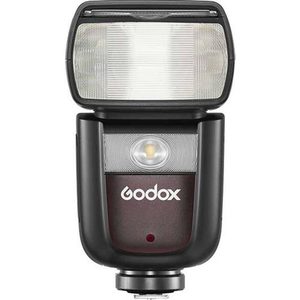
The V860III is the flash thousands of insect photographers start with — and many never replace. The Li-Ion battery is the defining feature: no AA packs, no inconsistent output as batteries drain. The integrated battery holds 450 flashes at full power and recycles in 1.5 seconds — fast enough to keep up with burst sequences. GN60 delivers enough power for f/11 at ISO 200 from 1–2 metres, exactly what insect macro requires. TTL works reliably across all supported mounts, and HSS up to 1/8000s gives flexibility to balance flash with daylight. The 10-step LED modelling light is genuinely useful for night shooting.
- Li-Ion battery — never run out of AAs in the field
- 0.01–1.5s recycle — fast enough for burst sequences
- LED modelling light helps AF in low light
- TTL + HSS across all mounts (Canon, Nikon, Sony, OM System, Fujifilm)
- Fires from above by default — diffuser required for good macro results
- Larger and heavier than dedicated macro flashes
2. Godox MF12-K2 Twin Kit — Best Dedicated Macro Flash
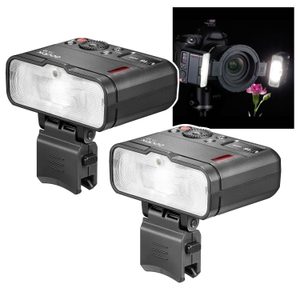
The MF12-K2 twin kit is the MF12 recommendation for most insect photographers. Two synchronised flashes mounted symmetrically on the lens deliver balanced, diffuse light that reveals fine detail without harsh shadows. The MF12 mounts directly onto the lens filter thread via a magnetic adapter and fires frontally — eliminating shadow problems entirely. With twin units at 45-degree angles, insects are rendered with laboratory-like clarity ideal for documentation work. GN16 sounds low, but at 10–15cm working distance it's more than adequate. Wireless 2.4G communicates with a Godox X2T trigger in your hotshoe.
- Mounts on lens — eliminates shadows completely
- Twin K2 kit gives perfect symmetric macro lighting
- TTL + HSS wireless via 2.4G
- Works with all camera systems via universal adapter
- Compact and lightweight
- Requires separate X2T trigger (~€35 extra)
- Integrated battery cannot be swapped
3. Godox V1 — Best Round-Head Option
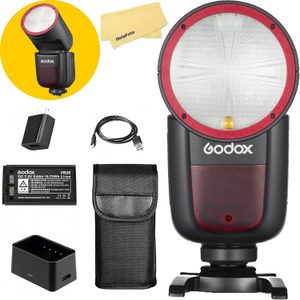
The V1 differs from the V860III primarily in head shape: round instead of rectangular. This produces more even light spread and more natural-looking bokeh. For insect macro it's less critical than for portraits, but still visible on shiny insect surfaces. Technically the V1 and V860III are very similar — GN60, Li-Ion, TTL/HSS, comparable recycle time. The key advantage is compatibility with the magnetic AK-R1 modifier system, which attaches directly to the round head. Many photographers already own one for portrait work and repurpose it for macro.
- Round head gives more even light spread
- Compatible with AK-R1 magnetic modifiers
- Same Li-Ion battery as V860III
- Full TTL + HSS
- More expensive than V860III for similar macro performance
- Round head advantage more pronounced for portraits than insects
4. Godox V480 — Best New-Generation Speedlite
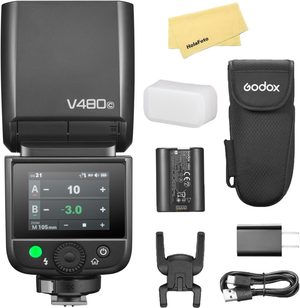
The V480 is the natural successor to the V860III in everything but name. The biggest upgrade is USB-C charging — you can top it up from a powerbank in the field, just like your phone. The touchscreen interface replaces buttons and dials: intuitive and fast to operate, even with gloves. GN50 is slightly lower than the V860III's GN60, but the practical difference at macro distances is marginal. For new purchases, the V480 is the smarter buy over the V860III — more modern design, USB-C charging, and touchscreen at the same price range.
- USB-C charging — top up from a powerbank in the field
- Touchscreen interface — fast and intuitive
- Modern design with full TTL + HSS
- GN50 vs V860III's GN60 (marginal at macro distances)
- Slightly more expensive than V860III
5. Nissin MF18 — Best Ring Flash
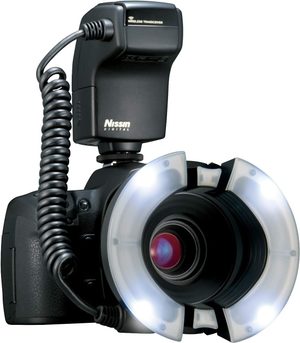
Ring flash is controversial in macro photography. The light is even and consistent — no shadows at all — which works well for documentation and scientific photography. The Nissin MF18 has independently controllable quadrants, so you can fire the left side only for more directional light, partially addressing the flat-light problem. We recommend the MF18 primarily for photographers shooting natural history or documentation work where consistent, reproducible lighting matters more than dramatic illumination.
- Completely shadow-free illumination
- Independent quadrant control
- Good TTL on supported systems
- Flat light — disliked aesthetic for many macro photographers
- Ring reflection in insect eyes looks unnatural
- More expensive than Godox MF12 twin kit
- Not available for OM System / MFT
Flash diffusers for macro
Bare flash is harsh for insects. The hard light creates deep shadows under compound eyes, blows highlights across smooth chitin, and the lens itself can cast a shadow across the subject. Standard bounce cards designed for portrait work are nearly useless at macro distances.
What works for macro falls into three categories: dedicated macro diffusers from manufacturers (Cygnustech for OM System users, AK Diffuser from Florida-based makers), professional aftermarket systems, and DIY solutions. A white foam ring around the lens front, translucent plastic disk, or a cutting board taped to the flash all work. Quality macro diffusers are not sold on Amazon — order directly from makers or within macro photography communities.
See our full guide to macro flash diffusers for detailed comparisons.
Which flash should you choose?
OM System shooters
Start with the V860III-O mount version plus a Cygnustech diffuser. You'll have TTL reliability, fast recycle, weather sealing, and a modelling light for night work. The investment covers macro, general flash work, and occasional fill light for daylight. The V860III is the trusted choice in field entomology communities.
Sony, Nikon, Canon shooters — new purchase
The V480 is the smarter pick over the V860III for new purchases. USB-C charging and the touchscreen are genuine quality-of-life improvements. The GN50 vs GN60 difference is negligible at macro distances.
Dedicated macro lighting
If you want dedicated macro lighting and don't mind the extra setup, go directly to the MF12-K2 twin kit. The learning curve is slightly steeper — you need the X2T trigger — but the light quality is superior. Twin setups are standard in professional macro photography.
Documentation and science
If you document insects for natural history museums or archival work where reproducibility matters more than aesthetics, consider the Nissin MF18. The flat, even light and quadrant control make it ideal for technical documentation.
FAQ
Do I need a dedicated macro flash or can I use a regular speedlite?
You can use a regular hotshoe speedlite like the V860III and get excellent results. The choice depends on your working style. Hotshoe flashes give flexibility — you can use them for general photography, fill flash outdoors, and events. Dedicated macro flashes (MF12, Nissin MF18) optimise specifically for close work and eliminate certain problems like lens shadow. If macro is your primary activity, a dedicated system is worth the investment.
What is TTL and do I need it for macro?
TTL (Through-The-Lens) is automatic flash exposure measurement. TTL is invaluable for macro because insect reflectance varies widely — a white moth requires less flash than a dark beetle. Manual flash settings force you to recalculate and adjust between subjects. TTL eliminates this. All modern macro flashes worth considering include TTL. Don't compromise on this feature.
Can I use flash with focus stacking?
Yes. Focus stacking works perfectly with flash. In fact, flash is ideal for stacking because TTL gives consistent exposure across all frames regardless of magnification. Flash stability is actually an advantage for stacking — exposure doesn't shift as you adjust focus.
Does flash harm insects?
No. Flash heat is negligible — it lasts milliseconds and carries very little energy. Flash light does not damage insects. Many entomologists and nature photographers use flash extensively on live insects in the field without harm.
How do I trigger a Godox MF12 wirelessly?
The MF12 communicates via 2.4GHz wireless protocol. You need a Godox X2T transmitter that sits in your camera's hotshoe. The X2T sends wireless signals to the MF12 (or multiple MF12s, up to 3 groups independently). Setup takes about 30 seconds.