
OM System OM-5 Review: Almost Everything the OM-1 Offers — For Less
As an Amazon Associate and member of other affiliate programs, we earn from qualifying purchases. How we test →
Last updated: September 2026 • Score: 8.9/10
- Our score — 8.9/10
- Best at — IP53 weather sealing — identical to OM-1
- Watch out for — 30fps burst vs OM-1's 120fps — misses fast insects
The OM System OM-5 shares the OM-1's most important features — IP53 weather sealing, 7-stop IBIS, and a compact MFT body — at a noticeably lower price. For nature and macro photographers who can live without the OM-1's stacked sensor and faster burst, it makes a compelling case.
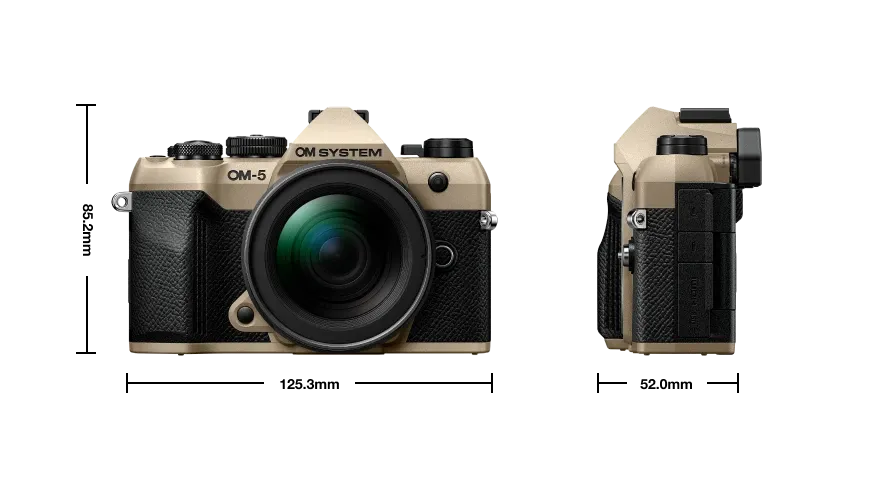
The OM-5 delivers the OM-1's core features at a lower price: identical IP53 weather sealing, near-identical 7-stop IBIS, and MFT's 2x crop factor for reach. The main trade-off is the conventional (non-stacked) sensor limiting burst to 30fps versus the OM-1's 120fps. For static macro and slower wildlife, the savings are hard to argue against.
- IP53 weather sealing — identical to OM-1
- 7-stop IBIS — near-identical to OM-1's 7.5 stops
- 2x crop factor — 100-400mm becomes 200-800mm
- In-camera focus bracketing and stacking
- ~€1,200 — €600 less than the OM-1
- 30fps burst vs OM-1's 120fps — misses fast insects
- No Pro Capture mode
- Slower AF tracking than OM-1
- Standard sensor, not BSI stacked
Specifications
| Feature | OM System OM-5 | OM System OM-1 |
|---|---|---|
| Sensor | 20MP standard MFT | 20MP BSI stacked MFT |
| IBIS | 7 stops | 7.5 stops |
| Burst speed | 30fps (with blackout) | 120fps (blackout-free) |
| Pro Capture | No | Yes (up to 70 pre-recorded frames) |
| Weather sealing | IP53 (identical) | IP53 (identical) |
| AF tracking | Good | Faster (AI-based) |
| Crop factor | 2x | 2x |
| Price | ~€1,200 | ~€1,800 |
OM-5 vs OM-1: what you give up
The core difference: The OM-1's BSI stacked sensor enables 120fps blackout-free burst and Pro Capture. The OM-5 uses a conventional sensor — 30fps burst with some viewfinder blackout between frames.
For static macro subjects and slower insects, the OM-5 is perfectly capable. The 7-stop IBIS and IP53 sealing are identical. You're not sacrificing core macro features.
For fast-flying insects and birds, the OM-1's speed advantage is real. If you shoot live insects in action, the faster burst matters. The OM-5 will miss shots the OM-1 would catch.
For macro photography
The OM-5 handles focus bracketing and focus stacking just as well as the OM-1. The optical performance is identical — same 20MP sensor (just not stacked).
IBIS: 7 stops is exceptional and near-identical to the OM-1's 7.5 stops. For handheld macro work, there's no meaningful difference.
Weather sealing: IP53 identical to OM-1. Shoot in rain, morning dew, and unpredictable outdoor conditions without hesitation.
Main limitation: Burst speed for live insects in motion. If you shoot fast-moving beetles, ants in action, or insects with unpredictable behavior, the OM-1's 120fps Pro Capture is a game-changer. The OM-5's 30fps will miss more frames.
Both cameras support focus stacking for static macro subjects requiring front-to-back sharpness.
For wildlife photography
Autofocus tracking: The OM-5's subject tracking AF is slower than the OM-1. Noticeable on fast birds in flight. For slower wildlife (reptiles, butterflies at rest, mammals), the OM-5 is excellent.
The 2x crop factor: Just like the OM-1. A 100-400mm becomes 200–800mm equivalent reach. Tremendous value for reach without a huge telephoto.
Verdict: 8.9/10
The OM-5 is the right choice if you primarily shoot static or slow-moving macro subjects and want to save €600 compared to the OM-1. You get nearly all the features that make the OM-1 special at a lower price.
If you shoot live insects in the field and need Pro Capture's fast burst, spend the extra money on the OM-1. The performance difference is real and will save you thousands of missed shots over time.
For budget-conscious macro photographers: The OM-5 is an excellent value. Weather sealing and IBIS are identical to the OM-1. The burst speed limitation mostly affects fast-moving subjects.
FAQ
Is the OM-5 weather sealed like the OM-1?
Yes, identically. IP53 rating means splash-resistant and dust-resistant. Shoot in rain, dew, and outdoor conditions without hesitation.
Is the OM-5's IBIS as good as the OM-1?
Nearly identical. OM-5 has 7 stops, OM-1 has 7.5 stops. The 0.5-stop difference is negligible in real-world macro photography.
Should I buy the OM-5 or OM-1?
OM-5 if you shoot static macro subjects (flowers, specimens, slow insects) and value the lower price. OM-1 if you shoot live insects in motion and need the fastest burst and Pro Capture.