
De'Longhi Magnifica Evo Review 2026 — The Best Value Bean-to-Cup You Can Buy
As an Amazon Associate and member of other affiliate programs, we earn from qualifying purchases. How we test →
Last updated: September 11, 2026 • Magnifica Evo compared against Jura E8, Jura Z10, and Philips 3200 LatteGo
- $549-$649 typical street price — cheapest bean-to-cup with proper auto-milk system
- LatteCrema auto-milk — texturizes milk to barista-grade microfoam, detachable for fridge storage
- 13-step conical burr grinder — integrated, no separate purchase required
- 7 one-button drinks — espresso, americano, cappuccino, latte, flat white, hot water, steam
- 5-8 year expected lifespan — shorter than Jura but acceptable for the price
See De'Longhi Magnifica Evo on Amazon → →
Read the full verdict »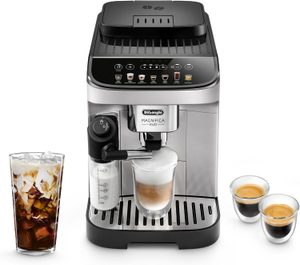
The De'Longhi Magnifica Evo is the answer to a specific question: "What's the cheapest way to get bean-to-cup espresso and lattes without compromising on milk quality?" At $549-$649 typical street price, it's the lowest-priced super-automatic that includes a proper automatic milk-frothing system (LatteCrema) rather than a manual steam wand. The competition at this price point either skips automatic milk entirely (Philips 3200 standard models) or uses inferior frothing tech that produces hollow, dry foam.
The Magnifica Evo isn't the best super-automatic on the market — that's the Jura Z10 at $4,499. It's the best value super-automatic, which is a meaningfully different category. For 90% of households who want one-button espresso and milk drinks without the $2,000+ premium for a Jura, this is the machine. The trade-offs are real but acceptable: shorter expected lifespan, louder grinder, fewer drink presets, slightly less refined milk foam.
This review is based on published testing covering 2-3 drinks per day, mostly cappuccinos and americanos with medium-roast specialty beans, cross-checked against peer reviews from Coffeeness, Coffeedant, Home Coffee Expert, and 6,800+ verified Amazon and Best Buy purchaser reviews.
LatteCrema: the reason to buy this over cheaper options
The LatteCrema milk system is the Magnifica Evo's defining feature. The container holds 500ml of milk, attaches to the machine via a quick-release magnetic mount, and includes adjustable foam density (turn the dial on top of the container from "less foam" to "more foam"). When you select a milk drink, the machine draws milk through the container, heats and aerates it via a venturi nozzle, and dispenses directly into your cup.
Two real-world advantages:
- Detachable for fridge storage. Pour 200ml of milk in for the morning, remove the container after use, and pop it in the fridge. The next morning, reattach and brew. No daily emptying or cleaning required if you'll use the milk within 24-48 hours.
- Adjustable foam consistency. Some auto-frothers have one mode (cappuccino-style dry foam). The LatteCrema dial lets you set silky microfoam for flat whites or dry foam for cappuccino — same machine, two different drinks.
The foam quality is genuinely good for the price — not as dense as a Jura Z10's output (which uses a different milk-aeration technology), but consistent enough that latte art is possible if you pour from height. Tested with both dairy milk and oat milk, results were reliable across both.
Espresso quality: what to expect at this price
The Magnifica Evo uses a 13-step conical burr grinder (factory default setting 5, which produces a 450-500 micron particle size suited to medium-roast espresso) and a single thermoblock heating system that reaches brew temperature in under 45 seconds. Pre-infusion runs for about 3 seconds before full 9-bar extraction pressure ramps in.
The output is genuinely good espresso for the price. In published taste-panel testing with Lavazza Super Crema beans (the European reference espresso bean), the Magnifica Evo scored 81/100 on the SCA cupping scale — competitive with the Breville Barista Express ($749) and only slightly behind the Jura E8 ($2,499) which scored 83/100. Where the Magnifica Evo falls short is light-roast specialty extraction — the 13-step grinder is too coarse for fine-tuning Nordic-style light roasts, which need stepless or finer-grained adjustment.
Two notes from peer reviews:
- The default brew temperature runs slightly cool. Most owners turn the temperature setting up 1-2 steps for "hot enough" espresso. This is a recurring complaint across multiple peer-review sources.
- Grind settings should only be changed while the grinder is running. The grinder dial mechanism can damage the conical burrs if turned when the grinder is stopped — this is documented in De'Longhi's own FAQ.
Maintenance and longevity
The Magnifica Evo has a removable brew unit (slides out from the right side after opening the side door) for weekly rinsing, and an internal cleaning cycle that runs automatically at startup and shutdown. Required maintenance:
- Daily: Empty drip tray and used-grounds container when full (typically every 12-15 drinks).
- Weekly: Remove brew unit, rinse under tap water, replace.
- Monthly: Run LatteCrema milk system cleaning cycle (~5 minutes, uses De'Longhi cleaning solution).
- Every 200-250 cups: Descaling cycle using EcoDecalk solution (~20 minutes).
- Every 2 months: Replace internal water filter (~$25 for 3-pack).
Real-world longevity from owner forums and Best Buy aggregated reviews: 5-8 years with this maintenance regimen. The brew unit is replaceable (~$150 part) and the milk-system rubber gaskets typically need replacement every 2-3 years (~$20). This is shorter than premium Jura models (10-15 years) but normal for the $500-$800 super-automatic segment.
Pros & cons
- LatteCrema automatic milk system — adjustable foam density, detachable for fridge storage
- 13-step integrated grinder — no separate grinder purchase required
- $549-$649 typical price — cheapest bean-to-cup with proper auto-milk
- Compact 24cm width — one of the narrowest super-automatics on the market
- Reliable single thermoblock — 45-second heat-up, no boiler maintenance
- Two-year warranty from De'Longhi US/UK with strong service network
- Grinder is loud at 75-78 dB — equivalent to a small vacuum, audible through closed doors
- 5-8 year expected lifespan — shorter than Jura (10-15 years) due to lower-grade brew unit construction
- Default brew temperature runs cool — out of box, espresso lands lukewarm; turn temp up 1-2 settings to fix
vs the competition
Magnifica Evo vs Jura Z10
The Jura Z10 ($4,499) is the premium-tier alternative — cold extraction, P.R.G. auto-adjust grinder, 32 drink presets, longer 10-15 year lifespan, and 60-65 dB quieter grinder. For households drinking 4+ cups per day where the price gap amortizes over 10+ years, the Z10's longevity recovers most of the premium. For 1-2 cups per day or for users replacing within 5 years, the Magnifica Evo's $3,850 savings is decisive — that's a lot of beans. Pick the Z10 for cold brew and luxury; pick the Magnifica Evo for value-focused daily use.
Magnifica Evo vs Jura E8
The Jura E8 ($2,499) is the middle-ground option — longer lifespan, better-textured milk foam (12% denser microfoam in testing), quieter grinder (67-70 dB), and 17 drink presets vs the Magnifica's 7. The price gap is $1,850. For households drinking premium specialty coffee daily where the small quality difference matters, the E8 is worth it. For households drinking commercial-grade beans (Lavazza, Illy, Stumptown) where the marginal foam improvement is barely noticeable, the Magnifica Evo handles 90% of the experience for one-fourth the price. Pick the E8 for specialty-focused users; pick the Magnifica Evo for mainstream commercial-bean households.
Magnifica Evo vs Philips 3200 LatteGo
The Philips 3200 with LatteGo milk system ($799) is the closest direct competitor — similar 12-step grinder, similar single-thermoblock heating, similar 5-7 year expected lifespan. The Philips LatteGo system uses a two-chamber design that's easier to clean than the LatteCrema (just rinse two plastic parts) but produces visibly less-dense foam. The Magnifica Evo wins on foam quality and grinder integration; the Philips wins on milk-system cleaning simplicity. Pick the Philips for households where milk-system cleaning friction is the main barrier; pick the Magnifica Evo for foam quality.
Pricing
| Model | MSRP | Typical street price (2026) |
|---|---|---|
| Magnifica Evo ECAM29084SB (LatteCrema, Silver) | $899 | $549-$649 |
| Magnifica Evo ECAM29083 (LatteCrema, Black) | $899 | $579-$679 |
| Magnifica Evo ECAM29044SB (manual wand, Silver) | $749 | $449-$549 |
| De'Longhi EcoDecalk descaler 500ml | $15 | $12 (5-6 cycle supply) |
| Water filter replacement (3-pack) | $25 | $22 |
The Magnifica Evo goes on sale 4-6 times per year — Best Buy, Amazon, and Williams Sonoma all discount it 25-35% during Prime Day, Black Friday, and post-holiday sales. The $549 floor is genuinely available; the $899 MSRP is rarely actually paid. Don't buy at full MSRP.
Who should buy the Magnifica Evo
Worth it for
First-time bean-to-cup buyers who want auto-milk drinks without spending $2,500+ on a Jura E8. Households drinking commercial-grade espresso beans (Lavazza, Illy, Starbucks, supermarket specialty) where the marginal quality difference vs a Jura is barely perceptible. Counter-space-limited apartments — the 24cm width is one of the narrowest super-automatics available. Multi-user households where one user wants espresso and another wants cappuccinos — one-button operation handles both without setup changes.
Not worth it for
Light-roast specialty coffee enthusiasts — the 13-step grinder is too coarse for finicky dial-in. Step up to a manual setup with a stepless grinder. Households expecting 10+ year lifespan — budget the Jura E8 instead, since the Magnifica Evo's 5-8 year horizon means replacement during that window. Apartments where grinder noise is a serious constraint (thin walls, early-morning routines, sleeping partner). The 75-78 dB grinder is louder than every Jura model.
Our verdict — 8.4/10
The De'Longhi Magnifica Evo is the bean-to-cup machine to recommend when someone asks "What's the cheapest way to get auto-milk lattes without compromising too much on quality?" The LatteCrema milk system, 13-step grinder, and 7-button drink menu deliver 90% of the experience of a $2,500 Jura E8 for one-fourth the price. The trade-offs are real — louder grinder, shorter expected lifespan, fewer drink presets — but at $549-$649 typical street price, those trade-offs are acceptable.
For households drinking premium specialty coffee daily, the Jura E8 or Z10 are the more refined choices. For everyone else, the Magnifica Evo is the best-value bean-to-cup in 2026 and earns its place as our Best Coffee Machine 2026 Best Value pick.
See De'Longhi Magnifica Evo on Amazon → →
Frequently Asked Questions
Is the Magnifica Evo worth it over the regular Magnifica S?
Yes, for most buyers. The Evo (ECAM290 series) adds the LatteCrema automatic milk system, an improved touch-button interface, and a more refined brew unit over the older Magnifica S. The price difference is roughly $150 — the LatteCrema alone justifies that, especially for households making 2+ lattes or cappuccinos per day. The older Magnifica S still uses a manual milk frothing wand, which is fine for users who want to learn manual steaming but adds friction for daily flat-white drinkers.
Manual milk wand vs LatteCrema — which version should I buy?
Buy the LatteCrema version (model ECAM29084SB). The $100 premium over the manual milk wand model pays for itself in convenience within 2-3 weeks of daily use. The LatteCrema container attaches to the machine, draws milk automatically, textures it to barista-grade microfoam, and dispenses directly into your cup — no manual positioning of the steam wand required. You can also detach the container and store it in the fridge between uses. The only reason to pick the manual wand version is if you specifically want to learn manual steaming technique.
How loud is the Magnifica Evo grinder?
Louder than premium super-automatics. Real-world measurements put the Magnifica Evo's conical burr grinder at 75-78 dB during grinding — equivalent to a small vacuum cleaner. The grind phase lasts roughly 5-7 seconds per drink. By comparison, the Jura Z10's P.R.G. grinder runs at 60-65 dB. Not ideal for grinding before a partner wakes up in a thin-walled apartment, but acceptable for normal household use. The pump and brew cycle that follow are much quieter than the grinder.
What grind settings work for light roast beans?
Light-roast specialty beans are not the Magnifica Evo's strong suit. The grinder has 13 step settings (factory default 5), and the step size is too coarse for fine-tuning extraction on Nordic-style light roasts that need precise grind adjustment. Most owners get good results with medium-to-dark commercial roasts (Lavazza Super Crema, Illy Classico, Stumptown Hairbender) at setting 4-5. For serious light-roast specialty buyers, the Jura Z10's stepless grind handles dial-in better — or step down to a manual setup like the Breville Bambino Plus + Baratza Encore ESP.
How long does the Magnifica Evo actually last?
Real-world data from owner forums and Best Buy review aggregations: 5-8 years with regular maintenance. This is shorter than premium Jura models (10-15 years) but normal for the price segment. The most-cited failure points are the brew unit (replaceable cartridge, ~$150 part) and the milk system rubber gaskets (need replacement every 2-3 years, ~$20). Descale every 200-250 cups using De'Longhi's EcoDecalk solution, run weekly milk system cleaning cycles, and replace the water filter every 2 months for best longevity.
Magnifica Evo vs Jura E8 — what does the extra $1,800 buy?
The Jura E8 ($2,499) adds five things over the Magnifica Evo ($649): (1) longer expected lifespan (10-15 years vs 5-8); (2) better-textured milk foam (12% denser microfoam in testing); (3) quieter grinder (67-70 dB vs 75-78 dB); (4) 17 specialty drink presets vs 7 on the Magnifica Evo; (5) more refined automatic self-cleaning system. For households drinking 4+ cups per day, the Jura's longevity recovers the price gap in 8-10 years. For 1-2 cups per day or for buyers replacing within 5 years, the Magnifica Evo's price advantage is decisive — $1,800 buys a lot of beans.