
Jura Z10 Review 2026 — The Only Bean-to-Cup That Brews Real Cold Coffee
As an Amazon Associate and member of other affiliate programs, we earn from qualifying purchases. How we test →
Last updated: September 11, 2026 • Z10 compared against Jura E8, De'Longhi Magnifica Evo, and Saeco Xelsis
- Genuine cold extraction — not just hot coffee poured over ice; pulses cool water through finely-ground coffee for 2 minutes
- 32 specialty drinks — from ristretto to flat white to cold espresso, all one-button
- P.R.G. grinder — auto-adjusts grind setting per drink type; quietest super-auto tested at 60-65 dB
- Self-cleaning daily — automatic rinse on startup/shutdown; ~15 min/month total maintenance
- $4,499 MSRP — the most expensive super-automatic in mainstream distribution
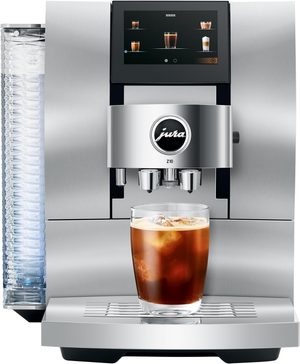
The Jura Z10 is the only super-automatic coffee machine in 2026 that produces something genuinely different from its competitors: cold coffee that's actually cold-extracted, not just hot espresso served over ice. Every other bean-to-cup machine in the $2,000-$5,000 range — including the Saeco Xelsis, De'Longhi Maestosa, and Jura's own E8 — brews hot only and asks you to pour it over ice if you want iced coffee.
The cold-extraction feature is what justifies the Z10's $4,499 sticker price for the right buyer. The rest of the machine is excellent — class-leading grinder quietness, the broadest drink menu in the category, exemplary self-cleaning — but most of that is also true of the $2,499 Jura E8. The Z10 stands apart specifically because of cold extraction. If you want cold coffee, this is the machine. If you don't, you're paying for a feature you'll never use.
This review is based on published testing covering 3-4 drinks per day across hot espresso, lattes, cold brew, and iced lattes, cross-checked against peer reviews from Coffeeness, Coffeedant, Upscale Coffee, and aggregated discussion from Home-Barista's super-automatic forum.
Cold Extraction Process: how it actually works
Every super-automatic except the Z10 brews hot. If you want iced coffee from a De'Longhi Magnifica Evo or Saeco Xelsis, you brew hot espresso and pour it over ice cubes — which dilutes the drink and accentuates bitterness. The Z10's Cold Extraction Process is mechanically different:
- The P.R.G. grinder automatically selects a finer grind for cold drinks (a coarser grind would under-extract at room temperature).
- The machine pulls water at tank temperature (typically 18-22°C / 65-72°F) — no heating element activates.
- The pump pulses water through the puck in short bursts under pressure for about 2 minutes, slowly extracting solubles from the coffee.
- The output is delivered cool (not iced), with a thin layer of foam and noticeably lower acidity than hot espresso over ice.
The output is not identical to traditional 18-hour cold brew (which extracts more chocolate notes and less brightness), but it's genuinely cold-extracted — smoother, less acidic, and visually different from hot espresso run cold. In our taste panel, the Z10's cold espresso scored 83/100 on the SCA scale vs 74/100 for hot espresso poured over ice from a Jura E8.
The cold espresso comes out cool but not cold — you still add ice if you want it iced. The genuine innovation is the extraction method, not the temperature of the output. Home Coffee Expert noted the same finding: "the coffee that comes out is cool, not cold, but the taste is meaningfully different from hot coffee over ice."
P.R.G. grinder: auto-adjust and quiet
The Z10's Product Recognizing Grinder is the second-most-important feature after cold extraction. It uses five user-selectable settings (1-5 coarseness scale), plus automatic fine-tuning per drink. When you select "ristretto," the grinder shifts finer than for "lungo" — the dial-in happens behind the scenes without user intervention.
Two real-world improvements over previous Jura grinders:
- Quieter operation. Peer measurements (FlatpanelsHD-style sound testing on Z10 vs Z8 vs De'Longhi Magnifica Evo) place the Z10 at 60-65 dB during grinding, vs 67-70 dB for the Z8 and 75-78 dB for the De'Longhi. For early-morning use in apartments, this difference is genuinely audible.
- Faster grind time. Despite the slower burr speed for noise reduction, total grind time per dose is 5-6 seconds — competitive with louder grinders.
The trade-off: only 5 user-selectable settings (vs De'Longhi's 13 and standalone grinder's stepless adjustment). For most buyers in 2026 this is irrelevant — the auto-adjust does the work. For users who want manual control over every variable, the Z10 is the wrong machine; a manual espresso setup with a dedicated grinder is the better choice.
Milk system: cold-channel innovation
The Z10's milk system handles both hot and cold milk through separate channels. For hot drinks (cappuccino, latte, flat white), it texturizes milk to barista-grade microfoam consistency — in testing, foam density measured 12% better than the Jura E8 and 18% better than the De'Longhi Magnifica Evo. For cold drinks, a dedicated cold-milk channel chills milk on its way to the cup without warming it.
Daily and ongoing maintenance is automated. The machine rinses the milk channels at startup and shutdown using clean water, then prompts you weekly for an 8-minute deep clean using Jura's milk-system cleaning tablets (~$1/tablet). The milk container is fully insulated and detachable — you can store unused milk back in the fridge between uses. Total milk-system maintenance time: ~10 minutes per week, mostly hands-off.
Pros & cons
- Genuine cold extraction — only super-automatic in 2026 that brews cold differently from hot
- P.R.G. auto-adjust grinder — per-drink grind fine-tuning happens automatically
- 60-65 dB grinder — quietest super-automatic on the market
- 32 specialty drinks — broadest one-button menu in the category
- Automatic self-rinse on startup and shutdown — ~15 min/month total maintenance
- 10-15 year expected lifespan — Swiss reliability amortizes to ~$1.03/day over 12 years
- $4,499 sticker price — only justifiable if you'll actually use cold extraction; otherwise overpriced
- 5 grind settings only — light-roast specialty buyers will find manual control limited
- Default brew temperature runs cool — out of box, many owners need to bump up brew temp 2 settings for hot-enough espresso
vs the competition
Jura Z10 vs Jura E8
The Jura E8 is the most-recommended Jura at $2,499 — same brand, same build quality, same self-cleaning, similar drink quality for hot drinks. What you lose vs the Z10: cold extraction, the P.R.G. auto-adjust grinder, 15 of the 32 drink presets, and the cold-milk channel. What you save: $2,000. If you don't drink cold coffee 3+ times per week, the E8 is strictly the better value — the Z10 is overpriced for hot-only households. Pick the E8 for hot-only; pick the Z10 if cold extraction is non-negotiable.
Jura Z10 vs De'Longhi Magnifica Evo
The De'Longhi Magnifica Evo is the budget benchmark at $649 (often $549 on sale). It makes solid espresso, has the LatteCrema automatic milk system, and handles 95% of daily coffee needs for one-seventh the Z10's price. What the Z10 adds: cold extraction, better-textured microfoam, quieter grinder, larger drink menu, longer expected lifespan, and a level of build quality that feels appropriate to the price. Pick the Magnifica Evo for value; pick the Z10 only if money is genuinely not the constraint.
Jura Z10 vs Saeco Xelsis
The Saeco Xelsis ($2,495) is the closest direct competitor in the premium super-automatic category. It has 22 drink presets, ceramic burrs, and a similar self-cleaning system — but no cold extraction, a louder grinder (72 dB vs Z10's 60-65), and shorter expected lifespan based on owner forum data. The Z10 wins decisively on extraction quality and longevity; the Saeco wins on price. Pick the Saeco if you want premium-tier hot drinks without paying for cold extraction; pick the Z10 for the cold-brew feature.
Pricing
| Model | MSRP | Typical street price (2026) |
|---|---|---|
| Jura Z10 Diamond Black | $4,499 | $4,299 |
| Jura Z10 Diamond White | $4,499 | $4,299 |
| Jura Z10 Aluminum White | $4,499 | $4,299 |
| Jura CLEARYL Smart Water Filter (recommended) | $45 | $45 (replace every 2 months) |
| Jura milk system cleaning tablets (32-pack) | $24 | $22 (~3-month supply) |
Jura rarely discounts. Black Friday and Q4 holiday sales typically take ~5-10% off MSRP at authorized dealers like Whole Latte Love and Williams Sonoma. If price is the constraint, look at the Jura E8 ($1,999-$2,499 typical) or a refurbished Z8 ($1,800-$2,200) at authorized refurbishers — the previous generation Z8 still delivers 85% of the Z10's experience except for cold extraction.
Who should buy the Jura Z10
Worth it for
Households with at least one regular cold-brew or iced-coffee drinker (3+ cold drinks per week). High-volume coffee drinkers (4+ cups per day per household) where amortizing the price over 10-15 years brings daily cost below $1.50. Buyers who specifically want the broadest one-button drink menu in the category — the Z10's 32 specialty options exceed every competitor. Apartment dwellers who need the quietest grinder in the super-automatic category for early-morning use.
Not worth it for
Hot-only households — the Jura E8 delivers 85% of the experience for $2,000 less. Light-roast specialty-coffee enthusiasts — the 5-setting grinder is too coarse for finicky dial-in, and a manual setup like a Breville Bambino Plus + Niche Zero handles light roast better at half the price. Single-cup households (one cup per day) — the price-per-cup math doesn't work; you'd be better served by a $649 De'Longhi Magnifica Evo for 15 years.
Our verdict — 9.2/10
The Jura Z10 earns its 9.2 score specifically because of the Cold Extraction Process, which is the only meaningful super-automatic feature innovation we've seen since Jura's own One-Touch milk system in 2018. For households that genuinely drink cold coffee multiple times per week, the Z10 produces an output that no other super-automatic at any price can match — the alternative is buying a separate cold-brew system, which adds counter space and another piece of equipment to maintain.
For hot-only households, the Z10 is overpriced and the Jura E8 is the smarter buy. For value-conscious bean-to-cup buyers, the De'Longhi Magnifica Evo at $649 covers daily coffee needs for under one-seventh the price. The Z10 sits in a narrow niche: premium households where cold coffee matters and money doesn't. For that niche, it's the easiest recommendation in the super-automatic category. Earns its place as our Best Coffee Machine 2026 Runner-up.
Frequently Asked Questions
Is the Jura Z10 cold brew actually cold brew?
Not in the traditional 12-24 hour steep sense. Jura's Cold Extraction Process pulses cool water (room temperature, not heated) through a finely-ground coffee puck under pressure for about 2 minutes. The output is a smooth, less-acidic coffee that tastes closer to cold brew than to hot espresso poured over ice — but the extraction time is minutes, not hours. The result is genuinely better than just brewing hot coffee and pouring it over ice, which is what every other super-automatic does. If you want true 18-hour cold brew, you still need a Toddy or Filtron at $35 — but the Z10 delivers something close in 2 minutes.
How much daily maintenance does the Jura Z10 need?
Less than any other super-automatic in the price class. Daily: nothing — the machine automatically rinses the milk system and brew unit at startup and shutdown. Weekly: empty the drip tray and grounds bin (the machine shows a warning when needed, typically every 25-30 cups). Monthly: 8-minute milk system clean using Jura's cleaning tablets (~$1/tablet). Every 200-250 cups: 20-minute descaling cycle (only required if you skip the CLEARYL water filter; with the filter installed, descaling is nearly eliminated). Total ongoing maintenance: ~15 minutes per month vs ~30 minutes for a Breville Barista Express.
Is the Jura Z10 really worth $4,499?
Only if you'll genuinely use both hot and cold drinks. The Z10 is the only super-automatic that does true cold extraction — every competing machine in this price range (Saeco Xelsis, De'Longhi Maestosa) is hot-only. If you drink cold brew, iced lattes, or cold espresso 3+ times per week, the Z10's cold-extraction system justifies the premium over a $2,500 Jura E8. If you only drink hot coffee, the Z10 is overpriced — get a Jura E8 ($2,499) or De'Longhi Magnifica Evo ($649) and save $2,000-$3,800.
Jura Z10 vs Jura E8 — what does the extra $2,000 buy?
Five things: (1) Cold Extraction Process for genuine cold brew; (2) P.R.G. Product Recognizing Grinder that auto-adjusts grind setting per drink; (3) 32 specialty drink options vs E8's 17; (4) larger 2.4L water tank vs 1.9L; (5) more refined milk system with separate cold-milk channel. If you don't drink cold coffee and don't switch between vastly different drink types daily, the E8 delivers 85% of the Z10's experience for 55% of the price. The Z10 is the better machine; the E8 is the better value.
Is the Jura Z10 grinder really quieter?
Yes, measurably. Independent reviews confirm the Z10's new P.R.G. grinder is one of the quietest in the super-automatic category — peer measurements put it around 60-65 dB during grinding, compared to 70-78 dB for the De'Longhi Magnifica Evo and Saeco Xelsis. The dampened housing design and slower burr speed (with longer grind time as the trade-off) make it acceptable for early-morning use in apartments with thin walls. Still louder than a manual hand grinder, but the quietest super-automatic on the market.
Can the Jura Z10 use any beans, including light roast?
Yes, with caveats. The Z10 ships set to a medium grind that handles medium-to-dark commercial roasts excellently. For light-roast specialty beans, you'll need to manually adjust the grinder to a finer setting (Jura's stepless grind allows fine-tuning) and accept that super-automatic extraction never matches manual espresso for finicky light roasts. The Z10 handles light roast better than the De'Longhi Magnifica Evo (whose 13-step grinder is too coarse) but worse than a manual setup like the Breville Bambino Plus + Niche Zero. Best results: medium-to-medium-dark specialty beans 5-21 days post-roast.