
Canon RF 100mm f/2.8L Macro IS USM Review
As an Amazon Associate and member of other affiliate programs, we earn from qualifying purchases. How we test →
Last updated: September 14, 2026 • Score: 9.4/10
- 1.4x magnification with autofocus — beyond the 1:1 of most macro lenses, including Canon's own EF 100mm
- Fast, quiet, reliable AF — sharper and quicker than the EF version, with eye detection that holds
- Focus shift at close range — the one optical weakness; focus at your shooting aperture
- No teleconverter support — the older EF version accepts one, this does not
See Canon RF 100mm Macro on Amazon →
Read the full verdict »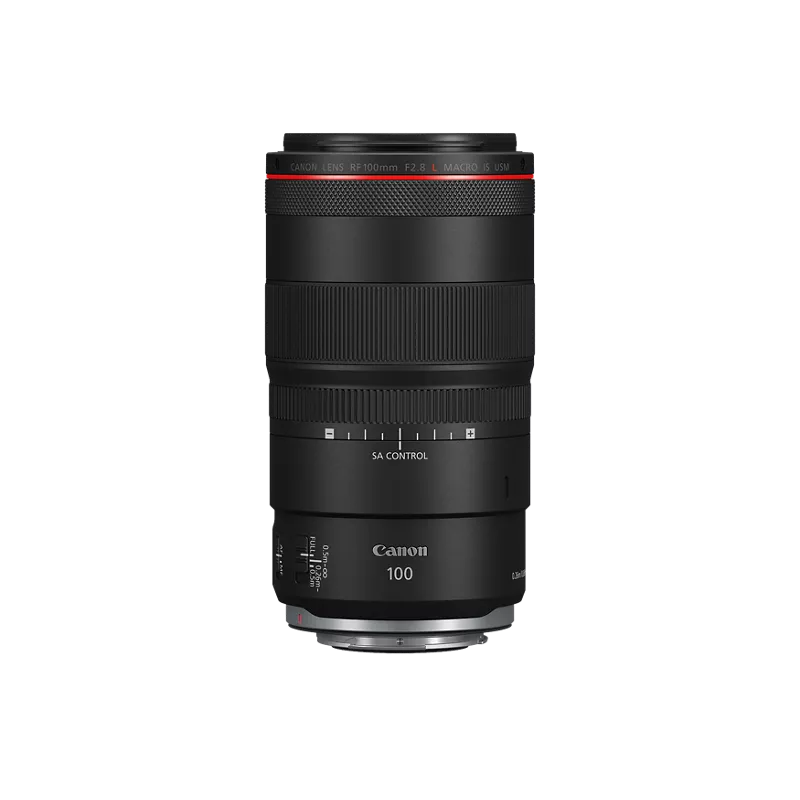
The Canon RF 100mm f/2.8L Macro IS USM is Canon's flagship macro lens for its EOS R mirrorless system. It replaced the long-admired EF 100mm f/2.8L Macro and added two things that version never had: 1.4x magnification without accessories, and a control ring that adjusts spherical aberration for softer backgrounds. It works on full-frame and APS-C RF bodies — on an APS-C camera such as the Canon EOS R7 it gives the field of view of a 160mm lens. It is also a genuinely good short telephoto for portraits, which the specialist 2:1 manual-focus macros are not.
Specifications
| Spec | Value |
|---|---|
| Focal length | 100mm (160mm field of view on Canon APS-C) |
| Maximum aperture | f/2.8 |
| Maximum magnification | 1.4:1 |
| Minimum focus distance | 26 cm |
| Image stabilisation | 5 stops (about 2 stops at 1:1); up to 8 with in-body IS |
| Optical design | 17 elements in 13 groups |
| Aperture blades | 9 |
| Dimensions | 81.5 × 148 mm |
| Weight | 730 g |
| Weather sealing | Yes (L-series) |
| Teleconverter compatible | No |
| Price | $1,349 |
1.4x: what the extra 40% buys
At 1:1, a 10 mm subject covers 10 mm of the sensor. At 1.4x it covers 14 mm. On a full-frame sensor that is the difference between a bee filling the frame and a bee's head and thorax filling it. It is not the 2:1 of a manual-focus specialist like the Laowa 90mm 2x, but it is the most magnification you can get from an autofocus, stabilised, weather-sealed Canon macro.
What it does not allow is going further with a teleconverter. The optical design rules them out, unlike the EF 100mm. For more magnification you need extension tubes — and Canon does not make them in RF mount, so those are third-party.
The catch: focus shift at close range
At very close distances, the plane of focus moves slightly backwards as you stop down. Focus precisely at f/2.8, then shoot at f/8, and the sharpest part of the frame has drifted. Reviewers found it is a trait of the design rather than a bad copy, and the older EF 100mm does not suffer from it.
In practice it is manageable once you know it: focus with the aperture already set, or rely on focus stacking, where a small shift matters less because every slice is captured anyway. It is the reason this lens is not a 10 — and the reason a lens with no focus shift, like the Laowa 90mm, is optically cleaner up close.
Autofocus and stabilisation
Autofocus is the RF's clearest advantage over manual-focus macros. In side-by-side testing against the adapted EF 100mm it locked faster and more quietly, and eye detection proved more reliable. A three-position focus limiter keeps it from hunting through the full range at macro distances.
Stabilisation deserves a more cautious reading. Canon's 5-stop rating drops to around 2 stops at 1:1, as it does on every macro lens, and at least one independent test found it did not meet Canon's claims. It helps handheld at moderate magnifications; at 1.4x, flash or a tripod does more.
For focus stacking, Canon reduced focus breathing compared with the EF lens, but a visible magnification change remains across a stack — stacking software aligns it, but it is worth knowing before you compose tightly.
The spherical aberration ring
A dedicated ring adjusts spherical aberration, softening or hardening how out-of-focus areas render. It has a locking switch so it cannot drift from neutral by accident. For macro work it is rarely useful; for portraits it is an interesting effect. Treat it as a bonus rather than a reason to buy.
- 1.4x magnification with autofocus and stabilisation
- Faster, quieter and more reliable AF than the EF 100mm
- Sharper than the EF version wide open at f/2.8
- Weather sealed, with a three-position focus limiter
- Doubles as a strong portrait lens
- Focus shift at close range when stopping down
- Not compatible with teleconverters
- Stabilisation falls to about 2 stops at 1:1
- $1,349 — more than twice a manual 2:1 macro
RF 100mm vs the alternatives
| Lens | Max magnification | Autofocus | Focus shift | Teleconverter |
|---|---|---|---|---|
| Canon RF 100mm f/2.8L Macro IS USM | 1.4:1 | Yes | Yes, close range | No |
| Canon EF 100mm f/2.8L Macro IS USM (adapted) | 1:1 | Yes | No | Yes |
| Laowa 90mm f/2.8 2x Ultra Macro APO | 2:1 | No | No | — |
| Canon RF 35mm f/1.8 Macro IS STM | 1:2 | Yes | — | — |
Against the EF 100mm f/2.8L on an adapter: the EF is cheaper, accepts teleconverters and has no focus shift, and it remains an excellent lens. The RF wins on magnification, sharpness at f/2.8 and autofocus. If you shoot moving subjects, the RF's AF is worth the difference.
Against the Laowa 90mm 2x: the Laowa reaches 2:1 and is optically cleaner up close for well under half the price — but it is manual focus, unsealed and poor as a portrait lens. The Canon is the better all-round tool; the Laowa is more magnification per dollar.
On a budget: the RF 35mm f/1.8 Macro reaches only half life-size and forces you very close to the subject, but costs a fraction of the price.
Who should not buy it
- Anyone who wants to add a teleconverter — the EF 100mm on an adapter is the Canon choice for that.
- Photographers who need beyond 1.4x without tubes — a 2:1 lens such as the Laowa 90mm gets there directly.
- Shooters who work single frames at small apertures and cannot live with focus shift — stack, or choose a lens without it.
- Buyers primarily on price — the adapted EF version delivers most of the image quality for less.
Verdict: 9.4/10
The Canon RF 100mm f/2.8L Macro IS USM is the best autofocus macro lens for Canon mirrorless. It goes further than the EF version at 1.4x, focuses faster and more reliably, is sharper wide open, and is sealed for field work. It also earns its place in a bag as a portrait lens, which few macro specialists do.
Its weaknesses are specific rather than general: focus shift when stopping down at close range, and no teleconverter support. Buy it if you want one Canon lens that handles moving insects with autofocus and still shoots portraits. Skip it if you need 2:1 or beyond, want teleconverters, or would rather put the money elsewhere — the Laowa 90mm 2x and the adapted EF 100mm both cover those cases for less.
See Canon RF 100mm Macro on Amazon → →
Frequently Asked Questions
Does the Canon RF 100mm Macro have focus shift?
Yes, at very close range: the plane of focus moves slightly backwards as you stop down. It is a characteristic of the design rather than a faulty copy. Focus at the aperture you shoot at, or focus-stack.
Can you use a teleconverter on it?
No. Unlike the EF 100mm f/2.8L, the RF version is not compatible with Canon's teleconverters. For more magnification, use third-party RF extension tubes.
RF 100mm or EF 100mm f/2.8L on an adapter?
The RF reaches 1.4x instead of 1x, is sharper wide open and focuses faster. The EF is cheaper, accepts teleconverters and has no focus shift. Autofocus and magnification favour the RF; budget and teleconverters favour the EF.
How good is the stabilisation for macro?
Rated at 5 stops, up to 8 with in-body IS — but around 2 stops at 1:1, and one independent test found it short of Canon's claims. At 1.4x, flash or a tripod does more.