
Laowa 90mm f/2.8 2x Ultra Macro APO Review
As an Amazon Associate and member of other affiliate programs, we earn from qualifying purchases. How we test →
Last updated: September 14, 2026 • Score: 8.8/10
- True 2:1 for about $500 — double the magnification of a standard 1:1 macro, at a fraction of an autofocus macro's price
- Optically near-flawless up close — no measurable focus shift and virtually no colour fringing
- Manual focus only — excellent for stacking and static subjects, harder on moving insects
- No weather sealing — a real limitation for early-morning dew and field work
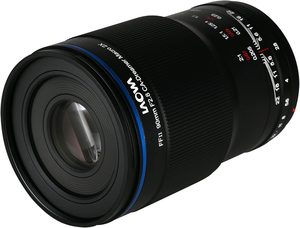
The Laowa 90mm f/2.8 2x Ultra Macro APO is a manual-focus macro lens for mirrorless cameras that reaches 2:1 magnification — twice life-size on the sensor — while still focusing to infinity. It is available for Canon RF, Nikon Z, Sony FE and L-mount, and since January 2026 in a Micro Four Thirds version. Its appeal is simple: the optics of a specialist macro lens without the price or bulk of an autofocus one. Its cost is equally simple: you focus by hand, and it will not survive rain.
Specifications
| Spec | Value |
|---|---|
| Focal length | 90mm (about 144mm field of view on a Canon APS-C body such as the R7) |
| Maximum aperture | f/2.8 |
| Maximum magnification | 2:1 |
| Minimum focus distance | 20 cm |
| Working distance | About 70 mm at 2:1, about 120 mm at 1:1 |
| Optical design | 13 elements in 10 groups, 3 ED |
| Aperture blades | 13 |
| Filter thread | 67 mm |
| Weight | 619 g (full-frame mounts); 542 g (MFT version) |
| Focus | Manual only |
| Weather sealing | None |
| Price | Around $500 |
Optics: where it genuinely beats pricier lenses
The "APO" label is usually marketing. Here it is earned. Reviewers who have measured it report no visible longitudinal colour fringing, almost no lateral chromatic aberration — even without in-camera correction — and no focus shift when stopping down. That last point matters more than it sounds: on a macro lens with focus shift, the plane of focus drifts as you close the aperture, so the frame you focused at f/2.8 is not quite the frame you shoot at f/8. The Canon RF 100mm f/2.8L has exactly that problem at close range. The Laowa does not.
Laowa's own MTF data puts the sharpest aperture around f/8, up to about f/11 depending on mount, at both 1:1 and 2:1. Past that, diffraction starts eroding fine detail. The 13-blade aperture keeps out-of-focus highlights round when stopped down, which is visible in the background of any flower or insect shot.
Manual focus: the trade-off you are actually buying
There is no autofocus on any version. For static subjects, focus-stacked work on a rail, or insects cooled and still in early morning, this is barely a limitation — many macro photographers switch autofocus off at high magnification anyway. For a butterfly that moves every few seconds, it is a real handicap.
The focus ring is large and well damped, with roughly 140 degrees of travel between 1:1 and infinity. Beyond 1:1 the throw lengthens sharply: going from 1:1 to 2:1 takes considerably more rotation than going from infinity to 1:1. That gives precise control exactly where you need it. Focus peaking on the camera is close to essential at 2:1.
Build and handling
The barrel is metal with engraved, paint-filled markings, and the lens does not change length as it focuses — the optics extend inside a fixed outer barrel. At 619 g it is front-heavy on a small body, which some find steadies the grip and others find tiring. It is noticeably shorter and lighter than Laowa's older 100mm 2x (around 638 g).
The weak point in the field is the absence of any weather sealing. For dawn macro, when subjects are still and covered in dew, that is precisely the moment you most want sealing and don't have it.
- True 2:1 magnification that still focuses to infinity
- No focus shift and virtually no colour fringing
- About $500 — well under half an autofocus L-series macro
- 13-blade aperture keeps bokeh round when stopped down
- Long, precise focus throw between 1:1 and 2:1
- Manual focus only — difficult on moving insects
- No weather sealing
- Flare in strong backlight at longer distances
- Front-heavy at 619 g on smaller bodies
Laowa 90mm vs the alternatives
| Lens | Max magnification | Autofocus | Weather sealed | Weight |
|---|---|---|---|---|
| Laowa 90mm f/2.8 2x | 2:1 | No | No | 619 g |
| Canon RF 100mm f/2.8L Macro IS USM | 1.4:1 | Yes | Yes | 730 g |
| OM System M.Zuiko 90mm f/3.5 Macro IS PRO | 2:1 | Yes | Yes (IP53) | 453 g |
| Canon MP-E 65mm f/2.8 1–5x | 5:1 | No | No | — |
Against the Canon RF 100mm f/2.8L: the Canon brings autofocus, image stabilisation and weather sealing, and it is the better lens if you shoot moving subjects or want one lens for portraits too. The Laowa goes further — 2:1 against 1.4:1 — has no focus shift, and costs well under half as much.
Against the Canon MP-E 65mm: the MP-E reaches 5:1, but it cannot focus to infinity at all; the ring only sets magnification and you focus by moving the camera. At the magnifications both lenses share, reviewers found the Laowa sharper with better colour correction.
On Micro Four Thirds: the new MFT version competes with the M.Zuiko 90mm f/3.5 Macro IS PRO, which adds autofocus, stabilisation and IP53 sealing at a lower weight. On that system the M.Zuiko is the more complete lens; the Laowa is the cheaper, faster-aperture one.
Who should not buy it
- Anyone shooting active insects handheld who relies on autofocus to keep up.
- Field photographers in wet conditions — there is no sealing to fall back on.
- Buyers who want one lens for macro and portraits — it works at distance, but backlit flare and the lack of autofocus make an autofocus macro the better all-rounder.
- Anyone who needs beyond 2:1 — that is MP-E territory, or a close-up lens such as the Raynox DCR-250.
Verdict: 8.8/10
The Laowa 90mm 2x is the most macro lens you can buy for around $500. Its close-range optics — no focus shift, near-zero colour fringing, 13 rounded blades — hold up against lenses costing more than twice as much, and 2:1 is a genuine step beyond the 1:1 or 1.4:1 of most autofocus macros.
Buy it if you shoot static subjects, focus-stack, or are happy to work in manual focus, and you want maximum magnification per dollar. Skip it if your subjects move, your mornings are wet, or you need one lens to do everything — in which case the Canon RF 100mm f/2.8L is worth the extra money.
Frequently Asked Questions
Does the Laowa 90mm 2x have autofocus?
No. It is manual focus on every mount. That suits static subjects and focus stacking, but makes moving insects harder than with an autofocus macro such as the Canon RF 100mm f/2.8L or the M.Zuiko 90mm f/3.5.
What is the sharpest aperture?
Laowa's MTF charts put the sweet spot around f/8, extending to about f/11 depending on mount, at both 1:1 and 2:1. Beyond that, diffraction starts to cost detail.
Laowa 90mm or Laowa 100mm 2x?
Both reach 2:1. The 90mm was built for mirrorless and is shorter and lighter than the 100mm 2x (around 638 g). If you already own the 100mm, there is little reason to switch; buying new for mirrorless, the 90mm is the more practical choice.
Is it usable as a normal telephoto lens?
Yes — unlike the Canon MP-E 65mm it focuses to infinity and is sharp at distance. The weak point at long range is flare in strong backlight.