
OM System MC-20 2x Teleconverter Review
As an Amazon Associate and member of other affiliate programs, we earn from qualifying purchases. How we test →
Last updated: September 14, 2026 • Score: 8.2/10
- Turns the M.Zuiko 90mm Macro into a 4x macro — with autofocus still working
- Costs two stops — f/3.5 becomes f/7, so plan on added light
- Softer at 4x — usable, but expect to sharpen more than usual
- Only seven compatible lenses — check yours before buying
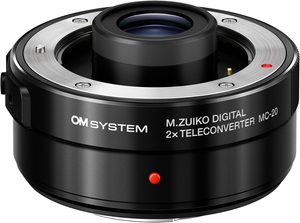
The OM System M.Zuiko Digital 2x Teleconverter MC-20 sits between a compatible lens and the camera and doubles its focal length. Most buyers think of it as a wildlife accessory for the 40-150mm or 150-400mm. Its more unusual use is on the M.Zuiko 90mm f/3.5 Macro IS PRO, where it takes a 2:1 lens to 4x magnification while keeping autofocus, image stabilisation and in-camera focus stacking. It is an unusual combination — but it is not free, and the costs are worth understanding before you spend around $470.
A note on sources: dedicated peer reviews of the MC-20 on the 90mm macro are thin. This review draws on OM System's specifications and compatibility data, OM System's own macro guidance for the 90mm, and published user reports from photographers using the combination.
Specifications
| Spec | Value |
|---|---|
| Magnification factor | 2.0x |
| Light loss | 2 stops |
| Weight | 150 g |
| Weather sealing | IPX1 |
| Mount | Metal |
| On the 90mm f/3.5 Macro | 180mm (360mm equiv.), f/7, up to 4x magnification |
| Price | $469.99 list |
On the 90mm macro: what 4x actually means
The M.Zuiko 90mm f/3.5 Macro IS PRO reaches 2:1 on its own. The MC-20 doubles that to 4x — a 5 mm insect head fills an MFT sensor. Because a teleconverter changes magnification without moving the lens closer, you keep the same minimum focusing distance: around 25 cm. That working distance is the real prize. Close-up filters such as the Raynox DCR-250 also add magnification, but they bring the front of the lens much closer to the subject.
The combination keeps autofocus and in-camera focus stacking. One practical detail from OM System's own guidance: pulling the 90mm's manual-focus clutch back disables autofocus functions, including stacking and bracketing. Set magnification with the clutch back, then push it forward before starting a stack.
The two costs: light and sharpness
Light. A 2x converter always costs two stops. The 90mm's f/3.5 becomes f/7, and at 4x the effective aperture is smaller again. In anything but bright sun, that means flash or continuous light — and at 4x, diffraction arrives early, so stopping down further to gain depth of field quickly costs detail. OM System's guidance for the bare 90mm already recommends lower f-numbers as magnification rises; with the converter that matters more.
Sharpness. User reports on the 90mm plus MC-20 are consistent: it works, but results at 4x are softer and need more sharpening than the lens alone. Some of that is the converter; some is simply that any flaw — in the optics, the focus, or a breath of wind — is magnified twice as much. Photographers getting good results at 4x typically rely on focus stacking rather than a single frame.
On telephoto lenses
On the 40-150mm F2.8 PRO the MC-20 creates an 80-300mm f/5.6 — a 160-600mm equivalent in a light kit. An OM System ambassador's field report from sub-zero wildlife shoots describes focusing that did not falter — worth weighing as a manufacturer-side account rather than an independent test. Its IPX1 rating is lower than the IP53 of the PRO lenses it pairs with, so it is sealed against drips rather than rated to the same standard as the lens.
- 4x magnification on the 90mm Macro with autofocus retained
- Keeps the 90mm's ~25 cm focusing distance — unlike close-up filters
- Works with in-camera focus stacking
- Only 150 g with a metal mount
- Doubles as a wildlife converter on the 40-150mm and 150-400mm
- Two stops of light lost — f/3.5 becomes f/7
- Noticeably softer at 4x; needs extra sharpening
- Only seven compatible lenses
- IPX1 sealing is below the IP53 of the lenses it pairs with
MC-20 vs the alternatives for more magnification
| Option | Magnification on 90mm | Light loss | Working distance | Autofocus |
|---|---|---|---|---|
| MC-20 | 4x | 2 stops | Unchanged | Yes |
| MC-14 | 2.8x | 1 stop | Unchanged | Yes |
| Raynox DCR-250 | Adds magnification | None | Much shorter | — |
MC-14: half the light penalty — check OM System's compatibility list for your lens. If you want a modest step beyond 2:1 and to keep shutter speeds up, it is the gentler choice.
Close-up lenses: a filter such as the Raynox costs a fraction of the price and loses no light, but pulls the lens closer to the subject — a problem with skittish insects and with fitting a flash diffuser in between.
Who should not buy it
- Owners of lenses not on the list — check the seven compatible M.Zuiko lenses first.
- Anyone shooting handheld in low light without flash — two stops is a lot to give up.
- Buyers expecting single-frame sharpness at 4x — the combination rewards stacking and sharpening.
- Those who only need slightly beyond 2:1 — the MC-14 costs half the light.
Verdict: 8.2/10
The MC-20 is a specialist tool that does one unusual thing very well: it gives the M.Zuiko 90mm Macro 4x magnification while keeping autofocus, stabilisation, focus stacking and a usable working distance. No close-up filter offers that combination.
Buy it if you own the 90mm Macro or a compatible telephoto, work with flash or in good light, and are comfortable stacking and sharpening. Skip it if your lens is not on the list, you shoot handheld in dim conditions, or you only need a little more than 2:1 — in which case the MC-14 is the better buy.
Frequently Asked Questions
Which lenses work with the MC-20?
OM System lists seven: the 40-150mm F2.8 PRO, 300mm F4 IS PRO, 150-400mm F4.5 TC1.25x IS PRO, 90mm F3.5 Macro IS PRO, 100-400mm F5-6.3 IS (both versions) and 150-600mm F5-6.3 IS.
How much magnification on the 90mm macro?
Up to 4x. The lens reaches 2:1 alone and the MC-20 doubles it. Focal length becomes 180mm — 360mm in full-frame terms.
How much light do you lose?
Two stops. The 90mm's f/3.5 becomes f/7, and the effective aperture at 4x is smaller still.
MC-20 or MC-14 for macro?
The MC-14 costs one stop and reaches 2.8x; the MC-20 costs two and reaches 4x. For a little extra reach, take the MC-14; for maximum magnification, the MC-20.